
 Spotify

 Amazon Music

 Apple Podcasts

 iHeartRadio

 PlayerFM

 Podchaser

 YouTube
 RSS Feed
All the President’s Men (1976): Redford and Hoffman Chase the Watergate Story
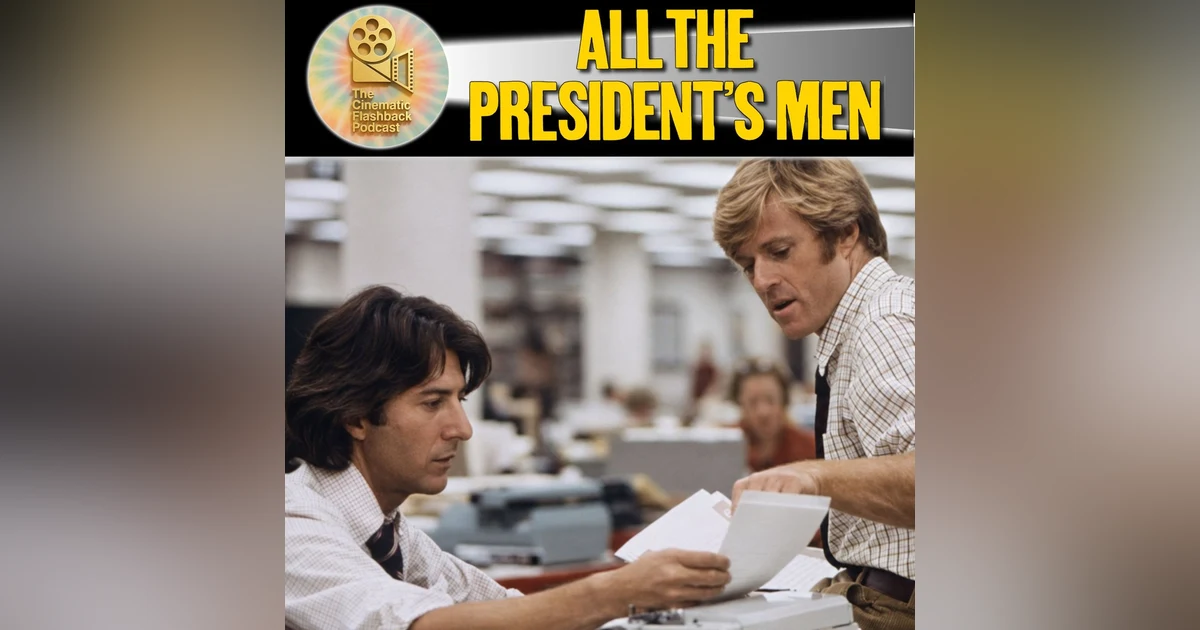
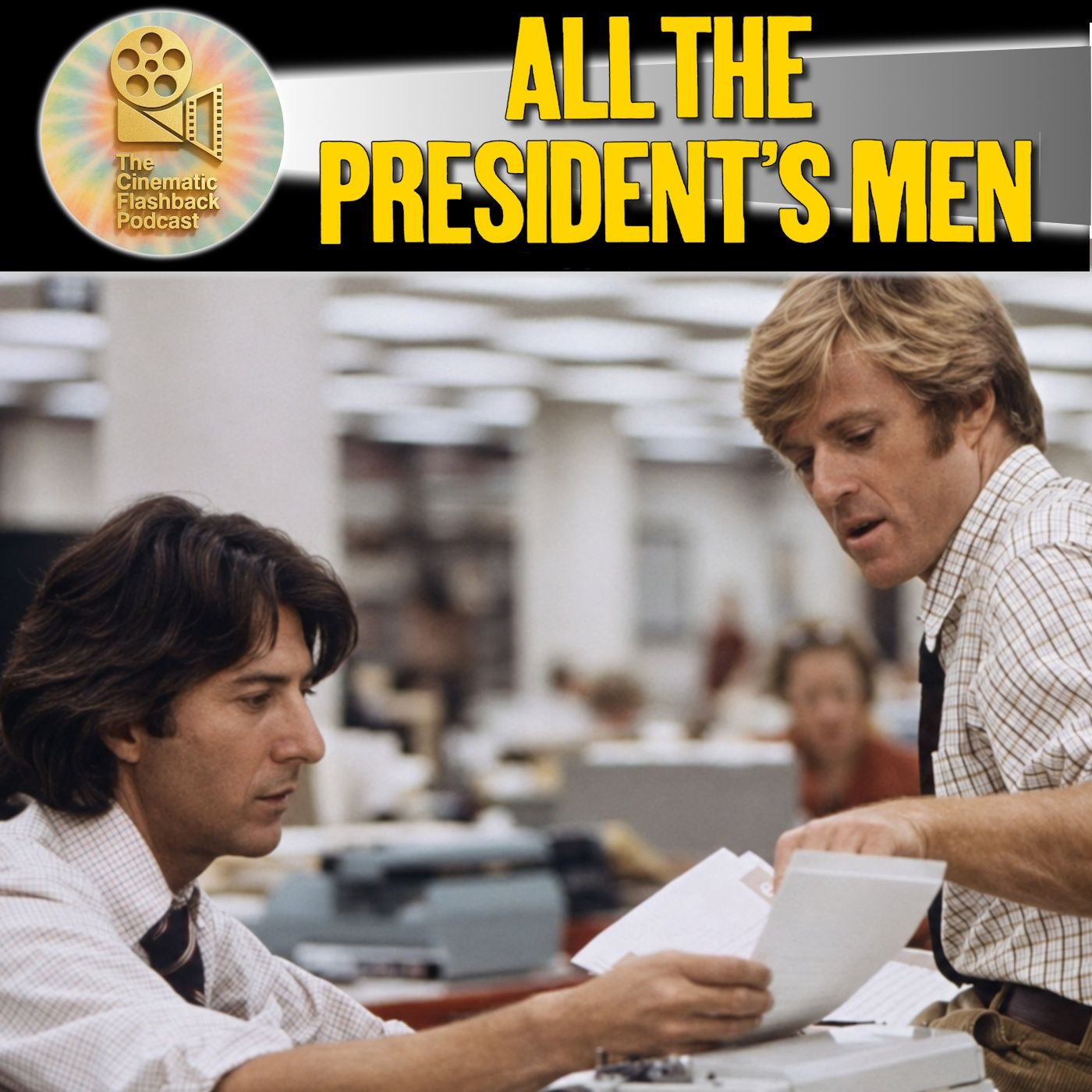
Chuck and Matt revisit the final film in Pakula’s paranoia trilogy and explore how Redford and Hoffman turn the day-to-day work of reporting into a political thriller. They discuss the ensemble that brings the newsroom to life, Gordon Willis’s striking cinematography, and how knowing more about Watergate changes the experience of watching the film today.
Does Pakula’s newsroom thriller still groove through the decades, or has it lost its beat?
Hop into the Wayback Machine with Chuck and Matt and the Cinematic Flashback Podcast as we revisit All the President’s Men and continue our journey through 1970s cinema.
Links & Contact Website:
https://www.cinematicflashback.com
Contact Us:
https://www.cinematicflashback.com/contact/
Listen to Previous Episodes:
https://www.cinematicflashback.com/episodes/
Leave a Review:
https://www.cinematicflashback.com/reviews/new/
Read the Blog:
https://www.cinematicflashback.com/blog/
Subscribe:
https://www.cinematicflashback.com/follow/
Share the Show:
Tell your movie-loving friends!
Other Podcast You Might Enjoy:
- Surely You Can't Be Serious Podcast
- 30 Something Movie Podcast
- A Film By Podcast
- Dockingbay 77
- Def Dave's 1984
- Accidental Legends
- Phasers Set to Stun
- Children of the 80s
0:01 Hi, this is Carl. I'm sorry to disturb you now, but we're going with the story that Holden was the fifth man in control of the fund, and they're hassling us here. We've got three confirmations, but if you could just help us, I'd appreciate it. Look, I won't say anything about Holden, not ever. I understand that. We wouldn't want you to do that. We know it's against the law for you to say anything. If there's some way you could warn us to hold on the story, we'd appreciate it. I'd really like to help you, but I can't. Look, I'm going to count to ten, all right? If there's any reason we should hold on the story, hang up the phone before I get to ten. If the story's all right, you'll just be on the phone after I get to 10, all right? Hang up, right? That's right. You got it? We're straight. All right, I'm gonna start counting. Okay? We all right? Yeah. Okay, I'm counting.
0:41 One, two, three, four, five, six, seven. Eight, nine, ten. You got it straight, man? Everything OK? Everything's fine. Hey, welcome back, everybody. Matt, from topics of the 1970s, you and I have just circled around both Vietnam and Watergate. Those were two events that just really defined the 70s. Yeah, 100%. And I think this is a great movie to talk about. It does reflect such a significant event and set of events and time period in the 1970s that forever changed how people viewed the United States government and how the government tried to make some guardrails to prevent the same sort of abuses to happen. And we can have a whole podcast on discussing whether that actually has happened.
1:43 Okay, well, why don't we hop into the Wayback Machine, and you and I are going to talk about Alan J. Pakula's 1976 film, All the President's Men, starring Robert Redford and Dustin Hoffman. This is the Cinematic Flashback Podcast. Hey, Matt, how do we do a spoiler-free movie about an event that is so public and so well-known as Watergate?
2:23 Yeah, I think that one is. It's a little like when I've seen comedians talk about The Sixth Sense and go, I'm sorry, yes, there's spoilers, but for goodness sakes, it's been 15 years. And this isn't just like a movie, right? I mean, this is a historical event based on a book that I believe Robert Redford actually had purchased the rights for. And so he was He was the one who was pushing this along and worked with Alan Pakula to get this made. I would point out, even though, you know, like those of us of a certain age that actually live through these events and largely we live through them through what we read in the newspaper and what was being reported on the news. Some of us were young enough. I mean, I was young enough that it was I knew it was something important. I know my parents were super at sixes and sevens about it being longtime Republicans. So they were very moral people, very upright. What do you mean by sixes and sevens? They didn't know what was up or down because they're Republicans. And yet the Republicans were the ones that were doing the shenanigans. And, you know, they're very, you know, do I support President Nixon like I have in the past? Or is it, you know, just everything that is in the movie about sort of that kind of thing. And so that was going on.
3:41 And I think that went on in a lot of families in our neighborhood and everywhere. in our area in Northern Virginia. I grew up in Northern Virginia, so right on the outskirts of Washington, D.C. So some of these places they talk about in the movie and a lot of the scenes that they show in the movie, those are places I grew up going and knowing. You know, I think that for a lot of our parents, my parents have the same political leanings as well. I would imagine that this could be difficult material for them back at the time. And I can I can definitely see that. Yeah. So whereas we can't like not spoil what actually happened, here's how we're going to handle this, Matt. There are so many names, so many leads, so many things that happen in this film. There's no way that we could possibly cover all of this in our amount of time that we have today. So I think that anybody going and watching the film after we've talked about it, I think that they're going to find enough in here that they're just, you know, that they'll be able to watch the film. I 100% agree because there's no way we could cover everything in this film with actually reciting the film and taking two and a half hours to have a podcast. So I think we should hit on some highlights and some highlights.
4:54 Yeah. Interesting parts. And, you know, I think I called out to you an interesting tie in with one of my favorite songs that was significant in my youth. So we'll talk about that, which is kind of fun. That is. That was that was a good call out. I can't wait to talk about that. So I think it goes without saying we've both seen this movie. You know, to be honest with you, I had never seen the whole thing. Oh, I had seen parts of it, but I had never been I never sat down and kind of watched it end to end. And I'm really glad I did, because I think a lot of us might have been like, oh, it's a retelling of everything that happened in the paper. And it's much more than that. And yeah, it's incredibly well done, I think. Even though you know what's happening, you know sort of the result. And this was very true for the movie going public. When it was released, they were all very up on whatever. It still brought a lot to light.
5:47 It had just happened. And I was doing a little reading this morning. Some of the convictions in the fallout was still happening while people were in the theater watching this film. How crazy is that? Yeah. I'm trying to think of. I mean, I'm sure I'm sure we've had plenty of it, but I mean, just something where it was so close to the actual event. I mean, I know after 9-11, I remember that there were films that it came out maybe about a year or so later about the events. But I'll be very honest. I was kind of surprised when I started looking at the dates and the timelines of everything. I was a little surprised that it came out when it did. Well, here's what I have to say about that and why I don't think it's been happening lately. And that is investigative journalism, right? They weren't repeating what the government was telling them about what happened.
6:37 They went out and figured it out by interviewing people and doing the hard work. And that's probably, to me, the best part of this film is you get to see how incredibly hard it is for a reporter to actually get the facts and confirm them enough that they feel safe publishing them. Oh, and even so, they were seeing the movie over and over again that the knife edge of whether they're going to publish or not, because maybe it's not right and they don't want it to be wrong. I mean, it had a lot of integrity and a lot of investigation going. And I'll be honest with you. One of the issues I think nowadays is that a lot of our media sits around waiting for the government to tell them what happened, which probably is a bad thing, you know. Sure.
7:22 What I was expecting from watching this film, if I was going to go in and think, oh, I'm going to get a political lesson or a detective story or a newsroom drama or all three in one. I saw this back in 86. I remember watching it. Our AP English, our AP American history class. Government. Our AP American History class, our teacher showed this film to us, which was appropriate for the timing and all that. And I remember I liked it then, but it's amazing having gone on this journey with you, what I have learned about the filmmakers since seeing it and how the film actually played differently.
8:08 Yeah, yeah. Did you see this as a combination of all three? Of like, was it a detective story, newsroom drama? Honestly, when I came into it, I probably had the preconceived notion and probably why I hadn't seen it from end to end was that it was going to be a dry retelling of... human nature at its worst yeah and just no fun to watch someone be bad you know what I mean it makes stupid stupid decisions you know I mean they even talk about at the beginning of the film it's like why did they do this break-in There was no competition. Yeah. Well, I kind of went into it thinking it was going to be this dry retelling of the facts.
8:51 And what I found was it was a very interesting portrayal of how hard it is to gather that that new story, how they have no official capacity. Right. They're just reporters. When you see these other dramas like, well, I'm here from the police and you have to answer me or we're going to bring you up on track. You know, you always see that kind of tit for tat. These guys are just doing it on personal magnetism, right? Of like, you know, you want to tell me and I'll, you know. Carl Bernstein. Oh, can I get, he walks up, knocks on the door. They open the door. He's talking. Oh, can I get a cigarette from you? And he walks right in. I'm late. A cup of coffee. Try that in some neighborhoods. That would never happen. There's a scene.
9:32 One of his favorite scenes is he goes in and has like 10 cups of coffee with some guy. And it's like 9 p.m. or something. And he ends up meeting up with Woodward. Afterwards. Like he's strung out. He's like, I've had 10 cups of coffee getting this guy to talk. That was the same scene. Yeah, it was great. It was great. Dramatic Flash! Let the show begin. You know, we mentioned the filmmakers. Let's look at Pakula. Last episode, we talked about the parallax view. And again, it had a reporter and he was doing his investigation there.
10:16 And then we had Clute earlier in the year. Were you expecting anything from Kula in this film? I think what I was expecting was, you know, well put together film. But I think due to the nature of the material and the temporal significance, in other words, literally people just saw things happen. Now they're going to go to the movies and see kind of the inside story. But to me, it needs to jibe. It needs to match up enough. So I think he was restricted in any kind of inventiveness he could do in terms of facts of the thing. But the way he presented it was, you know, a master filmmaker, right? It wasn't all laid out for you. They didn't jump to the answer. They watched you have to then put these facts together because... At the time, if you remember, everybody knew the names Haldeman and Ehrlichman, right?
11:06 At that moment, everybody knew it. But these guys are just trying to figure out who the guy was. Was it Haldeman? Was it Haldeman? Just really, really well done, in my opinion, in terms of not changing the facts too much and presenting it in a way, you know, I mean, I'm sure people would disagree depending on their political leanings on whether it was fair or unfair, but I thought it was pretty straightforward in terms of trying to get the facts out. So I'll tell you what I wasn't expecting from Kula. I wasn't expecting the leap. I liked Clute and I enjoyed the parallax view, but I thought that this film was like a graduate thesis. I thought it was so much.
11:46 I mean, we're getting to talk about that later, but I felt like he really came into his own in this film. I don't disagree, but I will also say that if you talk to really, really good chefs... they will always say, I have really, really good material to work with. And all I have to do is get out of the way, right? Not mess it up. That's what a good chef will be like. Yeah, all I have to do is let the ingredient shine through. And I think this is a good case of that because I think the book and the reporting by Woodward and Bernstein were spot on and you had incredible material. So you really, what you needed to do was present it in a way that kept people engaged and You know, I don't want to talk about the ending too much, but I like the ending.
12:35 Well, just in case people don't know, I don't know who wouldn't know who would be listening to this, but the Watergate break-in occurred in June of 1972. Now, the Watergate, it's a hotel in downtown D.C., correct? Well, it's a hotel and office complex. Ah. It's both. And it was the office of the National Democratic Party. Yeah. And during this break-in, It was a coordination. I think there were ultimately seven people who were convicted, including G. Gordon Liddy and Howard Hunt. They were attempting to wiretap the offices of the Democratic National Committee. So all that happened in June of 1972. And by August 9th of 1974, Richard Milhouse Nixon resigned office. from the presidency of the United States, the first and only president to ever do that.
13:27 In September, President Gerald Ford issued a pardon to Richard Nixon of anything that he did or anything that he might have done. And this film opened in April of 1976. As I said, while still some of the fallout was still raining down on some of the people who were convicted, whether directly involved or related to it. The challenge I think that this film had was to be able to create that suspense around an event and an outcome that the audience members already knew. Very much like when I went to see that movie, The Titanic. We all know the boat sinks.
14:10 Spoiler alert. Yeah. Yeah, no. And I think he does a great job with that. I think the other interesting part of that is I don't think everybody had a contiguous narrative. If I remember back to that time, it's kind of like, well, we don't really know what's happening. They don't even talk about Nixon's tapes, the missing tapes. minutes, any of that part of the scandal. It's very focused. It's very focused. And that's great because what's interesting about it is, is it was just a break in. The break in was the tip of the iceberg. As they investigate, they find out more and more about basically the slush fund of money, how people are getting paid in cash and all this crazy stuff that's going on in CREEP, which at first I'm like, these guys are really rude. And then I realized that CREEP stands for the Committee to Re-elect the President.
15:03 I'm so glad that I was not the only one to like, what is creep? Why are they calling him creep? Hey, Google, what is creep? I will not say what Google told me. There it is. Hold on. It just went off. I forgot I had a speaker in here. I have one, too. So let's not say L-A-L-E-X-A. Yeah. Hey, Google, stop. I'm sorry about that. All right. So one of the things, I think it's probably a good time to talk about my tie-in, because we brought up the name G. Gordon Liddy. Ooh, okay. People are probably familiar with G. Gordon Lidder. He went on after the Watergate and after his incarceration to become a bit of a, I don't know what you'd say.
15:47 He was on a lot of shows. He was a guest on a lot of shows. He's famously hard-boiled. Yeah. And I mean, he was a character and a half. And I know you're going to tell your G. Gordon Liddy story. I'm going to tell you mine. And real quick, because I found out about him when I first moved here to Hampton Roads. And I'm trying to figure out what radio stations are or what, you know, so you're scanning all over the place. And I came across talk radio. And there was this man who sounded like my grandpa. Right. And he was just he was. He sounded, well, after I listened to him a little bit more, I realized he sounded like a dirty old man, right?
16:28 Because he was always talking about guns and girls and he would promote this calendar. And then I realized that this was G. Gordon Liddy. So that's what I found about him. But you knew him and you have your reference that I totally interrupted you. Oh, no, no, it's fine. It was just he was a personality of later times after he was incarcerated. Of course, he he talks about guns all the time, but he actually lost his his ability to own guns because he was a convicted felon. Yeah. So it was his wife that owned all the guns. He did not own it. Anyway, the interesting part about this is when I was growing up, one of the songs in our neck of the woods, because I grew up in Annandale, Virginia, was a song by Steely Dan called My Old School. And it references, you know, I'm never going back to my old school, Annandale. And it references Annandale. And of course, being from Annandale, Virginia, we're like, yeah, that's our song. And of course, my wife, who went to Annandale High School, they really felt like it was their song. It turns out it's Annandale on the Hudson and the old school is Bard College. And the story goes that the principals of Steely Dan went to college there and they got pinched in a raid, a drug raid.
17:43 And it turns out that the prosecutor up there was none other than G. Gordon Liddy. And in the song, you'll hear a reference to either Chino or Gino and Daddy G. And Daddy G is G. Gordon Liddy. Oh, shut the front door. He was the prosecutor that went after these kids for essentially very light marijuana charges or something like that. And they ended up getting kicked out of school. And this whole song is, you know, I'm never going back. And then they became this huge famous band and they never went back. Hey, man, California can tumble into the sea, but, you know, I ain't never going back to my old school. I think I might have pointed out that there is also a tie to the French connection. I thought it was Fagin that was incarcerated. Could be wrong.
18:38 Could be. I don't know. He did a little bit of time there in a jailhouse in Poughkeepsie, New York. I am sure... He probably picked his toes. Yeah, so I think you're right. It was Donald Fagan that was incarcerated. And at the time, G. Gordon Litter was the assistant district attorney for Dutchess County, which is where Bard College is located. So there's also, and the other reason it's a fan within the community that grew up in Northern Virginia is they reference William and Mary. Oh, no, William and Mary. OK. They say William and Mary won't do. And I looked that up thinking, oh, did those guys end up, you know, not going or going? And it turns out that it probably was just it worked alliteratively in the song.
19:25 In other words, it was a good beat. William and Mary won't do and everything else. Obviously, since it references Annandale and William and Mary, I mean, it's got to be about our town. At least that's what all our high school friends thought. Well, I would totally own that song if I was from anywhere named Annandale. It's a cinematic flashback. Let the show begin. Okay. Matt, I said earlier that there's so much in this movie. This movie, from a character and from actors, it is like a 1970s disaster film. We're not talking the well-drinked material, man. We're talking top-shelf actors. Leading them off is Robert Redford.
20:06 as Bob Woodward. He plays a relatively new post reporter. I think he was there for nine months. He was very methodical. He's very persistent. And he was the one who was initially assigned to the story when it was just a simple burglary. And Robert Redford, he was last time we spoke with him was in The Sting back in May, where he played Mr. Johnny Hooker. That's a good episode if you guys haven't caught it. And his partner is played by Dustin Hoffman, Carl Bernstein. And I mean, I think everyone in the world has heard the Woodward and Bernstein team. And that team didn't happen right away. And it's an interesting part of the film on how they forged this relationship that then really changed the world. So Carl Bernstein is a more experienced post reporter. He's been on the beat for a while. He knows how to write. He knows how to write a lead. There's an initial clash with Woodward, but Woodward's good sense is that this guy knows what he's talking about and he goes ahead and they work together.
21:04 Although we can't name all of the actors, these guys are all top tier actors. But, you know, the greatest part about this film is they're just playing their roles. They're not playing their side role, trying to make it the most important role. Right, right. Which is what I think the director is probably, in my opinion, the greatest triumph. Basically, it's it's like directing a bunch of a number one stars who have been stars in their own right for a long time and getting them to play their supporting role. I think a good example of that is Jason Robards, who played Ben Bradley. He was great. I think Jason Robards could read the phone book and I would subscribe to that podcast. I have a friend who actually knew Ben Bradley, and she says that it's a good portrayal.
21:49 Nice, nice. Ben Bradley, for our listeners, is the post-executive editor. He's the one who actually pushes both Woodward and Bernstein to get more evidence. Ultimately, the buck stops with him for deciding what can be published in the paper and what he could personally stand behind in the reporting process. He's portraying a guy who was 10 feet tall in the world of journalism. But Jason Robards, obviously, he could pull it off because he's got that gravitas and the way he does it. And you're right. He pushes the team to get the evidence that he needs because he knows that if you come off half-baked with this, you'll either lose the story because everybody can write you off because you clearly made this huge mistake and you have no backup, or... you could get into legal trouble. And then you have Jack Warden paying Harry Rosenfeld. He's the metro editor, basically the boss directly in charge of these two guys who are doing it. And obviously there's a reporting hierarchy. Again, Jack Warden, famous actor, does a great job playing his role, staying in his lane, does a great job. Then we have Martin Balsam.
22:59 The last time we talked about him was from the taking of Pelham 1, 2, 3. You'll remember him as Mr. Green. or the hijacker with the sniffles. That's funny. And he played the managing editor named Howard Simmons, and he's part of the newsroom leadership. The good thing between Ben Bradley, Harry Rosenfeld, Howard Simmons is that you actually kind of get an inside baseball view of how a paper gets put together and what stories actually run on the front page and what gets pushed over into the side. I found, I kind of found that fascinating. Yeah. My friend who used to write for the paper used to talk about inches. Yeah. So your story had to end up being so many inches because it can't be longer than this many inches because it won't fit in one column or it would occupy too much space.
23:46 So it wasn't how many words per se. It was the inches, which is a cool inside baseball. When you see them talking about you're going to have three columns, you're going to have two columns and you're going to have one column and the rest of you is in the inside. Yeah. So then what comes up with another heavy hitter, Hal Holbrook. And Hal Holbrook plays the titular, not titular, I guess, but... It's not that movie. The very significant source of... For confirmation, it's Woodward's confidential source named Deep Throat. And I think possibly people may realize that the nickname Deep Throat came from one of the first widely released X-rated movies by the same name that made a bunch of money. Yeah. Evidently, the guy had some kind of Deep voice as well.
24:36 And we actually end up in the future, and I'll leave it to the listeners to realize this or to do their own research, that we know who Deep Throat was. That's right. Because he admits it shortly before he passes away and Bob Woodward and the Post confirm it. Yeah, that was a former senior FBI official, Mark Felt, who in 2005 publicly identified himself as Deep Throat. Hal Holbrook was good in this film. I'm just going to say, I think he has two scenes in it, but the scenes are amazing. The last time we discussed Hal Holbrook was back in our Magnum Forest episode this past February, where he played Lieutenant Briggs, and he was Harry Callahan's foil.
25:17 Mm-hmm. Yeah. There's one character in this film that I wanted to point out who was actually a participant in the Watergate break-in, but he wasn't one of the burglars. He was the security guard who, at the beginning, discovers that suspicious door tape and he alerts the police. That was Frank Willis, and he played himself in this film. That's funny. Yeah. He discovers the tape that was holding the door striker down, which is a common... way for someone to if they have access to the door while it's open to be able to keep it open people don't know so that was a cool little detail and it was neat that he was able to get into the film okay. The filmmakers were as we said before alan j pakula he directed william goldman wrote the screenplay and won the academy award bob woodward and carl bernstein were the source book Once again, we have Gordon Willis teaming up for the final time with Pakula. David Shire, this time, David Shire also did the score for Pelham 1-2-3. His score is actually very understated. This movie has very little music, and I think the editors, Robert L. Wolfe, wisely knew when to keep the music in and when to keep the music out. As we talked about earlier, Robert Redford's involvement, he pursued the project as well as starring in it.
26:37 I was very much convinced that they were working inside the offices of the Post, but that was a stage that was recreated in Burbank. It's amazing because it looks so realistic and. It's fun. This is, again, one of the fun things about watching 70s movies and one that actually took place in the 70s wasn't just made in the 70s. You get to see all the old cars. Oh, gosh. All the hairdos and the mechanical typewriters and doing things in triplicate and drop off boxes at the secretary's desk. And it's just hilarious when people look at that and realize that's how all sorts of business got done.
27:17 You know, there was there was a very there's a visual contrast. I want to talk about it right now. And we talked about this in the parallax view, how. Pakula will often take an individual, he'll make them look very small by photographing them in front of something very big. And in this film, there's a lot of contrast between light and dark. If you remember, in the newsroom of the Post, it's very bright, right? And it has all those columns and everything in it. But then contrast that to the garage where he meets Deep Throat. It has the same look, the same columns. It's very wide, but it's very dark. The newsroom represents that source of truth and in the light. Whenever they go out of that, even when they're going to talk to Bradley upstairs, it gets very dark. This is the reason why I think both Bakula and Willis work so well together. This film is their Mount Everest. They're 100% on the same wavelength because I think what Bakula is trying to do with the actors, Willis is echoing with his cinematography and the light and dark. Even when Woodward is talking to Deep Throat, Deep Throat before that had always been in the shadow.
28:29 You could barely see his lips even move. And then when he decides to actually really talk, he steps into the light. Yeah. Just a lot of great visual contrast that, quite honestly, I don't think I would have noticed before. talking to you about this or watching the talk online. Yeah. Well, and that's why we do this thing, because then when other people watch the film and we encourage you to watch the film after listening to our podcast, you, too, will notice these things and these films will mean that much more for you. It's a cinematic flashback. Let the show begin. You know, I think we've pretty much already talked about most of this movie. What do you think there, man?
29:10 Yeah, we did. I think it would be interesting for the listeners to know kind of how things go in general steps to be on the lookout. But I don't think there's any reason for us to cover any of this stuff in detail because I'll be honest with you. I think your opinion, and I know what my opinion is going to be, and that is people should watch this movie. If you haven't seen it, you should watch it. But we'll talk about that at the end. So let's just talk about what are the different sections of the movie. It really opens with the burglary, a pretty inept burglary. And I think that's one of the things that drives the whole movie is that the ineptitude of some of these clowns. That drove me crazy. I actually remember seeing the tape back in 86 where they had the tape on the door and I'm sitting there thinking, who would do that?
29:54 I mean, couldn't you just put it on the side, you know, to keep the lock down? Couldn't you use lock pick? I mean, honestly, it's the 1970s. Locks were easy to get through. I'm thinking somebody came through there during the day when it was open and they put the tape on. Amateur. That's what amateur burglars do. Yeah, it it it definitely it felt that way. But at the same time, it it was also like really coordinated. I believe that was supposed to be I'm not really sure who that was supposed to be. If that was supposed to be Howard Hunt in the hotel who was like the base unit, you know, telling them, hey, there's someone coming up. I don't know if that was turned off the dang radio and they turn off their radio.
30:37 Right. Because anyway, it's just it's it's great to watch it sort of unfold because I think they're pretty true to life on what actually happened. And then, to me, the most interesting faux pas was, so they arrest these guys for burglary, and it's sort of a nothing case. They're going to get very light, but the reaction... Like second degree or something like that, right? Yeah, yeah. It was burglary too, right? Right. And they gave him a public defender who knew from nothing. Right. And then he gets kicked off because these guys... Wait a minute. Get a lawyer. No, they don't get the lawyer. Well, a lawyer is given to them. Right. And that was the whole thing. They never made a phone call. Yeah.
31:19 And they were like, OK, if you have a public attorney assigned to you, but then all of a sudden these two guys show up who are going to represent you and they never made a call. How did you know how to come here? One of them had a radio. Anyway. Oh, man. Yeah. It's really well done on how inept, in my opinion, inept the whole thing was. And then, you know, like in any traditional story, it's like a pull a thread and the whole thing starts to unravel. But, you know, even even in the I think it might have been the first encounter in the garage with when Woodward goes to meet. Deep Throat, I think even Deep Throat says, yeah, no, they're not that clever. You know, I think Woodward is even amazed that they were that incompetent, you know? Right, right. And that's sort of how the story opens, which is cool because it kind of sets the bit as like, hey, there's a lot more going on here. We all know that because the context, you know, whenever you're watching a movie, there's a certain level of suspended disbelief that you want to do. So you're trying to put yourself in the time of the people and what they know and when they knew it. And this does a great job of getting you there because even though you know how kind of these names are going to come out later and you kind of have some idea, you don't really know the details of how they were tied in. And that's really gets us to act two, which is building the case. Right.
32:41 You know, like you said, what did Woodward and Bernstein know, right? You know, when we see it, the cake is already baked, right? They don't know. They're making cold calls. They're asking, they're calling up someone and saying, hey, why did your name happen to appear in notes that the burglars had in their possession? You know, it's just, it actually was very fascinating. And I think that that was a level of investigative journaling that I had never seen before. And I, to me, that was fascinating. That and the putting together of the paper and then making sure that what you got would stick, right? Right. Like you could say, I went to bed last night and I woke up and there was snow on the ground. Well, you could assume then that it snowed last night. But there are other times when that doesn't work because if you feel like you're about to get lucky, well... you know, Ben Bradley is going to say, no, you need something a little bit more substantial than you hope you get lucky.
33:39 Yeah, yeah, exactly. And I think that's one of the other things that you learn from this movie is just how hard investigative journalism is. And, you know, maybe that's why it's not done very much now. And it's done by independent people because it's just a lot of money. Think about it. They were paying Woodward and Bernstein Literally to do nothing else for several years. They were getting a salary to investigate one story. Now, of course, they had lots of bylines that happened from the story, but essentially it was one story. Who can afford that now? But that was the world before when papers mattered. And unfortunately, they no longer matter.
34:22 Another thing that I found fascinating about the story was that their leads just weren't in, you know, the Washington or the Washington suburbs. They would go to Florida. They would go out further west and they were just meeting with people or people who they thought they had a meeting with who no longer would meet with them. Right. Exactly. Yeah. Just just a lot of the paper is paying attention. Paying to fly them to Florida, paying to fly them to these locations, spending their time. spending the hotel money and all that, and all for hopefully a story. At some points of it, they weren't sure they're even going to be able to publish it. So it's incredible, really incredible. So, yeah, and I think during Act 3, we see that things are kind of coming together, but there's a lot of worry on whether they actually have the facts correct because they have no subpoena power. They're putting this together through chutzpah and a lot of coffee. Coffee opened the door for everything. The funniest part is to see how much they talk around. Like, would you like it or not like it if I said the following? I'm going to count to 10. And if I get to 10 and if you hang up before 10, then I know that you're agreeing with me. Then the confirmation is, oh, no, he told me to hang on, to hang on.
35:38 Oh, no. Yeah. So. So just weaseling, weaseling left and right. There are characters in the film that you might say, I can't believe that this individual is and that they allow for the dirty tricks to happen. Oh, yeah. Pardon my language, but the rat effing. It's a family show. Come on now. Yeah, yeah. But a lot of this stuff I thought was just was very fascinating. I know that I was hoping that I wasn't going to see a very boring movie and I was very excited that this kept me engaged the entire time. No problem. One thing I do want to make sure that we clarify. This movie is not about taking down Richard Nixon. It's about investigating what the heck was going on that eventually that was the result of the film. So in the time since this movie, the word gate has been attached to everything.
36:34 Yeah. But I really believe that maybe they are not quite earning the level of what was proven in this time frame. Yeah, yeah. 100%. It's a cinematic flashback. Let the show begin. Okay, Matt, I have to ask, and I think I know. Did All the President's Men groove through the decades? Did it skip a beat? Or maybe it fell somewhere in between. How did it land for you? I got to say it landed for me as it's still grooving. And I got to believe that had I seen it in 1970, what was it, six? 76, yeah. I would have thought it was grooving then as well. And I think it definitely still is really enjoyable because it really shows what real investigative journalism, what real hard-nosed reporting and stick-to-itiveness and really digging what that was about. And in some respects, unfortunately, holds up a mirror to our current times where that kind of journalism is only done now through maybe independent sources or different ways.
37:44 It's not done largely by papers anymore, which is a huge tragedy. I've said it over and over again that The loss of our institutions like a daily paper that can do these types of checks against government overreach. So that is incredibly bad and it has been bad. It's a great movie. to be able to see what was being done in the 70s when these types of things were going. And, you know, the other result is that there was a whole litany of safeguards and guardrails that were erected after these events to stop government overreach. FISA courts and all the other sorts of things that you just can't go and give it a warrant on an American citizen. Willy nilly, you have to actually go in front of a judge and get things. And all of those guards largely were put in place because of what was found out during this time. So it's a great movie.
38:37 I think it was a great movie when it was released, and it is a great movie now. And so I give it two thumbs up. Yay. You know, Matt, my opinion of this is it's just as good as I remembered it being But I have the advantage of 40 more years since I last saw it, watching it as an adult and being able to, I don't want to say, well, yeah, it's kind of like, I kind of felt like I was appreciating it like a fine wine and some good cheese, right? You know, it's like I can look at the filmmakers and what they were doing and it's like, oh, it just stands out. You know, I'm so glad that we looked at the three films from Percula that we did this year because...
39:18 I think we saw like this growth in what he was doing. And I honestly, I feel that this is the pinnacle of the three films that we have reviewed this season. I think that watching Gordon Willis, just knowing who he is and knowing his style, all of a sudden I watch this film and I can appreciate the darks and the lights and seeing the How the garage, the height of the size of the garage and the smallness of Bob Woodward as he descends the stairs to go in to see Deep Throat. I can appreciate what the craft is saying, but this film is super enjoyable.
40:00 I really recommend it to anybody if you're looking for a film that you can, I mean, it's two hours. It's, you know, it's not long as a Marvel movie, but, you know, there's a lot that's going on. And I honestly feel that it goes along at a fast pace. Our heroes have some setbacks, you know, whether it's from their bosses or whether it's from things that happen online. But, you know, overall, the film is it's really, really good. It's it's it's well made. I think the it was recognized at the Academy Award for several of the for the awards. And I definitely would recommend it. It grooves through the decades. Matt, is there anything else you want to talk about before we close out today? Yeah, I want to say that I think Pakula should be a household name. I don't understand why he isn't, because these three films, I mean, arguably this one being the best, are brilliant. Really great films, but it's just one of those things where maybe in the insider insides, Pakula is well known. But for me, not a common name in making this podcast. And hopefully our listeners have been able to appreciate and look for his unique storytelling ability and that teamwork. So, yeah.
41:14 You know, that's why we're doing it. I mean, I was I'm as you as you know, I am much younger than you. Not too much. But I wasn't around much. I was here, but I wasn't really at these movies. But, you know, I think I said this in the first episode. My view of the 70s was Star Wars, you know, and Disney and the later half of the 70s and and. this material was too adult for me at the time. And so, you know, it's great going back and discovering the directors and the filmmakers who were most prolific in this small period of time between 1970 and 1975, 76, arguably. Yeah. Even for me, being 14 or 15 in 76, I It was still a little old for me, to be honest with you. It was a little intrigue, and I knew everybody was upset, and things were happening at the Vietnam War ending, and you had Nixon resigning, and all that crazy stuff going on. So it was a tough time. Okay.
42:16 We want to thank you for taking the time to tune in, and join us in two weeks when we review The Towering Inferno, recommended by listener Jason Colvin, the host of the Surely You Can't Be Serious podcast. If you've seen All the President's Men, we'd love to hear from you and hear what you think. Reach out to us on Facebook or leave us a message over at cinematicflashback.com. Don't forget to subscribe so you never miss an episode. And if you're enjoying the podcast, we'd really appreciate a rating and a review. In fact, your review just might get read on the air. And tell your friends and family about what we still proudly believe is the best podcast dedicated exclusively to 1970s cinema. Join us next time as we climb back into the Wayback Machine and head once again to the 1970s for another cinematic adventure.
43:09 Until then, thanks for listening. It's the cinematic flashback Let the show begin Thank you.