
 Spotify

 Amazon Music

 Apple Podcasts

 iHeartRadio

 PlayerFM

 Podchaser

 YouTube
 RSS Feed
Apocalypse Now (1979)
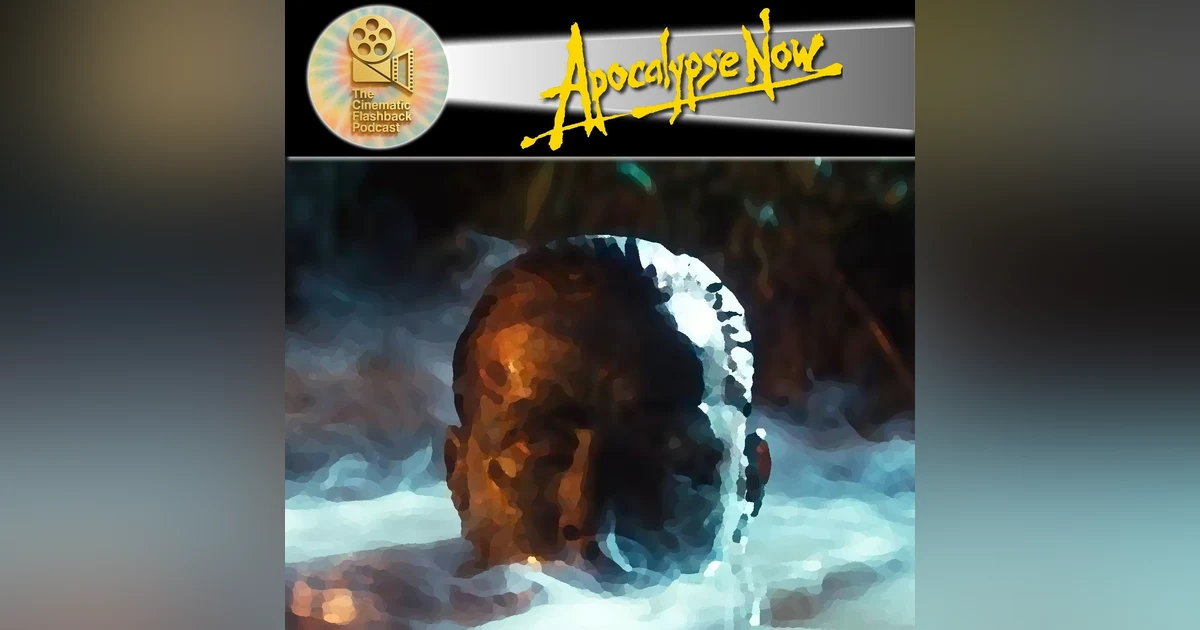

In this episode of the Cinematic Flashback Podcast, we fire up the Wayback Machine and travel deep into Francis Ford Coppola’s hypnotic, hallucinatory war epic Apocalypse Now (1979). Chuck is joined by returning guest Erin Mullinax and her husband Will Mullinax, who recommended the film and brings a lifelong love of Coppola’s masterpiece to the table.
Together, we break down the movie’s unforgettable opening, its surreal episodic journey upriver, and the contrast between major figures like Kilgore, Chef, Willard, and Kurtz. We explore the film’s impressionistic approach to the Vietnam War, its sound and music—from The Doors to helicopter rotors—its breathtaking visuals, and the themes that make Apocalypse Now one of the most enduring films of the 1970s.
We also discuss the different cuts of the film (Theatrical, Redux, and Final Cut), iconic scenes like Do Lung Bridge and “Ride of the Valkyries,” and why Coppola’s exploration of madness, morality, and the cost of war still lands with such force today. Finally, we answer the big question: Does Apocalypse Now groove through the decades or lose its beat? Guests
- Erin Mullinax — returning guest
- Will Mullinax — special guest and film recommender
Links & Contact Website:
https://www.cinematicflashback.com
Contact Us:
https://www.cinematicflashback.com/contact/
Listen to Previous Episodes:
https://www.cinematicflashback.com/episodes/
Leave a Review:
https://www.cinematicflashback.com/reviews/new/
Read the Blog:
https://www.cinematicflashback.com/blog/
Subscribe:
https://www.cinematicflashback.com/follow/
Share the Show:
Tell your movie-loving friends!
Other Podcast You Might Enjoy:
- Surely You Can't Be Serious Podcast
- 30 Something Movie Podcast
- A Film By Podcast
- Dockingbay 77
- Def Dave's 1984
- Accidental Legends
- Phasers Set to Stun
- Children of the 80s
0:02 He's out there operating without any decent restraint, totally beyond the pale of any acceptable human conduct, and he is still in the field of commanding. Troops terminate with extreme prejudice. Welcome to the Cinematic Flashback Podcast. Get ready to hop into the wayback machine as we journey through the wild, bold, and unforgettable films of the nineteen seventies. Each episode, we'll break down a classic movie or forgotten Jim by exploring the who's who of each film, diving into the premise and plot, seeing how it performed then and now, and wrapping things up with our final question, did a group through.
0:50 The decades or lose its beak? Today we'll be going upriver into the heart of darkness with Francis Ford Coppola's Apocalypse. Now. Matt is taking a little R and R this week, but returning is Aaron Mullinix and she is joined by her husband Big Duke six I mean Will, who recommended today's movie. Aaron and Will. Welcome to the show. And thank you for joining me. Hey glad to be here. Thank you. Huh night again, Oh Aaron, We had a lot of fun talking about Superfly last time we did I have to tell you. I don't know what happened last month, but that episode started tracking up and it is now like the third top downloads that we've had for cinematic flashback after two nineteen seventy one films, which was Dirty Harry and The French Connection. So Dirty Harry, French Connection, Superfly.
1:46 Well, that's because it's the coolest movie of the three. It definitely has the coolest soundtrack. Can we agree to that one? So will tell me a little bit about yourself. What's your relationship with Apocalypse Now? What prompted you to recommend it? Well, a Apocalypse Now is probably, if not my favorite movie of all time, It's definitely one of the all time greats in my opinion. If I had to make a list of top five movies acrossed any decade or just in general, Apocalypse Now would be on the list. It's just the first time I saw it, I feel that it carried me deeper into I guess the Vietnam conflicts. I just don't think that there's a war movie out there like Apocalypse Now. I guess that's the best way I could put it. It just seems unique to me.
2:29 What is your favorite movie from the nineteen seventies, fritt, I mean yeah, I had one favorite to be Apocalypse Now, okay for sure, okay, great close second would be God The Godfather Again Part one and two. What did you think of the Conversation? Have you seen that one with Geene had Conversation? No? I haven't gotten seen that one yet. So if you like Francis four Coppola, you cannot go wrong with his four films of the seventies, Godfather, Godfather Part Two, The Conversation, and Apocalypse. Now, before we get too. Deep into this conversation, let's go ahead and listen to the trailer for Apocalypse Now. I'd't been a soldier since I was nineteen, and I still haven't learned how to wait for him. I wanted a mission for my sins. They gave me one. Nobody'd ever gone on a mission like it before, and when it is over, I never want another one.
3:26 Your mission is set up the nung River and the Navy Patrol will pick up Colonel Kurtsi's path at New Mangba. When you find the colonel Infiltrator's team by whatever means available, and terminate the colonel's command terminate. Terminate is extreme prejudice. I ought to say, I'm not supposed to know what I'm taking this boat, so I don't. But one look at you and I know it's going to be hot. We'll pick your. One up and put it down like a baby, right where you want it. This is the person of the night Air cavs on. Well love Me and Moil of the Isaacs Sun and about a mile I'll put all the music scares the hell out of the soaps.
4:12 My boys love it. I love the smell of night palm in the morning. Smell Pike Victory. Man, this has been in Disneyland. I'm short, and we gotta go up there so you can kill one of our own guys. He's a commanding officer here joke. He was close. He was real clubs. I couldn't see him, but I could feel him. These are all his children, man, As far as you can see, they think you've come to Uh to take him away, and I hope that is the true. Could we uh talk to Colonel Kirks.
4:53 You don't talk to the colonel well when you're listening to him? Are you an assesssin, I'm a soldier, you're an errand boy fine cloth. It looks collectabil. So let's start with the first time you saw Apocalypse Now. Do you remember what your reaction was, and was it, I don't know, love it first napalm or did it take some time to settle in Aaron Well. The first time I saw Apocalypse Now was yesterday. Officially, I watched it in parts because it's a very long movie, and so I actually started watching it about a week ago and I got through about thirty minutes. It was right before the famous scene, the flight of the Knockers.
5:42 But just in that thirty minutes, it was hard to stop it because I wanted to keep going. It was I was hugged, I was invested in it. My impression was I don't need to take any drugs because this is this is life, kid and acid trip. The thing that I really liked was the very beginning of the movie where Captain Willard. He's in the hotel room and he's, you know, having his kind of based out moments. Was that they used the song by the Doors the end, and I thought, oh, this is the beginning of the movie, but this is the song, and that song shows up throughout the movie, and I feel like that kind of gives it a theme, like it's always the end.
6:30 The end is there in every moment throughout the movie. So that was kind of my first impression. But I liked it. I liked it. I'm going to drop in with my first impression because yesterday wasn't my first time that I saw it. I had to be back in college, so I'm. Working at a video store. I have my copy of The Godfather. Loving The Godfather, Let's watch Apocalypse now. And I didn't like it. And the reason I didn't like it was because number one, like you said, it was very long, right, Yeah, it seems like this was a film that had these little little episodes as they travel up the river, and then I just I just felt like it was really long, and I didn't really understand what the movie was about.
7:10 I don't think I invested because if you get to the first thirty minutes or the first forty minutes, you get to the helicopter scene, the one that everyone knows it has that famous line from Robert Deval I love the smell of napalm in the morning. I never knew where that came from because I never seen the movie. And then I saw it like cool. Now, I get it. It's ridiculous. It's great when those little quotes that have been around forever it comes to you and you're like oh, and then you ask yourself, what does napalm smell like? Well, it smells like gasoline, because it's essentially what it is, you know, smells like victory. I want to say one more thing about this first impression thing too, because way back when we first talked about doing a podcast on this movie and I had mentioned it to you, William had come downstairs after watching this and he's like, this is the greatest movie ever.
8:07 You have to say. Mean, he was just talking it up, and so that kind of maybe bias did a little bit. I mean, it's not a movie that I would just put on to watch and enjoy just chilling out. And even I was holding back because I didn't want to bias it too hard. Yes, I didn't do a good job. What was your first impressions? Well, I think Eric just gave you my first impression. Okay, So just so everyone knows, there are like, I think, what three three versions of the film. The theatrical REDUCS final cut, I believe. Yes, yes, those were it and I believe the main difference is that the theatrical release was cut down and it focused more on pacing then. I think in the Reducts he.
8:48 Added more scenes, and in the final cut, which was released in twenty nineteen, he pulled out one of the scenes, remastered it in four K and the audio into Dolby Adama. Which ones did you guys watch yesterday? The one we have is the final cut? Oh? Is that the one I watched? William? You did? That's the one we have? Oh? Okay, all right, well that's the one. I thought it was the original one that I was watching. I've never even seen the theatrical copy. Actually interesting, I was going to. Say, the final cut is the one that I understand is Francis Ford Coppola's favorite, or that, yes, the one that he wanted to make all the along.
9:28 Yes, I think that one of the scenes cut out in the theatrical was the French plantation scene. And if you watch the making of Apocalypse Now, which I recommend everybody do, it's an excellent film in its own right. There's a scene where he is saying, we're never going to be able to use it because the light is no good or the setting is no good, but with technology they were able to go back and then reprocess it so that it looks as great as it does. And for me on my four K TV with Dolby atmosts around, it's an experience. The sound, the video, everything, it's just amazing. It's so funny about the French plantation scene because William told me if I wanted to skip apart, that that would be the part to skip, because it's so it.
10:13 Was so long, not because I didn't like it. I know it was a great addition, but if you skip the implantation scene, that wouldn't be the worst thing to do. Yeah, but I didn't. So. The thing about Poculist now that sets it apart also is that for me it feels like an impressionists vision of the war. It's not trying to be an historically accurate representation of events. I still think it gives the most accurate impression of the war. I get that, how would painter paint a picture to describe war? And there are a lot of great paintings that exist, but how do you evoke an emotion from whoever is watching it? And I really think that's what Coppola is doing in this film, is he's painting a picture.
10:58 He might not have thought of it in those terms, but he's this picture. This is this piece of art that he's created. Is meant to provoke a reaction from the viewers who have seen it, But that's my first thoughts. Yeah, it conveys the reality of the situation, but not in an accurate way, Like when you look at an impressionist painting, you're not looking at what it actually looked like, you're looking at the feeling. I guess it invokes some people. I feel like Podcast Now is like, you know, the film version of that for the Vietnam War. I like what you said William about it transporting you, because I think that's definitely what it does as opposed to other movies about the war and kind of just just telling a story.
11:39 This takes you there. You feel it. The time I got to the end of the movie, I was like, where am I? It like really just transports you. You feel like you're going on a It's like an odyssey that's injected with Nate palm and acid. Oh man, that's what you feel like, like you've just been on an odyssey. That is an incredible description, but I do want to let people know, and I should have said this at the top of the show. We're going to be talking spoilers. If you haven't seen Apocalypse now, please go and watch it. We'll still finish up the rest of this episode. Actually, we're just gonna wait for you to watch it and then we'll continue. So just please email us when you're done. We'll start. I'm just going to get another cup of tea while we wait.
12:19 Just care, just just a little bit of time here, we'll take a quick intermission here, just enough time to grab some popcorn or top off your drink. You're listening to the Cinematic Flashback podcast. Stay tuned. The show continues right after this, and we're back. Hope you enjoyed that brief intermission. Now let's roll the next reel and get back into the conversation. Who stood out to you the most. Definitely a kill Glore. For sure. He's obviously loving the war, but at the same time, this is things about being at home, like surfing. If you look at the characters of say Willard and Kurtz, those guys they cannot function outside of war. That's not something they can do. But with kill Gore. You seem like he loves the war.
13:00 But I feel like with kil Gore he could function in this world because he has another passion, which is surfing. Aaron who stood out. To you, Well, there's a couple. I mean, obviously kil Gore. My first impression of him was he's a nut bag. But I think for me, well, Dennis Hopper's character the photographer and he had me laughing. And it was funny because even going back to Kilbowy, if I didn't know anything about this movie, you know, like when I get to that scene where we meet Colonel Kilgore, I would have thought this was some kind of satire, you know, honestly, the way that he was, you know, between I'm gonna, you know, help this poor man, give him water from my candy, oh, surfing, Oh, you know, it's like, you know, oh, squirrel, squirrel, Right.
13:42 If I didn't know, that's what I would have thought. But definitely Dennis Hopper's characters trip right there at the end and kind of adds, you know, some spice to a very creepy part of the movie, I think. But I liked the chef. Actually, I really enjoyed his performance, and you know, like all the guys on the boat, they haven't been jaded yet. They don't really maybe know what they're getting into, and so they kind of learned that. And I see that a lot with Chef. I like how his character evolves through the movie, and you know, he becomes more mature. By the end. Was there any scenes that you wanted to talk about? See One scene that stood out to me when I first watched it was the puppy boat scene. What bow, Let's take a look, man, you're a sexty chap get a sixteen, right, you.
14:34 Know, not sixtad. What's up Jason. Jog boat Captain, We're gonna take a routine check. Well, let's forget routine now let him go. He's about to run his placids down to Captain. I'm gonna take a look, jee. My missions got priority here. Hell, you wouldn't you be in a part of the river. What would make until we read your destination captain going for the ride. The Chief wanted to stop the boat, and Willard was like, this is not part of the mission, and the Chief is like, it's my boat, and he orders Chef on to search it more thoroughly. So when he gets to the container where the puppy is held. The woman freaks out, runs across. She's a frayed for the puppy, and Kleen, who's the youngest guy, overreacts and he opens up and just slaughters everybody on the boat.
15:23 And I guess what was the most interesting to me about that scene was Willard's reaction. Well, the chief he wanted to take I guess the woman was still alive. He wanted to go get her medical attention. Basically, Willard's calling out the hypocrisy of you killed everybody on the boat, one person survived, and now you want to give the medical attention. I mean, the only reason she needs medical attention is because you stopped the boat to begin with. Bring her on board. We're taking it to an Arvin. Look, get what are you talking about. We're taking it to some friend his captain. She's wounded, she's not dead. Yeah, the book says, captain.
16:04 I told you not to stop. No, let's go. So it's kind of like the theme of the Vietnam War and microcosm. If we weren't there, these people wouln't have needed all this medical attention to begin with. So that's why I like the scene is because it's kind of in your face and it's not something that you've witnessed before. It's really gonna stick with you. I think I wanted to just chime in on that because that I didn't see that scene coming, and I know that they were stopping them because they wanted to see if they were transporting weapons. And it's just I guess, a family and they have their produce and their animals on board, and they're just doing what they do, living their lives, and you could see in their faces the fear.
16:45 They don't know what's going on. They don't speak English, and they just see these soldiers with guns. They're you know, basically boarding their bold and you can see the fear in their faces and they're so afraid. Oh it's a saynd for us. The end, there's that theme again, but that's it was very upsetting because I thought, oh, well, maybe they're going to find some weapons on there or something, and then all of a sudden, no, they don't. They find a puppy, but then they end up killing all these people because they overreacted. It was very disturbing and sad, but then I think it I didn't like it, but what Captain Willard did by just going up and ending that woman's life instead of them having to take her for medical attention, just really drove it home. And he's like, you shouldn't have stopped the boat. I told you not to.
17:28 I feel like, yeah, Willard's reaction is the most honest one. It may not be the most compassionate exactly response to it, but it's the most honest because think about the logistics of trying to get this woman in medical attention in that environment. It just not it's not logical. It's most likely she's just going to die, and she's going to die slower. So he has the most logical, I guess response to it, or most honest for sure. Let me ask you, guys, thinking about Chef's reaction, Chef, did you ever think about what was his line after. The tiger incident? Never get off the boat. Or something, Never get off the boat. Yeah, And they forced him to get off the boat, and he was mad. He was so upset about that.
18:12 He's like, this is ridiculous. So you could see it. He's just throwing produce around. He's like, oh, here's you know, where's the mangoes or whatever. He was just he didn't want to be there. He thought it was a silly thing to do too philly chef. He's like, he's not meant for the war. I think that's that's probably the best way to put it. He's a saucier, right, Yeah, he starts off, I'm a saucier. What am I doing here? I think if you had to go one character who is the least meant for war, it's probably chef. But I think that that's why he is there. I think that's why we got so much character, Like we learn more about Chef than anybody. So he tells that he's a saucier, wants a saucier. He was trained to be a chef, and he was going to go into the Navy to be a chef. But then he saw how they cooked all of this beautiful meat and they.
18:57 Just destroyed it. He says, I'm not going to do it. I don't want to do this. Yeah. It's such a great character, and we got so much more depth to him than anyone else. I was going to say. The thing that stood out too, is that he kept repeating, I just want to cook. I just want to cook food. That's what he wants to do. Yeah, he kept pretending or he kept saying things like I'm not here. His whole theme the entire movie is I'm not meant to be here. I shouldn't have been here, which I think he conveys that that side of the war, so many soldiers and marines and everybody that was over there didn't feel like they should be there. That's like a really deep thought that many people did feel that way. I don't want to go. There were people that dodged the draft, they'll left the country. They did not want to go. They didn't want to be there.
19:39 They didn't feel like we should be there. Yeah, I mean, you got a whole cross section in the movie. You have a cross section of all these types people that couldn't function outside of war, like Willier than Kurts, and then you had people like Chef who just were not meant to be there. But that goes back to the impressionist division. He's just trying to press upon everybody every aspect of the war. I have something I want to add to this too. It was a small moment, but it was very poignant, and it was towards the end of the movie when the captain of the boat Chief when they get attacked and it's not guns, it's the natives, and they're throwing out spears from the banks of the river. And he gets killed. He gets speared, and he says it a spear of all things. There are a lot of things in that that I unpacked personally, just because of who he was. And he's in the juckle and he's in this war and he gets killed by a spear. And then it was just quick. It was quick and it was done. But it was a very poignant scene.
20:48 I think it's a very absurd way to die in this war. Of all things, it's a spear. I want to throw out this idea that we have two extremes that we see between Kilgore and kurtz Well. You brought up the movie Platoon, and. There's a line that Charlie Sheen's character says that he feels like at the end of the movie he was born of two fathers. I feel like in this film there are two fathers that represent one of the themes of the film. It has to do with a line that Kurt says. Horror has a face and you must make a friend of horror. Horror and moral terror are your friends. If they are not, then they are enemies to be feared.
21:42 You must make a friend of horror. Horror and moral terror are your friends. That was his philosophy of war. As long as American soldiers are serving one tour and we're trying to make this as comfortable and homelike as possible, we will never defeat this enemy. Now let's go to the opposite end. We have kil Gore. Okay, he's always trying to make the war more like home, even to the point where they're in a landing zone, mortars are going off all over the place, and he's ordering his men to go out and surf. Kil Gore is exactly the kind of soldier that Kurtz is reacting against.
22:29 One line that really stood out that Willard said to Kurtz is that you know he sees no method in this bloyer, Like what method is there? Yeah, because Eve runs into so many different people in his journey up the river and he's not seeing a method anywhere. There's just it's just a madness. It's just an apocalypse. Well, the inspiration for kil Gore, actually, I guess from John Millius said that he talked to Hi when his Vietnam veteran friends. And there was a colonel in Vietnam who would go hunting because again, you know, his passion was hunting, and so he's in the war and he would take helicopters out into the Vietnam to go hunting. That was part of his inspiration for Coolgor Kilgore has multiple inspirations, but he said that was part of his inspiration. So it's like kind of reminds me of kil Gore, who's always talking about surfing. Even though he's the middle of the war, he still atually still prosecuting the war, but he's not gonna give up on his hobby, right, Right, Like I'm bringing some of America here.
23:19 I think that's what Kurtz was reacting against. Right, We don't need to bring America here. What we need to do is we need to defeat the enemy. Well, I was thinking that. I think it was in the beginning, and because again I've only seen it once and I feel like I need to watch it about three or four more times. But there's two kinds of people that were there. There were people who could go there and do what they have to do and then come back home and move on with their lives, and then they're the ones who basically crossed the border into PTSD insanity and they were never going to be able to come back. And I got the impression from the very beginning Captain Willard is one of those people because he can't function unless he's there. And obviously Kurtz is also one of those people, but kil Gore is not.
24:09 Kill Gore's there. He's going to do what he has to do, but he's going to go home and he's going to serve and he's going to be okay. And so that that was my kind of take on the comparison, the contrast between kill Gore and Kurtz, and I don't know what lessons you could take from that. It's interesting about kill Gore. He he kind of straddles the line between someone like Chef and someone like Willard. Chef he doesn't function well in war. Willard can only function in war. Now, kill Gor's here, and he loves the smell of an apole, but he also loves searching. Yes, he loves Buck and he's going to combine them till the day Palm ruins the waves. The sound of this film is really unforgettable, whether it's from the doors to the choppers to the jungle silence.
24:53 So let's talk a little bit about the music and the soundscape and how that shaped the experience of watching Apocalypse Now. One of the things that really got me, and it was just a little thing, one of those little things on the boat they're going up the river. Mister Klean, Lauren's fish friend character, he's got his drumsticks out and he's just banging on stuff and banging on stuff and banging on stuff, and it's a nice little beat, but it's kind of annoying, and it's breaking up the silence of the jungle, and in a way, just that kind of stressed me out when I was watching it, because I'm like, maybe they should be quiet because they're an enemy territory and he's just banging on making some beats. And it's also i feel like he's creating tension and anxiety with the crew of the boat through that. I'm surprised somebody in the movie didn't just sell them shut up stop that threw the sticks overboard. But that was just like one of those little things along the way.
25:46 It wasn't a famous song or anything, but it was just the sounds and how they used that to create. At least for me as a viewer watching the movie, that's what it created for me. So that was one of those little things. Will pause here for just a moment. Think of it as a real change stick around. There's more cinematic flashback coming up right after this, and we're back. The lights are down, the film's rolling, and the final act begins. Let's jump back into the Cinematic Flashback podcast. When I was being transported, I feel like the music was part of the mood. I almost didn't notice it, which is a huge compliment to the sound of the movie.
26:31 I had to choose one scene I guess where the mood and the music really stood out to me would be the dough lung Bridge scene where it's like a carnival of cartage but wasn't Lance he had dropped acid or something. He's like, I had that last hit of acid? Had I just dropped it? It made you feel that was one of those scenes that made you feel like you were on acid too, because it kind of was slower, and just the way that they panned around the scene and the way that they sounds all kind of you can hear the wires with the lights. I think that scene is put in show the ultimate absurdity of what they're doing is just look at all this. This is madness, this scaos. And then you got the scene with Roach. They call him in and she's echo locating the enemy so he can kill him. And then he's like barely even showing any emotion. And it's like these guys are all just put through the ring.
27:23 They're not going to make it. Back about Roach, I think he's a guy who would fit in well with Kurtsi's team. So he's asleep, he's not bothered by this. They wake him up, he comes over, he turns off the Jimmy Hendrix music, he loads his grenade launcher and he fires it and kills the individual who they were trying to shoot with so many bullets. So the other guys are using a machine gun and they are just throwing bullets after bullets. They're lighting off flares to try to find this guy, and they're completely ineffective. And that is the theme of the film, or one of the themes of the film. Again, we have too many people, we have too much money that's come over here to be able to throw away all these bullets and what we need is we need somebody who can go up there and kill the enemy. And that's what I took away from that scene and how everything was all mad.
28:28 One of the things also in just the mood of the movie is the lighting. And it's funny because I was watching the movie last night and it didn't dawn on me, and so William told me about this, and I wanted to mention it. William, you know more about it than I. But there was a lot of special focus on the lighting of the scenes and how that affected the mood. I guess. Yeah. He had the cinematographer Tori Starro. He is well known. Su're using a lighting in and I think that scene really gets across the circus of carnage atmosphere going on, and his lighting, his cinematography compliments the mood of the scene.
29:09 I mean, the dude is a genius because his style is also going back to an impressionist or it's more I guess expressionist, prioritizing emotional response from the audience with his visuals. But I think that scene in particular just really conveys the emotion for the guys, like the grunts on the ground, fighting it. And it also shows the absurdity I guess up the war, because why are they keeping the bridge. They keep rebuilding the bridge, and it keeps getting destroyed, keeps rebuilding, it gets destroyed again, And just so a general can say the road's open, so he can get a promotion, and everyone else is suffering so he can say the roads open. I would be remiss if I did not mention Carmine Coppola's score. Which was fabulous to me. I love that he works in a musical motif that is called an ostinado, and any musician will immediately go to Gustav Holtz the Planet Suite, most particularly a movement called Mars the Bringer of War, and I thought it was really cool that this film brings in this connection to war through music, through the classics.
30:18 The soundtrack was brilliant. It's so worth listening to. I guess the musical motif. It almost sounded like a helicopter because it's a helicopter war. At the very beginning, as Willard is laying on his bed in Saigon, I was just thinking of that, and he's looking at a ceiling fan, and the ceiling fan sounds like. The blades of a HUEI. Yeah, it's like they tied it to the visuals as well. Yeah, apparently that was an intentional They filmed the ceiling fan and then later in editing they were just integrated with the sound. They didn't set out to do that, but that's the way some of the great moments of film happened. And that scene too, when he was in the hotel and Saigon, and I think was really cool because you get Martin Sheen and the thousand yards there that he has because he's staring up at the ceiling ban, he's just like dead until he.
31:09 Has his mission. Right. I think Copola set out to tell a human story and so that includes, you know, all the contradictions of humanity. I guess you could go back to kil Whar. Yeah, he's he's sitting blowing up this village and causing all these injuries, and then this woman runs up to him with her baby, and he picks the baby up and he's like, oh, his baby's got to go to the hospital, and then gives her back to the mother. You go with her, and then like he just blows up all these people, but then he shows this compassion and the same with and sends them off to the hospital via helicopter. It's kind of showing I guess, every aspect of humanity and all its contradictions. I think that Copla set out to convey that, and I think he, you know, obviously hit the nail on the head.
31:50 Yeah, there's just the duality of human nature and that we can bring ourselves to commit atrocities, but yet we still have this compassion in some way, even if it's warped. I have to watch this probably five more times. But like Colonel Kurtz, I think somewhere in there he was good and then he just went off the rails and created some kind of weird cult in the jungle. That's that's what I got from that. But then other smaller things that just stood out throughout the movie. And you know, the guy what was his name, Roach, He just stood up, he took care of it, and Willard asked him, do you know who's in command here?
32:36 Yeah? Do you know who's in command here? And he said, yeah. It's an interesting parallel there because he's got black power written on his helmet and a white man's asking him, do you know who's in charge? And he looks at the guy and he's like, yeah, I know who's in charge. It's like obvious who's in charge here? My reference another movie. One of the things that came to mind last night when I was watching this one is when to get to the bridge scene and they're talking about, yeah, we build it, and then they tear it down and we build it again. It made me think the Bridge on the River Kwhy. You know in that movie they put all that word to build the bridge, and there was a whole different theme and motive there. But in the end the bridge is blown up and I forget the character's name, but he's looking at it and the one thing he says is madness. And that those two things came together in my mind last night watching this.
33:31 How would you compare it to, say, Stanley Kubrick's Full Metal Jacket. I know that Full Metal Jacket. It's just that one always got me in the beginning, you know, with the boot camp part of it. I mean, I'm a huge fan of Stanley Kubrick as well. So it's it's similar to Apoculst now in that it's just giving you an impression. I felt there was a lot more irony. Yeah, yeah, like like the peace button, but he had born to kill on his helmet but a piece button. And the officer walks up to him and he's like, you better get your head or your butt wire together. Oh, I will take a giant you what on you? Have you seen The Deer Hunter by Michael Camino. Yeah, that's another good one that you could look at and compare. It's been a while since i've seen it. That one, that's a rough watch. I've not seen it, but I've heard. How do you express and how do you make your audience feel the anxiety? And it's done brilliantly through a game of Russian roulette, as each time they put the gun to the head to characters you care about and they pull a trigger and he goes click.
34:27 I had to close my eyes. I was that stressed watching this film. It's also a great film for showing the men what they were like before the war and then showed what the war did to them. And the one guy who had the most promise in civilian life, he was the one that was least meant for the war and he's probably the one that had the worst fate at the end. Yeah. Another movie that you may not consider is Rambo's First Blood and the n monologue where they had to call his old colonel in and the Karl walks up to him. He's like it's over, Johnny, it's over, and Rambo is like, nothing is over. You don't just turn it off. It wasn't my war. You asked me. I didn't ask you, and I did what I had to do to win, and somebody wouldn't let us win. So this kind of goes back to that theme where Kurtz is talking about, we're not doing what's necessary to win this war, so if we're going to win it, we should win it and not do this half in, half out kind of thing that they were doing. I think kill Gore's a good representation of that if you think about it. He's like half foot in, half out, not fully committing to the war. Where's Kurtz and Willard? I guess will theer's more of an exploration. He's exploring all sides where he's like the audience's eyes. One thing that I just realized that we didn't even really talk about directly. I was the right of the Valkri scene with the music and the theme. How could we not talk about that? And how they're coming in with the helicopters. When you first see that, it's almost adrenaline inducing, like you're just like, oh, here it comes. And I was his theme with this.
35:48 It's like saying that the Americans always want to put on a big show. Wherever they go, they put on a big show. And that's what kill Gore's doing. It's also have his historical precedents and that see I actually did things like that that stood out to me too, and. He said, turn it up loud. It terrifies them or it scares yeah. And you can see that because where does it start. It starts off. You know, they're coming in low, they're coming out of the sun right and then we cut to the village and we don't see the VC encampment on the beach. What we see as a school and the little children and they're lining them up and. They're peaceful village, moving them du It's also part of the class of the culture because you're seeing the Vimanese culture. They're just having a peaceful afternoon and then here come the Americans and then here they come, and we're just blowing everything up.
36:35 It's such an amazing scene and I cannot imagine what it took to film something like that. But it is definitely the raw, raw moment of the film, because everything after that just goes deeper and deeper and deeper until you're at they do Long Bridge. Yeah, Kilgary, he just has a very straightforward view of the war. He's not complex, he's not trying to dive deep. These people are savages, you know, That's what he says one scene when the woman throws a grenade in the helicopter and blows the helicopter up, and he calls them savages. But then he doesn't see the irony even though he just blew apart the whole village. Yeah, he's doing the same thing. It's just such an amazing film. I loved the sacrifice of the water buffalo at the end. Oh yeah, that's a tough scene to see. There's two stories that are going on at the same time, and the scene starts with Kurtz backlit in the temple doorway in the water buffalo going down the steps. Meanwhile, Willard is preparing to kill Kurtz. There's symmetry between the sacrifice of the buffalo and his attack on Kurtz. When Willard comes out his face is half in shadow, and all of Kurtz's followers they kneel and they bow, and I think they're recognizing what has happened. You're now our god.
37:57 Willard walks in between them and he grabbed Lance. As the PBR is pulling away, you see superimposed Willard's face still in half shadow, along with the statue of the god. And then Willard's face comes out of shadow and the film ends. I mean, yeah, everything you said is exactly hygree. And the theatrical cut as it's fading out and see the helicopters coming back, and people interpreted the ending of the film was Willard called in the air strike and that wasn't Coppola's intention at all. When this film was shown in seventy millimeter, there was neither credits at the beginning or credits at the end. It just went into the movie.
38:38 Wow, it's kind of cool. I didn't know it. So are we ready to ask a question? Does Apocalypse Now roof the decades or did it lose its beat? Hopping in the way back machine and pulling back a years. Dude, William, what did you think? I think it definitely grooves because to me, It's one of the most timeless masterpiece that I've ever seen. We could watch it two hundred years from now and it will still I guess resonate. I believe that he achieved his goal of telling a truly human story, and that notes what makes it so timeless. Yes, I do believe the movie definitely still grooves. It is, in my opinion, one of the timeless masterpiece, so it's definitely still grooves.
39:21 Aaron Well, I think it grooves. I knew it grew because William came and told me how amazing it was. But you, having only seen this for the first time, I would say, yes, it definitely still grooves because I want to see it a few more times now because I feel like it's one of those movies you have to see it more than once because you're going to get new things from it, and that to me says it's a good movie. And I think, like what William said, it's timeless and it's like an Impressionist painting. I can look at Impressionist art now and those are still grooving too, So definitely, if you haven't seen it like me recently, do put it on your list to watch. I think Apocalypse now still lands today. I think that this is a film that the younger generation could come in and watch and pick up what Coppola was trying to say, because he made a picture about the Vietnam War, and I think that the themes and the messages that it asks the viewers to consider and to deal with, I just think it really lasts even today, So I think it's a very relevant movie for someone to go back and watch again. I think this is why this is Copola's magnum opus, and I think that's why for me it still grooves today. So Will and Aaron, thank you guys both for coming on today and talking about Apocalypse Now with me.
40:39 Well, thanks for having me on. It's been a lot of fun. Awesome, and thank you listeners for joining us today. Did you see Apocalypse Now? We'd love to hear what you think and which version you prefer. You can reach us at our website, Cinematicflashback dot com, and while you're there, be sure to check out our previous episodes, dig into our blog articles, and hit that subscribe button so you never miss an episode. And hey, if you're enjoying the show, we truly appreciate you sharing it with your friends, but join us next time as we fire up the Wayback Machine and head back to the nineteen seventies to explore another unforgettable film from that air and remember, never get out of the boat.
41:21 Certain chat, sirs, The only thing that hold this cuts in, Sirs, that motlan. What do you have to say? Goody PC. If you want water, you get three paddy watta get out of. Here, give me that, give me that? Can't you don't riv it up? Yes it. Up? Why would you pick my cat teat any day? Colonel? I think one of those sellers, Lance Johnson The Surfer where John every Twist maadic flashback and the show begin