
 Spotify

 Amazon Music

 Apple Podcasts

 iHeartRadio

 PlayerFM

 Podchaser

 YouTube
 RSS Feed
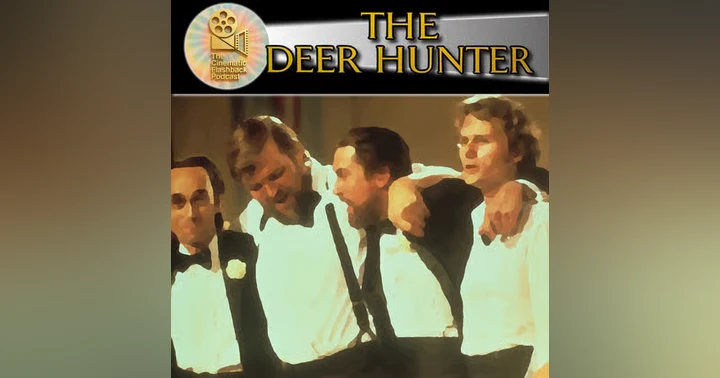
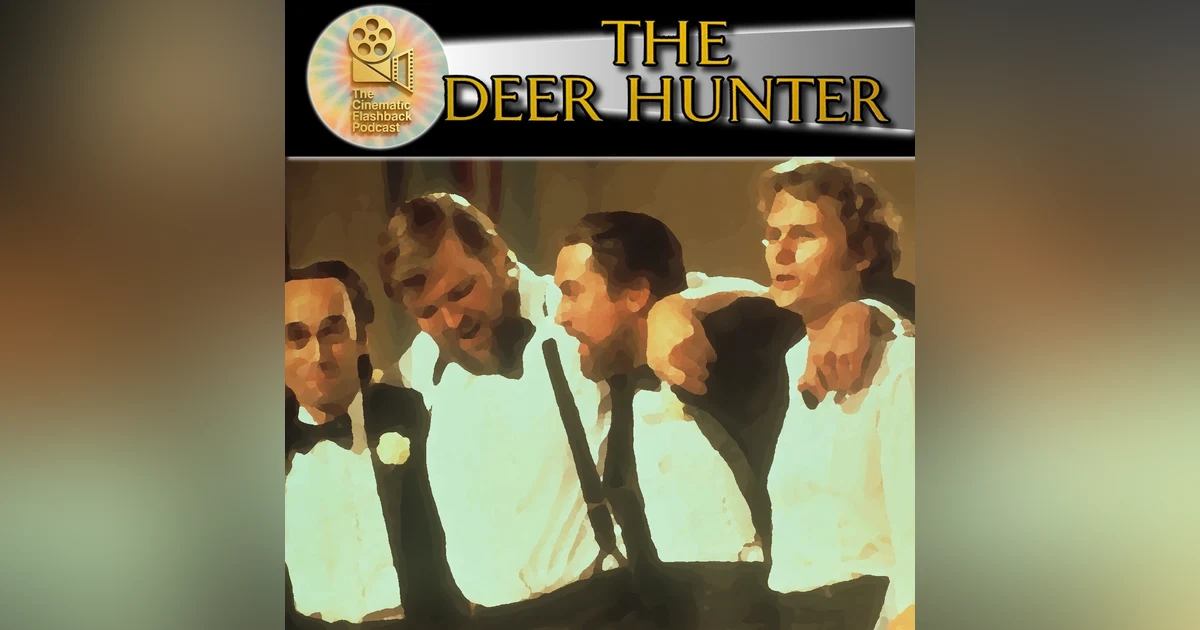
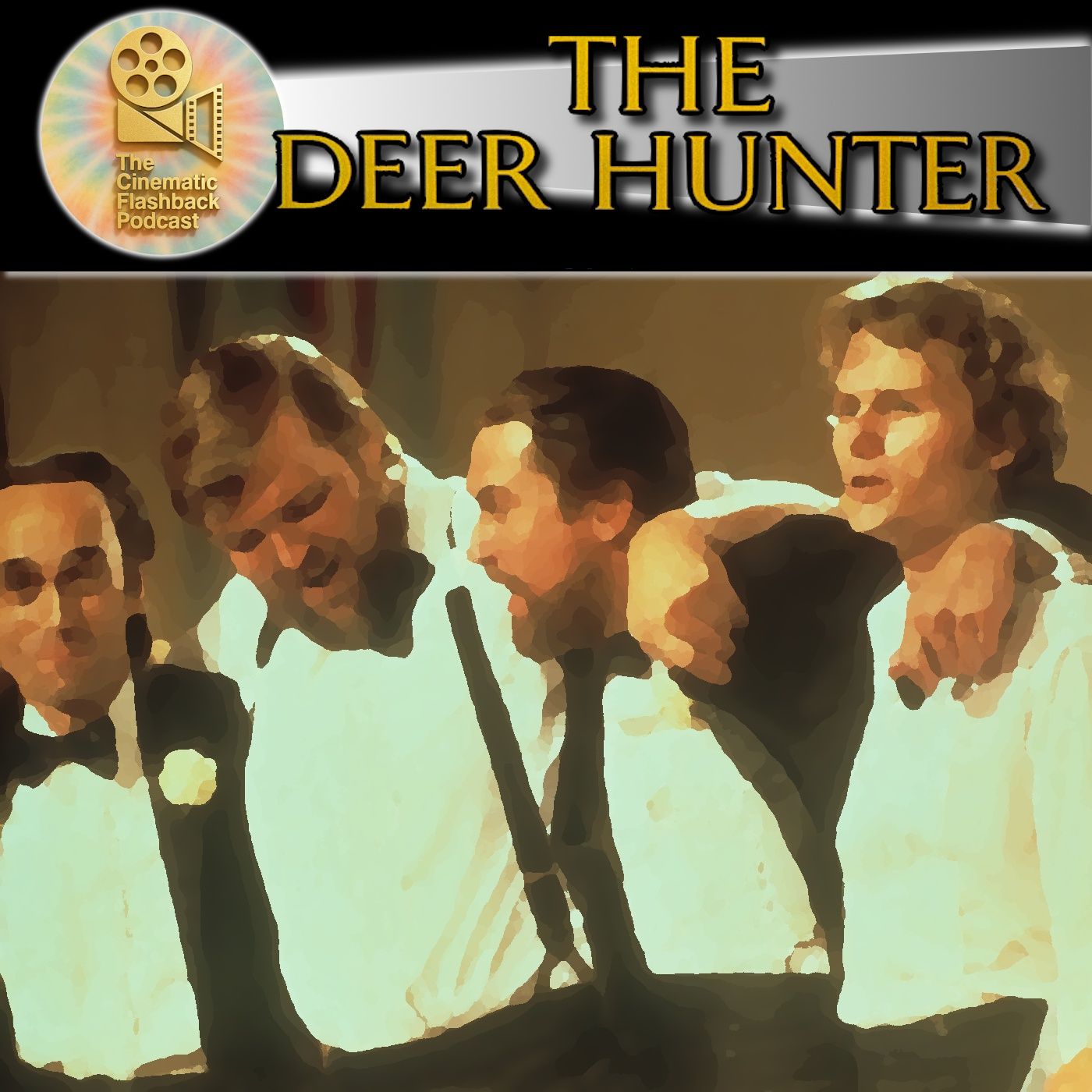
De Niro and Walken in The Deer Hunter (1978)
In this episode of The Cinematic Flashback Podcast, Chuck and Matt discuss The Deer Hunter, Michael Cimino’s 1978 Academy Award–winning drama starring Robert De Niro, Christopher Walken, John Savage, John Cazale, and Meryl Streep.
The conversation follows the film’s three-part structure: the extended wedding and steel-town life in Pennsylvania, the Vietnam War and captivity, and the difficult return home. Rather than focusing only on the film’s most famous scenes, Chuck and Matt talk through how the first act establishes relationships and routines, how the middle section disrupts them, and how the final act lingers on the long-term effects of war.
They also discuss the performances of De Niro and Walken, John Cazale’s role as Stan, and the real-life circumstances surrounding Cazale’s final film. Other topics include Vilmos Zsigmond’s cinematography, the use of music (including Cavatina performed by John Williams), Michael Cimino’s career trajectory, and why the film’s pacing and final moments continue to divide audiences.
The episode wraps up by weighing where The Deer Hunter fits among Vietnam-era films and asking the show’s closing question: does it groove through the decades, or does it lose its beat?
Links & Contact Website:
https://www.cinematicflashback.com
Contact Us:
https://www.cinematicflashback.com/contact/
Listen to Previous Episodes:
https://www.cinematicflashback.com/episodes/
Leave a Review:
https://www.cinematicflashback.com/reviews/new/
Read the Blog:
https://www.cinematicflashback.com/blog/
Subscribe:
https://www.cinematicflashback.com/follow/
Share the Show:
Tell your movie-loving friends!
Other Podcast You Might Enjoy:
- Surely You Can't Be Serious Podcast
- 30 Something Movie Podcast
- A Film By Podcast
- Dockingbay 77
- Def Dave's 1984
- Accidental Legends
- Phasers Set to Stun
- Children of the 80s
0:01 You know that we did that one great hunting chip tonight, Mike, I don't know what the hell you come up with all this? Hey? Wait, what are you? What are you thinking of going deer hunting tonight? Not tonight, I'm. Getting married tonight. You guys, go Dida honte. Hey. Hey, welcome to the Cinematic Flashback Podcast. Get ready to hop into the Wayback machine as we journey through the wild, bold, and unforgettable films of the nineteen seventies. Each episode, we break down a classic movie or forgotten Jim by exploring the who's who of each film, diving into the premis and plot, seeing how it performed then and now, and wrapping things up by asking did it groof of the decades or did it lose its beat? Today we're reviewing The Deer Hunter from nineteen seventy eight, directed by Michael Chimino and starring Robert de Niro and Christopher Walken. I am your host, Chuck Brian, and joining me is my co host, fellow movie lover and partner in crime, Matt Sargent.
1:06 Happy New Year man. Yes, it's weird how that happens in our release schedule, but we definitely are super happy to be back and coming to you in season number. Two, and we are now covering our second movie about Vietnam, The Deer Hunter. Yeah, this is the movie that I think of when you talk about a Vietnam movie. There have been some others later and later times, but I remember as a young person. You know, it's funny. This movie came out in nineteen seventy eight. My brother graduated from high school in nineteen seventy two, and I distinctly remember seeing the numbers for the Selective Service being printed in the newspaper.
1:50 Oh yeah, it was the last four digits of your social security are sort of like, those are the ones they were pulling from. And I remember thinking that that was it was very real for us. Even with me being kind of a young person in nineteen seventy eight, I was, well, I wasn't that young. I guess I was about seventeen. Well, this movie, even though it released in December of seventy eight, it was a limited release, and you might can guess why. Well, I think it's absolutely clear that it was so that it could get into the Academy Awards for that For that's I guess their Academy awards are done in the winter spring right timeframe. Yeah, they actually remember it being released early. And the reason I remembered is my sister married a guy who was really he loved this film, and he really really was into sort of the whole He had friends in the military. He never served, but he had a lot of respect for the military and a lot of interest in Vietnam War. And I think we went and saw it. Possibly we saw it as soon as we could, so it was right when it was in wide release, or if it was in limited release here we were, which possibly it was.
3:09 I don't know. We were in northern Virginia, so DC area. You might have been early. Yeah, been early, because I do remember him being very excited about going and seeing it. Yeah. I realized that this film it went into wide release like early nineteen seventy nine, like February, right, And I realized while preparing for this that Apocalypse now released in August of seventy nine. So in this year there were two films about Vietnam. Yeah, they were definitely a one two punch about you know, sort of the writ I don't want to say it was sort of the coming the reckoning of our involvement in Vietnam kind of through film and popular history. It definitely was on a lot of people's minds. It was a big deal when people a lot of people, I mean, I was talking to somebody today who was born in thousands or something. Wow, I just you know, just it's so funny us that are of a certain age when you talk to someone who just islike, I mean to them through remembering those things that happened during the Vietnam War and after the Vietnam War is like for us remembering what happened or thinking about, you know, how our parents dealt with World War two, right, you know, Korean War, the Korean conflict and stuff.
4:30 Yeah, yeah, yeah, just. Really really an odd feeling on that. So I hope that we can relate to the people that are listening, if they're younger than that, we can give them a little bit of the view of what it was like to be that age during that time when you know, at the beginning, nobody talked about Vietnam. It was just a taboo subject. And then this film came out, Apocalypse Now came out, and some other movies that came out that really pushed it to the forefront. Of everyone's reckoning, and obviously this film did a great job at that, because I mean, it was critically acclaimed and it hits with a lot of impact for sure.
5:11 Matt who's talking with us today. Well, we received a review on the Apple Podcasts platform from Dan though Man. So it looks like Dan though Man, but I'm going to give him the benefit of a doubt and say he was going for Dan the Man. Here's what Dan the Man says, unbridled enthusiasm fueled by amazing knowledge of movies and culture, emphasized by creativity. I find myself smiling unexpectedly while listening and googling names I've never heard of and then saying, oh, yeah, I remember them. Thank you so much, Dan though Man. We really appreciate that, and we thank you for the five star rating that genuinely helps the show reach more fans of seventy Cinema and keep those comet's coming. We'll do our best to read them on the air, and obviously, the more effusive you are with your praise, the more likely it will be read on the air.
6:11 And don't forget, we're still looking to see if anybody else wants to listen to us. Talk about I have the Needle. So let us know, yes, please, I want to talk about I have denodl. We are about ready to get into The Deer Hunter. But first we need to take a quick commercial break. We'll be right back. There's one scene the Deer Hunter that I think a lot of people talk about, which is the Russian Roulette scene. Christopher Walkin and Robert de Niro have been captured by the Viet Cong and they're being toyed with by a bunch of people that don't speak a word of English, and they're asked to play Russian Roulette with each other. And these are two boyhood friends. They've known each other their whole lives, and as each one passes the gun to the other, they have to anticipate that they're going to watch their best friend's head blow off, and with each click of the gun, their bond is cemented even more.
7:03 I remember distinctly sitting in the movie theater and you know, sort of weeping in the middle of this film at this scene, and feeling as if I was going to be changed for the rest of my life, that it was a moment of filmmaking that was so true and so horrifying and so real that I would never be the same. Welcome Back. The Deer Hunter tells the story of the impact of the Vietnam War on three Slavic American friends from a small steel town in Pennsylvania. It actually is just outside Pittsburgh. The film is structured in three movements. The first centers on the wedding of Steve played by John Savage, The second takes place in Vietnam, and the third takes place back in their town and is the aftermath after their survival from Vietnam.
7:56 Let's talk about some production details, as we already mention. The Deer Hunter had a limited release in December of nineteen seventy eight, followed by a wider release on February twenty third, nineteen seventy nine. It had a budget of around fifteen million dollars and made roughly forty nine million at the box office. It was produced by EMI Films and distributed by Universal Pictures. It also won Academy Awards for Best Picture, Best Director, Best Supporting Actor that would be Christopher Walkin, Best Sound, and Best Film Editing. The Vietnam scenes were filmed in Thailand, and the river scenes that was the River Kwai from.
8:38 The movie Bridge Over the River. Kwai from the Bridge over the River Kwai. But Bridge over the River Kuai wasn't filmed at the River Kwai. It was filmed elsewhere in Burma. I believe. I will say that in rewatching this film and watching them those scenes in the river and the scenes of them floating down the river, that was very effective. Hey, let's talk about this cast. Robert bar played Michael, and a little bit of trivia here, Roy Scheider was originally casted to play him. I could see that, Honestly, I could see Roy Scheider playing the Michael character. Christopher Walkin played Nick, who is probably one of the most interesting characters in this entire movie. Obviously, Michael drives a lot of the action and he's in virtually every scene, but Nick is portrayed by Christopher Walkin amazingly.
9:29 Do you know what I found funny? This may be one of the earliest Christopher Walken performances that I remember seeing. And he wasn't Christopher walkening all over the place with that exaggerated manner of speech that he is so well known for. I don't know if I was expecting that. Yeah, No, I definitely. I agree with you. He did not have that sort of that almost affected or affectation of speech, which is effective in his other movies. But he was great in this movie. He really was understated. It was powerful, It was very powerful. Enjoyed him a lot. John Savage played Steven, and I have to admit I looked at John Savage's filmography, and he's played in a lot, and he's still appearing in television productions and films, and he has things that are in the works. But I cannot, for the life of me remember him in any other film, and when you try to look up information about him, it always says he's best known for The Deer Hunter.
10:31 So we also get to talk about Meryl Streep, who played Linda. It turns out we'll talk a little bit more about about this as we as we talk about the actor who played Stan. But Meryl Streep is in this movie kind of as a not a deeply written character. Her amazing acting chops are not shown to their full potential. But when you hear more about why she was in this production, it will make a little more sense. There were two other guys. There was There was John and I don't remember the actor who played them, but he was the owner of the bar. Yeah, the heavier set guy. And then there was also Axel, who was part of the group of friends who would go out hunting. It turns out that the actor who played Axel was not actually an actor. When Robert de Niro was preparing for the role, he would go into blue collar bars to kind of pick up on speech patterns and how how blue collar men who work at steel factories act. And he struck up a conversation with Chuck Assbergen and he said, you know, this guy is really good. He would be good in the film. And this was the only film credit that he had, and he was he was amazing.
11:44 Yeah, yeah, it was good. Some people have natural talent like that. And he was essentially playing somebody from his town, you know, probably doing the things that they do. So Matt, let's uh, let's do a little actor spotlight. Let's talk about John Kazel. I I have quite a bit of information about John Kazel. He is such a good actor that you fall into the trap of disliking him. Yes, because he's so good. You have to be careful because the guy was portraying somebody. But anyway, let's get into it. Actor John Cazell's performance as Stan in The Deer Hunter is a standout. It brought a mix of comic relief and tention to the group of steelworker friends from Pennsylvania. You know, Michael's intensity needed a target because if it had been unleashed on someone more serious than Stan, we would have thought Michael was a jerk all the time, not this, So it was a great foil. And he's super fussy. He's always fixing his hair. He fancies himself a ladies man, but clearly not real good at it. And you know, it's pretty funny because there's scenes all through the movie where he's asking whether his date is attractive and Michael's telling him no, which is hilarious. It's a funny scene, does it Great brings a thirty eight Revolver on a Pennsylvania hunting trip, which is typically Pennsylvania hunting is rifles, right, because you're up in the mountains and stuff. I will have to point out though, that there are no mountains
13:15 in Pennsylvania that look like the mountains they were hunting in. There are no snow capped mountains in Pennsylvania. But the idea of what they're trying to do. They're doing a certain kind of hunting, which is they're stalking and having John Cassel's stand kind of be along the trip is you know, jarring in its doesn't fit right. His whole personality doesn't fit. He's not serious about it. He forgets his boots years before. He clearly forgot his socks, and he forgot his gloves. And you know, we see this in the scene with Michael on the hunting trip where Michael's had enough, right, it's been years, and he gives you a clue into the idea that Michael knows he's leaving and he feels like these guys need to take care of themselves. He can no longer take care of them, and so he's trying to set that bit almost like a parent saying you need to pack your own bag and if you forget stuff, well you gotta live with it, right, And that's at least that's what I took from that, And Kazel's goofiness and insecurity really is a great foil for that scene. And I think it's one of the reasons this movie works well is using Stand in that way.
14:30 And I will say the other part that's very interesting about Kazel is he was diagnosed with lung cancer, terminal lung cancer before filming even started. The film studio didn't want to ensure him because they knew he had terminal cancer and he was dying, so the director went ahead and shot all his scenes up front, So he upfronted all the scenes that John Kazel was in so that if he succumbed during filming, they would still have his parts in the can. And he did survive filming, but he did die shortly thereafter. The other interesting part about this is, and we kind of talked a little bit about it, is Meryl Streep was in this movie. Meryl Streep and John Kazeil were in a very serious, committed relationship at the time, and she was very concerned with his health. So she let it be known that having her in the movie would be a great way for her to be able to keep an eye on John to make sure he's not over exerting himself, and that she could be there and, you know, to be honest with you spend as much time with him. You know, the writing's on the wall. It's really a moving kind of situation. The other thing about John Kazelle. He literally was in five films and all of them were fantastic hits, so I think I can name him off. Obviously, he was in The Conversation, which we have reviewed here. He was in The Godfather, He was in The Godfather part too, he was in Dog Day Afternoon, and of course he was in The Deer Hunter. It's an amazing repertoire of
16:05 films to be in and then to pass away. I mean, I think we kind of missed a great one here. But you know, he sure gave us a lot while he was with us, and it's quite sad to think that he passed away after these films. I think he would have gone on to be an amazing senior statesman of film. He would have been a great guy to listen to to hear talk about his stories. You know, we really lost something there, and I think it also put probably a pretty indelible ink mark on you know, Meryl Streep's acting going forward to the rest of her life. I mean, obviously she's a national treasure. Marri Streep is an amazing actress, and I think the roles she's most known for are those ones where she's really emoting deep, deep, emotion and emotional loss, and you can kind of get where some of this might have come from. Sure, I know I went along on and on about it, but it was pretty moving to hear about that. I always just sort of didn't even know much about John Kazel.
17:11 And one of the best things about doing this podcast is even we do a little bit of research and we find stuff that we didn't know about. And that's one that was very interesting. And I am here to say that I am happy that I learned this, and I'm happy to realize that my dislike for the character Stan was probably one hundred percent due to his good acting. So you mentioned that he was in the conversation. Do you remember what his character's name was in the conversation? I think it was Stan again, it was Stan, Yeah, yes, And clearly the guy would have been the best guy in the world to talk to you. He acted with de Niro, he acted I mean. She know, a couple of twice, I mean three times.
17:56 Actually, yeah, amazing, what a lot. I had not put together John Cazell until we did the conversation, and then I was like, he looks so familiar to me. Of course this is Fredo. And then you look at his IMDb page and it's like, oh wow, this is amazing. So I was glad to see him in Deer Hunter. This was really good. Yeah. And I think his role, I mean it was a I can see why Michael Chippino fought to have him in the film because I think he was the perfect foil for Michael's intensity. Yes, yes, Well let's talk about the filmmakers now. The director of cinematography was vilmosh Zigmont, whose work we've already seen in mckayb and Missus Miller and Deliverance, and we will see him again this season in Scarecrow and The Long Goodbye. He also has an audio commentary on the Blu ray for The Deer Hunter, and I picked up some trivia that I did not know. So, first of all, the director of photography is not the guy who is actually operating the camera. For some reason, I always thought that the cinematographer was the camera operator. He's not. He's he's the guy who is in charge of the camera operator, the gaffers who set up the lights, and he works with the director to get his vision up on the screen.
19:20 And I thought that was interesting. When they shot this film, it was shot during the summer in Pennsylvania. Do you know how hard it is to make Pennsylvania look like winter during. The sauce, because it's one hundred percent green. They were plucking leaves from the trees so that it would look like leaves had dropped, and then they sprayed some chemical that would brown the grass up to give it that winter. Dormant, winter dormant. And then of course it was wet, which is absolutely just like Pennsylvania in the winter. It's always wet and nasty if it's not frozen and dangerous. Well, the reason why you saw snow on the mountain was because they filmed those in Seattle.
20:00 Yeah, clearly. I mean, they're the wrong kind of mountains. It's the wrong kind of mountain. I wouldn't know about the particulars of Pennsylvania, but I know that the style of mountains on this coast versus out on the West Coast is much different looking. Music. I know you had to have noticed the music, it. Was, Yeah, yeah, I noticed. The one thing I was gonna say is I did notice the music on this film, and it was the main thing. What I noticed is there was some I'm gonna I'm gonna throw a guess out here, because music is not my thing, go for it. But I'm gonna say in most of those scenes at the hunting and the mountains, it sounded like Gregorian chant or something along those lines.
20:40 What I would say is that it felt like it was like a church chral. Yes, ye, right, so it gave you this idea like you're in some place that's holy. Yeah, the cathedral of the Hunt. And of course the theme song from The Deer Hunter is the guitar piece that's played through that's called Cavatina, and that was performed by Australian guitarist John Williams. The music I did, I mean, I'm getting better about noticing the music and movies, not just having it as an an afterthought or as a flow for me. So I definitely did notice that, and I noticed the music at the wedding and uh, what.
21:21 Was that song? I Love You Babe? Yeah? Right right? Did you notice that people were singing the song? A lot of times whenever you see a movie and you're at a party and everyone's either dancing or whatever, there's no music in there, right right, so that they can get the actors talking, you know, and they have a nice, good bass, and then they put the song. No, they recorded the music right there with that band playing, and I saw someone singing in time to that song, and I'm like, holy cow. They they were actually playing. This is live. That's why I think maybe in some cases it was a little hard to hear them. Yeah, this was very familiar to me in these scenes, the wedding scenes. I had gone to a wedding of who remained very very good friends of our family, and it was exactly like the wedding in The Deer Hunter.
22:13 So the dancing, the music, the collecting of the money for the bride, the bride price, all of that stuff that went on in that wedding that you saw going on all happened. And I went to a wedding that was like that this and then a few years later, when I'm watching The Deer Hunter, I'm like, hey, I have been there. I have been to that wedding. That's crazy. Let's talk about Michael Chiappino, the film's director and co writer. He's a fascinating figure whose career really is the classic Hollywood rise and fall story. He was born in nineteen thirty nine. He started out studying architecture and dramatic arts before breaking into the industry, starting out with commercials and screen running gigs. He co wrote the screenplay for Silent Running, directed by Douglas Trumbull, and he also tributed to Magnum Force, the Dirty Harry sequel. Chimino's directorial debut was the heist comedy Thunderbolt and Lightfolk, one of my favorite movies by the way, starring Clineaswood and Jeff Bridges, which showed snack for character driven stories. The Deer Hunter was his sophomore effort and a massive triumph. Obviously won five Oscars for this, including Best Pitcher, Best Director. Chibbino's epic western Heaven's Gate in nineteen eighty became one of senna's most infamous disasters, ballooning from a seven point five million dollar budget to over forty million due to endless reshirts and perfectionism. The film flopped spectacularly at the boss office, losing United Artists and estimated thirty seven million and effectively bankrupting United Artists
23:43 that they were sold to MGM for pennies on the dollar after this, and United Artists basically ceased to be after that, and he is largely blamed. For this film was four hundred percent over budget. Yeah yeah, I just let that sink in. Yeah, four hundred percent. Yeah, that's crazy. He only directed a handful of films later, and I think they pretty limited. They probably put a very close leash on him, wanting to tap into his talent but not also lose their shirts. So it was the Year of the Dragon from nineteen eighty five, the Sicilian in eighty seven, before largely retreating from Hollywood. He passed away in twenty sixteen, but people are looking back at his work and sort of seeing what a visionary he really was. But what amazing effort on this film, really and think about it, it was like, what is a second film?
24:39 Right? That's crazy that kind of success. And I did not realize Christopher will walk in one an Oscar so early in his career. Sure, yeah, it's amazing. Well, we're going to step aside for another quick break and when we come back, we'll move into spoiler territory. We're going to see it on the other side. Hey, this is Matt and I'm Dark. We're just out here riding our bikes circle in the cul de Sac, talking about the movies. Music and TV shows that we all love and remember, but just as easily could have fallen by the wayside and been forgotten. These are the tales of creative chaos, last minute miracles, and lightning strikes no one saw coming. So settle in, because every legend has a backstory, and sometimes the best ones start by mistake. This is where we talk about and discuss.
25:34 The accidental legends. Welcome back. I've been kind of fascinated how divided critics are on the first act, the whole wedding scene, and how long it is. What were your thoughts on that? To me, Act one sets up the relationships of the people, the relationships of these main protects that are going to be, you know, basically pushed forward into the Vietnam War. It's very important in my opinion, to lay that groundwork and to understand what's happening. So so to me, it was like you get to know the people, you get to know them, they're working in a steel mill. There was a little bit of disjointedness on like where you're getting out on a Thursday night and getting married and then you're going hunting for the weekend. It was a little weird on that that whole timeline was kind of jumbled to me.
26:26 Well, this is how I saw it. Michael, Nick and Steven they have signed up to go to Vietnam. This is their last day of working. And now Steven he's going to get married before he goes off, right, And so they have this wedding they're going to get in one last deer hunt, and so they're cramming a lot of life in prior to leaving. Yeah, I would one hundred percent agree with that. There was an idea that these guys have been going along for a while in this pattern, because they referenced many previous deer hunts. They reference the idea that these guys when they walk through the steer mill, we're saying goodbye to everybody. They had been there a long long time, right, So this had been their license graduating from high school most likely, right, right. So, and these guys are looking like they're twenty five. So I mean it's been ten years, maybe eight years, they've been doing this. They're living their life.
27:21 There's obviously some stuff going on with Steven getting married, and there is a very interesting part in there where he basically admits to Nick that he's never really had relations with the woman he's going to marry, although it's pretty well understood that she's pregnant already by another man. So you know, there's that whole kind of what's what's underlying a lot of interpersonal things that are happening. I was going to say, there's also during the wedding, it's pretty clear that Mike and Nick's then girlfriend have had or had a relationship, because they're kind of forced dance together and they're kind of trying to pretend like they're not dancing together, and you know what I mean, It's just it's very awkward.
28:06 It was there was obvious attraction I think between Linda and Nick and Michael, and I just think that that was just a very awkward because I think Nick and Linda were getting engaged or had gotten engaged. Yeah, he wanted to marry her. When he came back, he said, let's get married. But I think they were also very casual. Because I think you find out and I think this was revealed this it might be a spoiler. This was revealed by the filmmaker in some interviews that later that that Steven's bride was actually carrying Nick's baby, so that baby is Nick's baby, and you do get a confirmation in that as we get back from the war that baby's been born, and he has a head of blonde hair just like Nick, not like not like even or his wife. Right, it totally looks like not the right thing. So so there's that. And you also see Michael takes like a double take at the kid when he first sees the kid when he's going to try to find where Steve is.
29:07 What did you think about the scene where the veteran comes in to the VFW and goes off to the bar. Well, I thought it was sort of bringing in and foreshadowing a little bit of what's going to happen in the future, sort of these guys are possibly don't have any idea what they're getting into. I have two thoughts on this. And in this case, they're seeing this soldier they're not even in yet, and they're looking at this this they're talking with this vet. This vet has this thousand yard stare right that he is just looking off at it and he is he has this look of like, you guys don't even know what you're about to go into. And I thought that that scene was riveting because as it's foreshadowing, you know.
29:54 And then the other area of foreshadow was when in the wedding ritual there was a Slavic ritual where they the bride in the groom, they would drink from a this this this. Wine loving two shops hooked together. And as as they're drinking, the idea is to not spill anything, and of course the bride spills a little bit of red wine on her dress, which maybe was for telling of what was going to happen with Steve. There is a scene after the wedding where Nick and Mike are running down the street and Denaro's character is stripping off his clothes. Yeah, and they end up underneath a light and there is a great conversation there because Mike is talking with Nick and you're starting to get the idea, okay, so there might not be quite as much bravado on his side, and Nick is saying, Hey, if something happens, don't leave me over there.
30:52 Yeah, you gotta bring me back. You got to bring me back. And then but after after the wedding they go off on this hunt. Let's get to it. But you know, this is where we get that interaction between Mike and Stan where Stan has forgotten his boots and Mike's like, hey, look, I'm not going to be around here to take care of you. You need to start doing this for yourself. Yeah. He also just says I said no. Yeah, so and because because at one point Nick tries to step in and said gives them the boots, and he's got his boots over his shoulder, and at that time you sort of see a glimpse under the basket of Michael's extreme intensity, like no, I said no, And that's how we're going to do this, And we see that come up again later in other scenes.
31:39 Before we move into Vietnam. They finished the hunt and Mike has stalked this year? Is that what you were saying that they were stalking? And then you have someone like who's a John and Axel they're just kind of shooting and going off. They're they're drinking. Yeah that they were more into that. When they're done with the hunt, they go back to the bar. And I love this about the actor who played John. He actually learned that piece of music and he played that on the piano and it bookends with the ending of the movie where he's playing and it just captures everyone's attention, and then we move into Act two at Vietnam, almost like it's almost like boom, you're there, and it's a little disjointing. Right at this point, Nick and Steve I think, are part of a unit and Mike is on some other unit, and somehow they miraculously all are at the same place.
32:35 They happened to get to this, and I think one of the things is I think Mike goes off and he's ends up being he's a Green Beret, he's a ranger, right, and so he's obviously in sort of a different kind of thing. But they get thrown in together with this other unit. You get off the helicopter and then and then things take a turn for the worst and that all three of them get captured. But you don't see any of that. You just see sort of a big group of the coming and the next thing you know, you're at the river. Right right, and they're in this makeshift prison that's floating on the river, and there's like two levels and down at the bottom level that keep everyone and then upstairs they're playing what I found to be just a very horrifying game of Russian roulette.
33:19 They're forcing the captured soldiers, some of them, I think one of them is a South Vietnamese soldier, and then some American soldiers and they're basically just piling up the dead bodies from this game. They're betting on it. It's all loud, and the guy who's running the game is a slapping them and yelling and getting them to play the game. The idea of this is maybe not one hundred percent accurate, but the idea is to portray the random, senseless violence that was war in general and the Vietnam War and in particular. But I think it's important to talk about this with Stephen beforehand. Sure, Stephen was falling apart underneath. Every time the gun went off or every time the gun didn't go off, Stephen was falling apart.
34:06 And Michael is basically trying to get him, you know, to pull himself together. You got to pull yourself together. And he's like, he's clearly I mean that acting John Savage is acting in that is amazing because you can see he is falling apart. I mean the click and he said he just loses it and then then he gets pulled up and has to do it, and you know it did the gun does go off and it grazes them, and they're so mad that they basically just pick them up and throw them in this this sort of pit with you know, that's underwater ninety percent and like maybe there's an inch of headspace to be able to and they're floating. Sure, and that's where John is, well, he's freaking out in there.
34:49 Mike has a plan. He's you know, he's a Green Beret. He's kind of the leader from act one. He has his head together and he has a plan for how they can Was this a good plan? It was the only plan you could have done? Right? So he had them put three bullets. He convinces him to put three bullets, and he talks to Nick about it and Nick's like, you're out of your mind. This is crazy, and he works it so that it's him versus Nick, right, and every time he puts the gun to his head. I have to be very honest. The first time I watched this film, I had to close my eyes a couple of times. It was pretty rough.
35:32 Well, and the craziest thing is that he puts three bullets in, he spins it, he hands it, Michael does it first pulls the trigger and goes click, and then he hands the gun over to Nick and he's freaking out because it's three bullets and one has already been blank, so that means out of five remaining shells, two of them are blank, three of them have bullets, And he ends up pulling the trigger and it's empty, and of course Nick freaks out. The tension is amazing. They had talked about this plan too before this is I'm going to shoot him, and you've got to pick the gun up and shoot the rest of him because I don't have enough bullets to shoot everybody. But they escape. They go get Steven out of the baskets. Nick has been shot in the leg during this altercation, and they're floating down the river to try to save themselves.
36:15 Did you notice that there's a lot of archival footage from the war that was shown. Yeah. Yeah, they used real footage. They would take the sixteen millimeters, they would blow it up, and then they would color match and grain match their footage so that it would work in. Nick actually gets rescued. Yeah, the helicopter comes. They've they've caught themselves on a bridge and the three of them are trying to get on the helicopter, but it's it's nearly impossible, but Nick gets bold, Mike and Steven drop and Steven hits his leg on a rock in the water as a massive fracture compound fracture. Back at the hospital, Nick is recovering. It's like he checks out at this point. He starts to forget everything about who he is. I don't know, he's like blocking it out or something.
37:03 Well, I think he was in like the full throes of a terrible PTSD, because if he had been with Mike or with Steve, they would have been able to tell the doctors this is what we went through, and the doctors would have immediately put them into some kind of psychological something. Instead, he just they just think he's kind of a coward or something because he's crying at the right point. They basically get him in a uniform and get him out, which is insane. He winds up in Sigon, and some of this part here is where it kind of gets a little strange. But he's in Sigon and he comes across a Russian roulette gambling hall at the same time. Mike just so happens to be in Sigon at the same time. At the same season show at the same place. They're both drawing like moths to a flame, to this remembrance of their trauma. The whole thing is that this frenchman who's on a run in the show, immediately identifies Nick as somebody who would do this game and he could make a lot of money on and he gets him in there.
38:10 And what happens in the scene is that two of them are doing it and they're getting ready. One of them is really scared about it, and Nick's standing there and he just picks up the gun and he holds it against the kid's head and click, and then he holds it to his own head. Click, and the frenchman then drags him out before Mike, who sees him, can get to him, and they disappear into the crowds, and that's the last just see of Nick for a very long time, you know, real quick. In the scene where Mike is coming home and he's in the cab and he doesn't want to stop at his home, I didn't realize at that point he had no idea if Steve was alive. Yeah, if Nick was alive, he was the protector, he was the leader. And he comes back and I you know, the PTSD and the Russian Roulette, Notwithstandy. You know, he's just not ready for that. And I didn't put it together that he didn't even know that his friends were alive or not.
39:05 But the other interesting thing is Mike ultimately does get in touch with Steven. Steven has lost both his legs. He's in an electrified wheelchair, and he's at the VA hospital recovering quote unquote, but really has no plans to get out, to leave, to do anything. And he ultimately shows Mike a drawer full of money that his wife's been hundreds hundreds and hundreds of hundred dollar bills and who's been sending him, Well, his wife's been sending him socks and this money. This was another key in to why Nick was sending the money to his wife, because that was his kit that she was pregnant with.
39:48 I didn't put that together. Yeah, so there's some of that. But she sends it to Steven saying I don't understand this. I think she's packing it in with the socks and sending him this money. But this tells Mike immediately that Nick is alive because Nick sent in the money. How cool was the effect of Steven in the wheelchair with no legs. Oh, it's great blue screen it was. It was so good the first time I'm looking at it and I'm like going, okay, how like you know, you know, Lieutenant Dan, you always see the behind the scenes where they have the socks and all that on that they blue screen. How but wow, this is nineteen seventy seven when they're filming it, and it was just such a.
40:30 Well that's why they had to put it in an electric wheelchair because they had to put the battery underneath to sure to where his folded legs would be behind right, And they did a great job. It was a great job. It was. It was very effective. Yes, by the way, thank you. I didn't even put together that he was sending the money because of his son. Yeah, I didn't get that. That was well something, I mean, it's crazy because he was it may totally just point. Yeah. You have to understand how much money this was, because think about it, Mike's can get on a plane and fly to Southeast Asia. He gets there and he has to try to find him. So he finds that frenchman and he basically offers him so much money that the French was like, all right, fine, I'll take you and takes them by boat, which I thought was a little bit interesting because the river plays another part in this whole thing and the Russian Roulette, right, So you got the boat, you got the river, you got the Russian Roulette.
41:24 It kind of was a good tie in to me with the original Water and Russian Roulette. So before it was Russian Roulette floating in the water, this was water to the Russian Roulette. So the bookending it to. Me, and also like going back to the wedding scene where they're underneath the light and Nick saying, don't leave me over there. So now Mike is honoring that he's there to get him back. Yeah, and the only way I can get in front of him is to play. So the sad things for me was that Nick doesn't even recognize him anymore, even though he says, yeah, he doesn't. Right, he's gone. And the final scene it was, it was it was very moving. I mean, it was very it was very good, very tragic.
42:08 Yeah, and we left out a huge thing that we should have talked about because it was very big central theme and this whole thing was the whole idea of the one shot. Yes, one shot. So we didn't talk about it. But in the hunting and in the run up to the hunting, you had Mike He's like, this is this, you know, he holds out a bullet, a thirty I think it's a thirty thirty, but a bullet he's going to use to hunt this year, and it's like, this isn't anything else, this is this. And then it's like one shot. He hunts, one shot. He doesn't hunt and jack more shells in and shot shoot like his Twoposo friends. He takes the one shot and that's it. And that comes full circle at the end because that's the one sentence that breaks through to Nick. He's like, you know, one shot and he immediately picks up the gun and he loses the game. Yeah, it was just so close, so heartbreaking.
43:04 The final scene of the movie, they're back at the bar they had the funeral of Nick, and John is in the back. He's starting to cook scrambled eggs and he starts singing God Bless America. Yeah, and eventually the others inside the bar they start picking this up. What were your thoughts on that? How did you interpret that? Ye wasn't it to be cynical. I think it was no be cynical. I think it was they put it in the movie because this was such a controversial movie about the war. The war was already controversial. We had huge protests in America about it. You had people protesting the Vietnam War. You had the Kent State massacred, people were dying, and this was one of the first movies and it portrayed the soldiers as somewhat heroic, which was not the take that most people were doing. And I think it was a nod to Middle America to say, we're not gonna beat up these people. These men that went over there thought this in this terrible situation. So that's what I think they put it in there for, was to kind of ease the everyman conscious. But that's you know, that might be totally rough.
44:10 I found it to be almost ironic. You know, it's a very patriotic song and you're singing it and at the end of this film, during this you know, potentially very sad moment for these people, it just seems like an odd song to be singing. So it felt like it was out of place. But you know, it bookends with the nocturn that John was playing prior to him going to Vietnam, and I think in one way, just in the simple irony of the song, it was also very sad. Before we get to our final verdict, I think we need to take one more quick break. We'll be right back, and now it's time for the big question. Does the Deer Hunter groove or did it skip a beat? Matt, This is a complex movie. It was award winning. I think I can see why, but for my modern palette, I thought it dragged a little bit, especially in the scenes after Mike returns from the war that just went on far too long. The other thing I had problems with, which a lot of people have called out, is that Mike wears a beard through the entire movie, even when he's a green beret, which was absolutely against the rules in the Army at the time. You could have maybe a mustache, but you could not have a full beard because you know, basically it was because your gas mask wouldn't fit. Now, I have heard that it was a
45:43 conscious choice by the director to set Mike apart to show his strangeness from everything right, But my problem with that is he had a beard at the beginning. He had a beard at the end. He had a beard all the time. It would have been far stranger to me for him to come back without a beard, because that's not who we knew it. So I think that was a poor decision and I don't like it. So I will say in summary without further ado, that this movie grooves through the ages, but I think it has lost a tiny bit of luster because the pacing could be better in terms of how the acting is done.
46:29 I don't think there's any complaint, but other than that, I think it groves Matt. There is a mount rushmore of Vietnam movies. Yeah, Platoon, Apocalypse, now Full Metal Jacket, and then you have The Deer Hunter. And I also felt that the film dragged, but for me it was an act one, not Act three. But you're not wrong. The beard when he was in his dress uniform was a tad off putting to me. For other reasons, this film is good, and I would like to say that if you were to compare The Deer Hunter to Apocalypse Now, I think The Deer Hunter is really more about the effect that the war had on people who had come home, particularly blue collar workers who typically tend to bear the brunt of these kinds of operations, whereas Apocalypse Now was there to show the craziness of the war, the excess it was napalm fueled madness. The acting in this film was great, the cinematography was great.
47:41 Overall for me, it also grooves. I'm not going to condition that at all. So there you go. Before we wrap up, we're heading into a travel section. I've changed things up on us, Matt. I decided to pair the Last Detail with Jack Nicholson and Dennis Quay with Scarecrow, which has al Pacino and Gene Hackman, two great rogue movies from the decade. I hope you haven't seen either one of them, because I kind of want to know, like which one we like at the end. Best I have seen the Last Detail. I remember it, I know what it's about, but I don't I'm not looking at it with this critical eye that I have gained since doing this podcast.
48:23 Can I give you a quick spoiler? Sure? Jack Nicholson is so good as Billy Bedusky. Oh my gosh, he is so good. So we got a fun stretch hit. All right, sounds good, and so that wraps up our show for today. If you have a question or comment. We'd love to hear from you. You can reach us through our website at cinematic flashback dot com. Thanks for listening to the Cinematic Flashback Podcast. Join us next time as we dive into another classic from the nineteen seventies. We'll see you then. Fast Scare. Flashbag. Well, guys, I won't be seeing you for a while. Where are you going. I've joined the Naval Reserve. Well, I'm not gonna let anything happen to my best friend.
49:09 I'm joining TOW. Well, I'm not gonna let anything happen to my two best customers. I'm joining toe. Jeez. Thanks guys. This is just like the Deer Hunter. The Deer Hunter. Ah, that reminds me the demo demo. I'm sorry, guys, we're shutting down for a while. Sorry,