
 Spotify

 Amazon Music

 Apple Podcasts

 iHeartRadio

 PlayerFM

 Podchaser

 YouTube
 RSS Feed
Dirty Harry (1971) - Don Siegal - Best of Cinematic Flashback Podcast
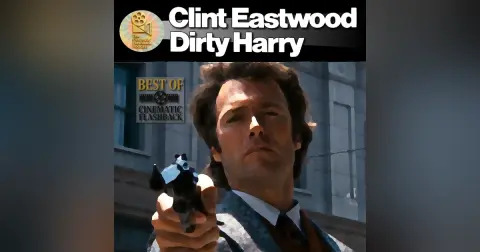
Best of Cinematic Flashback: Revisiting Dirty Harry (1971) You're listening to a Best Of episode of The Cinematic Flashback Podcast. While Matt and I wrap up our summer break, we’re revisiting one of our favorite episodes of the year: Dirty Harry (1971), starring Clint Eastwood and directed by Don Siegel. We’ll be back with a brand new episode on August 14 — mark your calendars. What We Talk About:
- Clint Eastwood’s unforgettable turn as Inspector Harry Callahan
- How the film reshaped the crime genre and launched a wave of renegade cop movies
- The evolution of the “dirty cop” archetype across the Dirty Harry sequels
- The real-world influence of the Zodiac Killer on the film’s villain, Scorpio
- Iconic moments, including the “Do you feel lucky?” showdown and the bank robbery shootout
- The choice of weapons and whether Harry’s .44 Magnum is more myth than muscle
Links & Contact Website:
https://www.cinematicflashback.com
Contact Us:
https://www.cinematicflashback.com/contact/
Listen to Previous Episodes:
https://www.cinematicflashback.com/episodes/
Leave a Review:
https://www.cinematicflashback.com/reviews/new/
Read the Blog:
https://www.cinematicflashback.com/blog/
Subscribe:
https://www.cinematicflashback.com/follow/
Share the Show:
Tell your movie-loving friends!
Other Podcast You Might Enjoy:
- Surely You Can't Be Serious Podcast
- 30 Something Movie Podcast
- A Film By Podcast
- Dockingbay 77
- Def Dave's 1984
- Accidental Legends
- Phasers Set to Stun
- Children of the 80s
0:00 Hey, movie lovers, You're listening to a best of episode of Cinematic Flashback. While Matt and I are finishing up our summer break, we're pulling out one of our favorite episodes that we covered earlier this year, nineteen seventy one's Dirty Harry, starring Clint Eastwood and directed by Don Siegel. We'll be back with a brand new episode on August fourteenth, so mark your calendars. Enjoy us then, but for now, enjoy this flashback. Welcome to the Cinematic Flashback Podcast. Get ready to hop into the wayback machine as we journey through the wild, bold, and unforgettable films of the nineteen seventies. Each episode will break down a classic or not so classic movie with a fun, fresh approach. We'll explore the who's who of each film, dive into the premise and the plot, see how it performed then and now, and wrap things up with did it roof of the decades or did it lose its beat? In today's episode, we are going to talk about nineteen seventy one's Dirty Harry, directed by Don Siegel and starring Clint Eastwood. Joining me again this week is Matt.
1:14 Matt, Welcome back. Thanks for having me again, and we're going to be reviewing a great seminole movie that really set the stage for a lot of movies in the future in the nineteen seventies. It changed cop movies forever. Yeah, it did. It's also sort of introduced normal people to Miranda Rights. One hundred percent. We're talking today about Dirty Harry, the toughest nail San Francisco inspector who's tracking down a serial killer. It was released a December twenty third, nineteen seventy one, directed by Don Siegel. Story was written by Harry and Rita Fink and was polished up by longtime collaborator Dan Reisner. Andy Robinson plays the killer who goes by the name of Scorpio.
1:58 This is about a movie about a couple of killers, Harry Callahan and a homicidal maniac. The one with a badge is Harry. There were a lot of reasons they called him Dirty Harry, and he kept inventing new ones. You don't assign him, stop the murder cases. You're just turn him loose.
2:51 Did you see this one in the theaters? I did not. I was only ten years old at the time this came out, and I think I did see it pretty early on, probably earlier than maybe I should have. I remember it well, but I don't think it was ever on TV, and if it was certainly way cleaned up. Yeah, I mean, it's a little bit racy here and there. And the interesting part about San Francisco has depicted in the movie, is you really spend a lot of time in those parts of the city that were, let's say, catering to more carnal a red light district. Yes, exactly. Yeah, but of course the old saying goes, you go to where the criminals are. It's a great movie. I remember it being different when I just watched it again recently, and it was cool to watch it again recently and say, it's actually a pretty simple film. I thought it was much more complex in thinking back about it, but after watching it again, it's a very simple storyline. It's a cop who's a bit hardened, although I remember him being much more hard boiled than is depicted in this movie if you just take this movie by itself. Possibly in later Dirty Harry versions they made him more hard boiled, but in this one he's clearly a cop who is on the edge somewhat because his partners get injured quite often, and you find out in the movie that his wife was killed in an accident.
4:20 This film sets up the prototype of so many future cop films, both on film and in television, including movies TV shows like N White, PD Blue. I always say that character Sipowitz whenever I think of Dirty Harry. I think my introduction to Dirty Harry, the first movie. There's five movies in the whole series, the latest one being from the late eighties called The Deadpool, which is the one I remember seeing in the theaters. But I know I did watch the earlier ones on videotape, and I don't recall if I really liked one or the other better. But from what I was reading about, the hair Callahan movies drift back and forth a little bit, So if some of the critiques was maybe he played a little fast and hard with the law, or maybe the next one it might have changed a little bit where somebody else was doing it and then he was reacting to that.
5:14 I think this Harry Callahan is probably the dirtiest of the Dirty Harry movies. Yeah, and it's funny. There's sort of a running theme that he gets a new partner because his partner is in the hospital. I'm putting somebody with you. What are you talking about? You need a partner. It's better the partner. I've got nothing except he's in the hospital. So he'll be on a couple of weeks. Say hello to Chico Gonzalez. He'll be working with you. Yep. From a gunshot wound to the gut, which seems to his partner previous to that was actually killed. Yeh. So he's saying, I don't need another partner, and they assign him this young college graduate partner, and that I think that's used in the movie for us to be able to get to understand Harry. He's not just striding around not talking because this character is his low on words and high on action. So you needed a foil of some sort. So this character does that.
6:16 Yeah, His partner, even his partner's wife, helps to pull out some of the details about Harry that we otherwise wouldn't have seen. Right like the death of his You knew his wife was dead, you didn't know what happened, and the wife of the partner, you find that out. The other thing that's interesting is that partner is a good partner if it turns out, if you see they work really well together. Harry lets him drive the car, which in typical cop movies, if you don't trust your partner, he doesn't try to dry it. So I noticed that in the movie is like, he clearly has some trust for this guy after they work a very short time together, which I thought was pretty cool because typically you would paint Harry very one to as being, you know, the gruff. I don't trust anybody.
7:02 This guy's a knucklehead. You don't get that because he lets him drive, and he drives pretty aggressively at points, So they're clearly of one mind how they're gonna do things, which I thought was quite interesting in looking at it in retrospect. And you'll see the same kind of buddy cop pick or when they're partnering up. Like if you think of the first Lethal Weapon movie, you have Riggs who is joining Murtog, and Murtog is the more experienced cop. Riggs is the more unhinged cop. Be as I'm suppose to tell you, you're breathing in a new partner in on this partner again. Yeah, some Caddy's on loan from dope real burnout on the Ragged edge. Oh perfect. Yeah, but you still see that same kind of relationship initially when they're kind of feeling each other out as to whether or not what kind of partner will this person be.
7:51 So I think you can't talk about this movie really without talking about the idea of Harry Callahan's weapon of choice. He's a detective. He's an inspector, which means he's actually higher in rank than Jake. I even have better trivia on that one. What's that? So in the San Francisco Police Department they're only referred to as inspectors. Oh okay, yeah, everywhere else it's a detective. Today in England, an inspector is a rank like a lieutenant, and so that's where you would get increases. But they just call him inspectors in San Francisco, which I'm not sure if it's unique to San Francisco. I was wondering what's the difference between the inspector and the detective, and I came across that, Oh.
8:32 Very good. When I said that John Millius did some rewrites and he polished up the script, he was uncredited, but the things that he brought to it also were some of the bigger over the top things like the choice of weapon that he used. And I know that you know a lot more about weapons than I do. What firearm is Harry carrying here? So Harry is carrying the forty four magnum by Smith and Wesson. It is the Model twenty nine, and I think he had like a six and a half inch or six inch barrel on it, which is quite a giant gun, commonly referred to as a hand cannon. It is not one that any policeman would probably ever carry. And the reason is it's incredibly heavy. It's a giant gun, and it has to be heavy because that load, that forty four magnum load, that refers to not only the diameter of the bullet, but the amount of powder that's in it. That's the magnum. It's a longer shellcasing with more powder in it. So it's incredibly powerful. It's really was designed for having as a side arm when you're hunting bears. It was not something you would carry around the streets of San Francisco. You couldn't run with. It would beat you to death. But it was good in terms of this movie. The other famous part about this is that it is a six shot revolver. They're famously inaccurate because you have part of the barrel as moving, the part with the cartridge in it, and it has to line up per quickly with the barrel. Typically, that doesn't happen. If you really wanted to shoot accurately with
10:05 a gun, you would have some sort of automatic that lodges the bullet into the barrel in the exact same way every time. It's great for a cinema because it's a giant gun, and it photographs well, and it makes a very distinctive sound in the movie. And they do a great job with that because I think the first time you see in the movie he pulls it out during the bank robbery. Oh what a scene. Yeah, that is a great scene. That scene is so classic. I had forgotten a lot of details about this scene. I know what you're thinking, did he fire six shots or only five? Well, I'll tell you the truth.
10:47 In all this excitement, I have kind of lost track myself. But he in this forty four magnet, the most powerful handgun in the world, and would blow your. Head clean off. You've got to ask yourself one question. Do I feel lucky? What do you think they do a great job with this storytelling, because what you find out from the scene is not only that it's an exciting scene and everything, but you find out that Harry is incredibly observant. And they do give us a hint in the movie, because of course they're trying to lead us along, because if you just had Harry go hey, is that car stilightling? You would be like why in the movie they show the guy sitting in the car, they show the cigarettes piling up outside of his window on the ground, so clearly he's been there for a while.
11:29 Harry notices this when he goes into his favorite coffee shop, has some banter with the owner and it gets a hot dog and he wants to finish it. And then, of course you also learn somewhat about Harry as he has the owner call the police and tell him what's going on. And then he's sitting there eating his hot dog, hoping that they police get here, and he says they says that please wait for the cavalry cavali. Hey, before we move forward, When he's walking into the restaurant, did you notice the cinema marquee that he walks by? No? I didn't, Oh, okay, So on the cinema. It was showing play Misty for Me Oh, which was Clint Eastwood's first directorial movie. Think about this though, in the world of Harry Callahan Clint Eastwood exist. Yes, that's bizarre funny.
12:15 I always think those those little inside jokes that they do for each other that it's hilarious. They probably who knows when they were filming it, and they probably had to get the guy to put a markie up say this will be out by then. This is great advertising. I think the locations that they shot on were all over San Francisco due to the stunts with the car and with the shooting and everything. I think this was filmed on a stage on a. Back was it Okay? Well, that's even funnier. So they definitely set that up. It was very purposeful. So I will tell you a funny anecdote about Clint Eastwood movies. My brother was a huge fan of Clint Eastwood spaghetti westerns, right like The Man with No Name and yeah, all of all of Us, all of the Dollars, Yeah, good, bad, and the Ugly. He loved those movies, absolutely loved him.
13:01 And it was funny when you follow Clint Eastwood's career. He basically went out to do it is Sergiet Was it Sergio? Yeah? Spaghetti, the Spaghetti Western, the spaghetti Westerns. But they were they were They're great movies. When you watch it, they're they're super hokey. But my brother just loved him and we had to watch them whenever they came on TV. He would make us watch it. It was pretty funny. It's one of my one of my very treasured memories of my youth is like any Clin Eastwood Spaghetti Western game on, we were watching it. And this went on all through most of my young life. So I knew Clint Eastwood from that. We knew Clint Eastwood from another a bunch of other movies. He was a known quantity for the most part, although not as well known as he was once these series came out.
13:50 He was. He was also on television. I thought he was maybe on on Wagon Train or one of those. Yeah, yeah, he was, or he was some sort of cow poke or something that was That's why he got the spaghetti Western roles, I think is because he could ride a horse. There was something about that. So it's funny. The character of Dirty Harry was originally envisioned to be in his late fifties, like fifty five to sixty years old. Clint Eastwood was forty one at the time. He had been acting for years by the time he got to this film. Like you said, he's very well established. I know we talked about this during the French Connection, but America was going to transitional time, and so in terms of stories that were being told, we were transitioning from the Cowboy movie into the cop movies. I think Clint Eastwood after Dirty Harry, has established himself as the biggest action star, even surpassing John Wayne.
14:46 Yeah, I would definitely agree with that. I do remember some of this undercurrent of large amount of change that was going on in our society, right. There was a lot of people and they make reference in the movies like your hair is too long, you need a haircut. The protagonganist, the bad guy's got a big, bushy head of hair. He looks sort of like what we would term as a long hair, and he's very despicable. We know we can trust somebody who protects children and women. Yes, and you hear about that in the movie. He gets dressed down by the mayor about an alleged rapist, Sir, I don't want any more trouble like you had last year in the film or district understand that's my policy. Yeah, Well, when the adult male is chasing a female with intent to commit rape, I shoot the beast. That's my policy. Intent.
15:44 How did you establish that? Well, a naked man is chasing a woman through an alley with a butcher knife and a heart on. I figure isn't now collecting the Red Cross. I think he's got a part when a rapist is Yeah, it goes, but it gets pretty bad. But the floody part is the mayor is just like okay, I guess, so. You may have a point with I think. Another thing that resonated with the movie going audience at the time was the character of Scorpio. Scorpio is the moniker of the bad guy in the film, and it's heavily influenced by the Zodiac Killer. The name Zodiac was the pseudonym that an unidentified serial killer had taken who was murdering known victims in San Francisco in the late sixties. And the scary thing is that the Zodiac Killer was never caught.
16:40 Well, is that true still? Because I thought they caught him through the DNA tracing. The way in which they handled DNA on the stamps. They didn't handle it very well. Other serial killers that had cold cases were resolved due to DNA. But what I read and what I researched on the Zodiac was now caught. There's a lot of similarities in the Zodiac and with Scorpio, including the Zodiac would send these taunting letters to be published in the newspapers, and if they didn't, he would go on a killing spree or blow up things. He would include these cryptograms and them there were four all together, and two were solved to or not. At one point he threatened to shoot a tire out of a school bus, and as the little children were exiting, he would shoot at them. The symbol that I thought this interesting was the symbol the Zodiac would always sign his letters with the crosshair. At the very beginning of the movie, when Scorpio is about to take his first victim, the first thing you see is he's looking through the scope and the young woman in the pool is swimming within his crosshairs.
17:44 There was definitely some fear, and you can imagine with the Zodiac killer it's all in the newspaper or we're not even on the internet at that point, where, yeah, that makes a lot of sense on audio that hit. And from an audience perspective, I don't think that Scorpio, being one of the astrological symbols would have been lost in They knew right away that this was maybe a stand in for the Zodiac. Killer as well. You had talked about Harry's side arm. Yeah, okay, So I did a little bit of research on the weapons that Scorpio carried, yes, and I found the thing that I found very interesting about this is there's three weapons that he uses in the film. There's the sniper rifle, which is six, Yeah, the thirty six. It's an Arisaka Type two paratrooper takedown rifle.
18:35 Right, it comes apart into a. Case, and that's a Japanese rifle. And then he also has the MP forty submachine gun, yeah, the German rifle. And then he from the store, the liquor store clerk, he takes a Walter P thirty eight, which is also a German gun as well. So the weapons he uses are all access guns. I only looked at that gun really quick that he stole from the liquor store guy. I thought that was a lucre ye, but Walter made a gun that was very similar with a narrowed barrel, so that makes sense. Yes, still a German. If I had not looked it up, I would have said.
19:16 It was a luger. Yeah, yeah, it has a similar look to it. Calling back to our the size of the gun, So a thirty odd six was actually the thirty caliber round point three of an inch, right, and those other to the MP what was it an empty? It was an MP forty. I think that's a nine millimeter round. I'm pretty sure that the forty is point four to zero, but it could be something else, but probably a nine millimeter or something like that. And then that pistol was probably chambered for Did you get the size from the sun No? I did so Walter. It was probably again a nine millimeter or a thirty eight type, so point three of an inch. So it was just interesting to compare that to a pistol that's shooting a point four to four.
20:04 It's his pistols obviously have shorter barrels, so they don't shoot as far and aren't as accurate. But it's just interesting to see the biggest of all the shots were being fired by Harry Callahan. And you mentioned the weight of the Smith and Wesson. Yeah. Originally the actor that was tied to play Harry Callahan was Frank Sinatra, and he. Fit the profile. He was fifty five years old at the time. They were going to get IRV Kirshner to direct the film, so IRV Kirshner. He went on to direct the best Star Wars film ever, The Empire Strikes Back. But Sinatra had injured his hand. He was not able to hold the Smith and Wesson.
20:45 That gun is heavy. I'm telling you, I used to have a three fifty seven magnum years ago with a four inch barrel, and that was a heavy gun, So I can't imagine all the forty four now. Everybody always ask is it's still the most powerful made in the world, and no, it is not. The power of a gun comes from a variety of different things. One is the size of the cartridge and how much weight is in the bullet and how much powder, but also how long the barrel is, so how fast the bullet can get going because of the back pressure, because you know, with a short barrel, once the bullet leaves the barrel, there's no more pressure pushing it down. So that's why rifles have a higher power coming out because they push gas for longer. But that's why you have that pistol with a pretty long barrel. So it was pretty powerful. And he was shooting across the road through car doors and.
21:34 Yeah, he put it was oh man, so he put what in the bank robbery scene, he was able to shoot the driver of the car that was coming straight at him. So one of the things that I picked up on is like when he's eating the hot dog and he's waiting for the cavalry to come, the first thing he hears is prior to the bell of the alarm of the bank going off, you hear a shotgun blast. Immediately he already knows that these are armed criminals. He's walking down the road, still eating and chewing on his hot dog, and he fires at the guy holding the shotgun, and then a couple of the robbers get it into the getaway car, which he shoots and it flips over and it hits and eventually, let's say. In the movie, he fires off a bunch of rounds because no one thinks to count them during that scene.
22:17 I think he's counting it. Oh, he absolutely always knows. Right. You have to know because if you have six, you need to know if he fired six or if he fired five. Oh, he absolutely knew whether he had around aft or not. There's no doubt about it. And we know that. At the beginning, you're thinking, huh, did he maybe not know it? And it turns out he had fired all six and the guys. That one guy says in one version of the script, Callahan puts the gun to his temple and pulls his own. Yes, in this case, it was better. Pointing at it. And he knew for Fiuelli had shot all six. I mean they knew that, So you knew that then. And then when there's a callback, which all good movies have a callback to a similar scene at the end, which delivers beautifully.
23:02 I was trying to count the shots at the end, because knowing how it ends, I'm trying to count how many times and I because they're in this rock quarry with all the machinery that he was not able to follow who was shooting. I got lost in that one. But I'm just going to assume that, based on movie magic and accuracy, that he fired the number of rounds. That he said he found just real quick. Going back to guns and police work, nowadays, policeman carries a lighter gun nine milimeter, usually a glock or something special similar, usually holds up to thirteen rounds. They don't want to have to reload if they actually have to fire their weapon in the middle, whereas a six shooter reloading revolver is a slow process. You certainly have seen that they can reload them quick in some other movies where they pop it open, they dump all the shells onto the ground, but it's very often that a shell doesn't spent, cartridge doesn't come out easy, it's a pain, and then you have to dropped the speedloader in. So the idea of carrying a six shooter is a little bit archaic. Even in nineteen seventy one.
24:07 It did play though, into that idea of him being the modern day cowboy. This wasn't the first movie that Clint Eastwood and director Don Siegel had worked together. Ford helped Wayne mold this persona and then shaped it. I think that John Houston was instrumental in creating Bogart's persona, and I think that Don Siegel was instrumental in establishing Clint's persona. Don Ziegel is a veteran director of Hollywood films. He got his start directing montages for older films. He also directed films such as Riot and Cell Block eleven, Escaped from Alcatraz with Eastwood and the film that I was more familiar with was Invasion of the Body Snatchers, which again gets remade in nineteen seventy nine starring Donald Sutherland.
25:02 He had a very specific kind of character in his films. Often tough and stoic. They're rebellious, they're a bit of a rule breaker. There may be a little morally ambiguous in that they they're not black and white heroes. They're often flawed with some kind of demons or questionable means. They're often loners or outsiders. They're very efficient, and they're very practical, and they have somewhat of a cynical worldview. Does that describe Harry Callahan to a t now, Harry? It's often recognized that he is the more extreme version of the SEAgel hero. For Andrew Robinson, this was his theatrical debut. He was actually picked by Eastwood, who had seen him in a local production of a play called The Idiot, and Don Siegel wanted him because he had this face of a choir boy and his portrayal was so convincing that afterwards he got death threats.
25:56 Yeah, heck of a movie to be your debut, because talk about getting type cast. And he did have that sort of disconcerting, creepy I don't know what it was exactly. There's a scene where he's wearing a ski mask and all the acting is coming from his eyes, and then there's another scene where he pays a person to beat the living snot out of him, and his face is all blurred up and broken up, and all you can really see is the remainder of his eyes and whatnot. And then when they have them all wrapped up afterwards and bandages, you just see his eyes and it just it's always a little bit crazy and unhinged. Yeah, for sure, he does a great job with that.
26:38 It is tough to be an actor who portrays that world. I will say my overall estimation of the guy comes in all beat up like that, like crazy beat up, and then accuses Harry Callahan, and to me, it's we go from that right to holding up the school bus I think they cut something out because it just feels like there should have been like six or eight months or Harry wasn't allowed to follow him was waiting for something to happen, and then a guy finally breaks and he has to go. He beat up, he gets better and he immediately goes out and takes over a school bus. Which that was one of those things where it's like in a movie, while you're watching, you probably don't notice. It, you don't think of it. I've gotten more critical and I'm watching movies. I'm like, yeah, it doesn't really hang for me. And there should have been more trouble for Harry. He might have even had to have lost or been on suspension and lost his weapon or something. That would have been a really interesting turn of events for him because he's so identified with his weapon.
27:35 Sometimes films don't show you transitions. Because there there was a scene where Scorpio gets the knife in the leg and then he goes over to the emergency room and they patch him up, and then Callahan's lieutenant gets the call that hey, we just treated a knife wound in the leg over here, and then the very next cut, Harry is there at the hospital talking with him, And when I watched, I was like, wait, how did he get from point A to point B? Yeah, cut out, we're not going to show it. You need to have film driving. And I get that one, that one's easy to follow. I just think that the one where he where it seems like more time. Why get beat up like that if it's not actually going to really impact Harry in the department. So I think the scene where he's in the hospital after being beaten up was to introduce this idea of accused rights versus the victim's rights. Harry goes to the DA who is saying, haven't you heard of Miranda, haven't you heard of Escabido? And these are all Supreme court cases that were decided within a few years of the movie.
28:34 Of course, Miranda, we all know that, because if you're going to be questioned by the police, you have to be read your rights. And then for Escabedo was about their council during police investigation. And if you think of the scene on the football field, both of those are completely violated. And that's why the das end up letting Scorpio go, which is what then allows him to go to the liquors, which then has him go get on the bus with the kids. So I will point out a slight difference in that, And what they were really talking about was any of the evidence that was gathered after he's kicked in the door without a search warrant was basically null and void.
29:16 So the first part of that, it was the gun that was used, that they had the ballistics they could prove it was his was accessed through kicking in the door. Now I have to say that's where the judge equivocates a little bit, because there was someone's life at stake, and then those what do they call them, those circumstances, they're the rules of being able to enter. So that probably would have been okay. But him actually putting his heel on the guy's injured leg and questioning him without arresting him or reading its miranda rights, that's definitely outside of the rules. But of course Harry's upset about this. It doesn't go crazy because we've very control.
29:58 He's very controlled, but I think control, yeah, But calculating, well, I was thinking, this is the girls, right, but this is the girl that has a limited amount of air supply that is buried. But at this point they're talking to the judge and she's dead. Well, yeah, but when he put his hand on it, when he put his foot on the leg yet. Right now, so I get that I'm talking about. In the scene with the judge and the DA, Harry's angry that they're going to let this guy go. And the reason you find out when he walks out is like, how do you know he's going to do it again? He goes because he enjoys it. So it was one of those things where he's a step ahead of these people. He knows this guy's going to go out. He's trying to save the future person's life who's going to get killed, but they don't seem to care, and he's I'm not going to lose any sleep about him just going to basically get this guy when he does invariably commit a crime again.
30:48 We have a certain knowledge about Scorpio that if this was happening in real life, we really wouldn't know that he is guilty, right, and we may want to play by all the rules. I think one of the appeals of this movie is that Harry is more concerned with justice. It might not be what's legally right, but what is just it's getting back into that Don Siegel's character. Right. A good example of that is going up in the ladder thing just to get the guy who's gonna commit suicide. Aren't you gonna try to grab me? A friend of mine was up about twenty floors with a jumper a few years ago, and jumper grabman. They went off and twenty floors down just mashed them all over.
31:33 The paper couldn't tell which legs group with which and which arms are with witch And it was a terrible miss. I tell you, I almost drew up myself. I just like your name and andress. That's all why. Like I said, it's such a mess down there afterwards, and. It's a It makes identification impossible even if they. Find your driver's license, all that blood and everything. Oh and he goes up there and he just starts telling him what a mess it's gonna be on the ground, Yeah, and basically gross the guy out. And he's not nice about it. He's telling him, he's yeah, that's my god, I'm I'm just trying to tell you this is what it is. Knowing full well, he's basically spooking the guy and then he grabs him and with no ceremony. He's like holding him barely on to the side of that box where they lower him, and he doesn't care if the guy struggles and falls he dies, but he's super efficient because he's just gonna go up there and get him.
32:25 And then at the end of that, which I thought was really telling, is he's talking to the new partner. Now you know why they call me dirty here every dirty jump it comes along. This is the scene that Clint Eastwood directed, and it's the reason why he has a directoral credit on this film. They had already predetermined that Eastwood is a director, and he's going to be way up high, going up inside up this bucket, and they're going to have this conversation with him and the stunt man that's going to be up high, and then they're going to do that stunt where the jumper ends up on the bucket and then comes down. And so between having lighting and a cameraman up there that just said, hey, Clint, you do it, go ahead and direct this particular scene.
33:09 That's great. It just so happened though that Don Siegal was sick that week or that during that night, so but that had nothing to do with it. The studio had set aside on their schedule six days to film this. Clint Easwood sayd I can do it in two and he ultimately did it in one night. Wow, that's amazing. So yeah, and as we know now, I mean looking back, Glinny' still going on to have a stellar career as a director also an actor's director. I don't know if you've heard a lot of anecdotes about how he directs, but he doesn't yell action. He just says go ahead, and actors love that because it's not a shocking transition, it's not a and if you talk, I've seen a few of the videos of saying, work in with Clint is just a real pleasure because he lets actors act and he has very small adjustments since suggestions, and evidently people love that.
34:03 He's an American treasure. The film Dirty Harry was inducted into the National Film Registry in twenty twelve. The other nineteen seventy one movie that had already been injured was The French Connection. These films are selected not as the best films, but as films that best represent the culture in who we are as a people at a particular point in time and side note, did you know that in Culpeper, Virginia is the Packard Campus for Audio Visual Conservation of the Library of Congress. I did not know that. They have a two hundred and five seat theater and they regularly show movies and television, both digitally and on film that you can go up to see.
34:47 I have to do an on site I'm going to do a live podcast. I was searching to see if they had shown Dirty Harry. They had shown other movies that were inspired by Dirty Harry, but I could not find where they had. You have to show up to get you check it. There's no pre booking or anything like that, so you could possibly go up and not be able to get in which case then we go out and have dinner. Yeah, exactly, I have family up there. I talked a lot about some other stuff with the gun. The most interesting part about the big forty four Magnum. They originally reuse a forty four Magnum with a four inch barrel, but when they did some screen tests, it just looked too ridiculous with this tiny little barrel. The actual movie posters show a eight and three eight inch barrel, which is a huge barrel. They actually filmed with a six and a half inch barrel, So it's funny there's all these different sizes that were happening, and that's all sort of cinematic magic right in the poster. They wanted to show how it's so commanding, and in the actual filming, part of it had to do with handling an eight inch barrel is ridiculous. It's so heavy and so hard to get out of the hole ster. I'm sure they moved it back to a six and a half inch barrel for that reason. It's two full in that's a lot of steel to wheeled around, So I thought that was an interesting point about the weapon they chose for this. Again, totally impractical for police work, in my opinion. Do you ask me what my favorite scene was, and I have to say that it's up in the air for two of them. One is the bank robbing scene because I
36:18 just think that was just classic, so classic, and it's out in the street it's big street fight. And the other one is in the mayor's office when he's getting dressed down for shooting this alleged rapist. So the dialogue that happens in there with how he treats the Mayor and the fact that Mayor ultimately has to acquiesce with Harry's assessment of what happened and just goes on with it. But those my two favorite scenes for sure. Yeah. I had a few that I had listed on there, and I think we had already talked about. I had the bank robbery scene as well. I also really liked the Kisar Stadium scene, and I thought what was really really cool about that was when it was pulling out at the end and they obviously had some kind of aerial camera that they were pulling back, maybe on a helicopter, and you have all the nice San Francisco fog.
37:13 It's all before drones, so covering up. Oh yeah, couldn't. I keep wondering. Sometimes they filmed things and and they'll display them in reverse, but they would have filmed them just bringing in. I wasn't sure if they had done it that way, but I thought the whole scene was great for the reasons why we talked about. And another scene that I really liked was where Scorpio goes and pays a guy two hundred dollars to beat the living snot out of him. Yeah, and the last one, this one's on the house. Yes, yeah. And the final scene that I liked was the culmination. But the part that I like is as the buzz is coming off the highway and it's coming down and it's going to turn right and go underneath the bridge, Harry is just standing on top of this bridge and he is the baddest of the baddest cops ever, but he's just standing there. He's caught him. And then he jumps on to the top of the bus and dodges the bullets and.
38:09 Right luckily the bus has a luggage rack on top. Most buses don't have that. You don't have that. But Clint Eastwood did his own stunts for that, Oh did he? That was him jumping off and holding one and all throughout, and I thought that was just an awesome scene. But just when I think of the movie Dirty Harry, the thing that always comes into my mind is just seeing him standing on that bridge. I thought that was incredibly iconic imagery. Yeah. I like the fact that also we didn't mention it, but who's a herring bone woll suit jacket throughout the almost the whole movie. And then he complains when he gets a shotgun blast to the leg. His doctor is removing the bullet the penalty his pants and he says, I'm gonna cut your pants. He's like, oh, you're not.
38:53 I'm gonna take him off. They were twenty nine to fifty or something like that. Well now twenty nine to fifty back in nineteen seventy that it's still going. To have a hole in it with blood. So I don't know why he's so worried about him getting cut out. I think that, you know, we can slide into the commentary with the French connection in this movie. I think the difference with the French connection in this is I think the French connection really shows a lot more of that down and dirty police work that you know, the talking to the informants and the roughing up of people that you didn't see in Dirty Harry. You saw. This guy's a guy of action. He's pretty simple. Things kind of fall in his lap, the bank robbery and he deals with it. You know, he gets some information. He doesn't really shake down a lot of people to get info.
39:45 It doesn't seem like he's obviously friendly with the people, you know, in that red light district because he's in the club, he's in the dance club. He's in the little Diner and they know him. So there's a different, to me, different tenor of what Popeye Doyle was like in New York City, really being that uncomfortable ruffian at every turn. He is like that to everybody, And clearly I think Harry ended up how Harry was because a variety of things, notwithstanding his wife being killed. Let me throw it in this way, I think that French Connection is a police story like Dirty Harry, but it is much more about a realistic, procedural police story.
40:42 So you see how everything is done more or less by the book. They get the court orders to be able to wiretap sal Boca's phone, and you see the different procedures for following and tailing. And the only time you really see that, maybe in Dirty Harry, is when they're first trying to catch Scorpio before he's about when he's taking aim at a couple sitting on the bench eating ice cream and you see that they're stacking police officers, watching rooftops and everything. That's the only time that you really see a procedural thing. But then Dirty Harry is much more. I was surprised that it came out in December, because I think today this would be a summer blockbuster that you would bring out. It felt more popular in terms of it being that's an action film, it's a man of action.
41:37 I think we definitely see that in the French Connection. You know, it's absolutely, like you said, procedural police work, cooperation, all of that. In Dirty Harry, it's more like a night doing single battle, right. You know, there's a little bit of that stuff where they're covering the rooftops, but we know pretty quick that it was dumb luck that they're able to see a guy on a roof about to shoot somebody and thwart that shooting and get on some kind of taiale of them. But after that, it's really we've essentially follow Harry in his single minded pursuit. So yeah, I think that's the difference. I think it definitely calls back to that kind of single gunfighter role that CLINTI. Eastwood known some well for. It's just sort of fast forwarded into modern day or at the time, modern day San Francisco, which was also a character in this movie. Because you see the hills and you see some of the filming and going over those steep hills in Santra. If you've ever driven in San Francisco, you can't forget the hills.
42:37 It's definitely just such a well known, iconic city to see. Yeah. Yeah, So, Matt, I am going to ask you, did this groove through the decades. I will answer you in the following way. When I thought back on it, I thought no. But when I rewatched it, I thought, yeah, yea, this still holds up. This is a great movie and it doesn't really make you cringe. It's great to think about sort of the time in which it came out, But in watching it again in modern I was like, I'm at the edge of my seat because I couldn't remember everything that happened, and I got a little mixed up on some of the other ones. I'm like waiting for something to happen, and it happened in a different movie.
43:21 But it was very enjoyable, So I think it holds up. Yeah, I have to agree. My experience is very similar. It was a long time since I have seen this, and I was really glad that it showed up on our list. However, I was thinking after watching French Connection and knowing that this is more of a not to be derogatory. It's more of a popcorn movie. It's more entertaining, it's easier to digest. It hit me that Dirty Harry established the blueprint of the renegade cop archetype. In fact, it set up the entire serial killer as the bad guy. And you can see in movies such as Lethal Weapon you can see it, and Die Hard you can see it.
44:04 In forty eight Hours. Heck, you can even see a very funny version of Harry Callahan in Beverly Hills Cop with Axel Foley. And of course I cannot forget to mention marrying Cobretti from Cobra, which again is another great role by Sylvester Stallone. It was a great movie. It was fun to sort of take a trip back. And again, like I said, I was ten years old, so I did not see this in the movie theaters. I saw the others in the movie theaters. I'm pretty sure, because they came out in following years. I was already a big Clint Eastwood fan even before that because of those spaghetti westerns and my brother. But they would come on the TV. This is even before VCR. They'd come on the TV and we'd have to watch them and it was funny. So he loved the Three Stooges. He still loves the Three Stooges.
44:53 Anytime the Three Stooges were on, we watch them Saturday morning in black and white. And I agree, I am always up for the Three Stooges. I think that's going to wrap up our episode on Dirty Harry. Thank you Matt for once again joining me, and I also want to thank our listeners for joining us. Please be sure to subscribe so. You don't miss an episode. If you want to contact us, you can email us at podcast at Cinematic Flashback dot com or leave a comment on our Facebook page, the Cinematic Flashback Podcast. Also, we are trying to build this show and we would. Deeply appreciate a review on the platform you were listening on. If you enjoyed the show, please consider giving us a five star review so that we.
45:36 Can reach more listeners. So join us next time as we take the way Back machine to the seventies to explore another film from that decade and. The guys who me and mister Smith and mister Wesson or something like that. I didn't remember that. Do you remember what scene that was? Actually? That was from a different movie. Oh is it? Are we recording now,