
 Spotify

 Amazon Music

 Apple Podcasts

 iHeartRadio

 PlayerFM

 Podchaser

 YouTube
 RSS Feed
Don’t Look Now (1973) — Grief, Time, and Disorientation in Nicolas Roeg’s Psychological Horror (Encore)
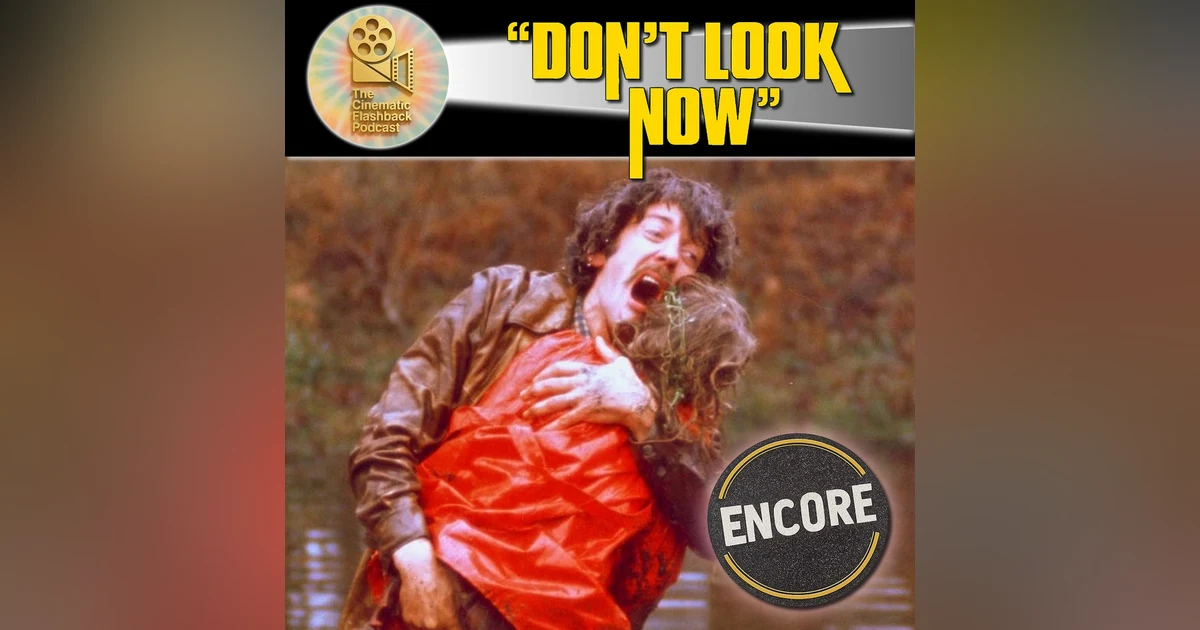

In this episode of The Cinematic Flashback Podcast, Chuck and Matt revisit Nicolas Roeg’s 1973 film Don’t Look Now, starring Donald Sutherland and Julie Christie, and explore why this haunting psychological thriller continues to unsettle audiences decades later.
The conversation examines how the film uses non-linear time, fragmented editing, and repeated visual motifs to create a constant sense of disorientation. Chuck and Matt discuss Roeg’s belief that time is “lateral,” not linear, and how that philosophy shapes the audience’s experience — particularly on a second viewing.
They focus heavily on the film’s central theme of grief, looking at how John and Laura Baxter process the death of their daughter in very different ways: John through work and rationality, Laura through spirituality, therapy, and eventually psychic mediums. This contrast becomes a key driver of the story and its emotional weight.
The episode also breaks down:
- The importance of water imagery, from the opening drowning scene to the canals of Venice
- The repeated and symbolic use of the color red, especially the red raincoat
- How Venice itself functions as a fractured, maze-like environment that mirrors the characters’ emotional and psychological states
- The ambiguity surrounding the two sisters, Wendy and Heather, and whether they are spiritual guides, manipulators, or something else entirely
- The growing sense of dread created by the background murders and the constant suggestion that something is wrong
They also talk about Donald Sutherland’s performance and career, his physical and emotional vulnerability in the film, and how his work in the 1970s helped define a new kind of adult, psychologically complex cinema.
Finally, the episode looks at Don’t Look Now’s long-term influence on later filmmakers, including its parallels to films like The Sixth Sense and Christopher Nolan’s Memento, particularly in how narrative structure and delayed revelation reshape meaning on repeat viewings.
Links & Contact Website:
https://www.cinematicflashback.com
Contact Us:
https://www.cinematicflashback.com/contact/
Listen to Previous Episodes:
https://www.cinematicflashback.com/episodes/
Leave a Review:
https://www.cinematicflashback.com/reviews/new/
Read the Blog:
https://www.cinematicflashback.com/blog/
Subscribe:
https://www.cinematicflashback.com/follow/
Share the Show:
Tell your movie-loving friends!
Other Podcast You Might Enjoy:
- Surely You Can't Be Serious Podcast
- 30 Something Movie Podcast
- A Film By Podcast
- Dockingbay 77
- Def Dave's 1984
- Accidental Legends
- Phasers Set to Stun
- Children of the 80s
0:01 You're listening to an encore presentation of the Cinematic Flashback Podcast. Welcome to the Cinematic Flashback Podcast. Get ready to hop into the wayback machine as we journey through the wild, bold, and unforgettable films of the nineteen seventies. Each episode will break down a classic or not so classic movie with a fun, fresh approach. We'll explore the who's who of each film, dive into the premise and the plot, and see how it performed then and now, and wrap things up with did it groof to the decades or lose its beat? Today we're covering Don't Look Now, a nineteen seventy three film by director Nicholas Rogue starring Donald Sutherland and Julie Christie, based on the short story by Daphne du Moyer. Welcoming back as Matt.
0:49 Sergeant Matt, welcome back, Glad to be here. Ah, we missed you at the midnights last time. I had quite a bit of fun. Oh, I'm sorry I missed it and you have to apologize. I have to apologize for my voice today. I have a bit of a cold, so I have an even deeper voice today, which is hardly possible. I am sorry to hear that. However, we will enjoy your deeper voice today. Hey, Hey, what on earth? Essential? It was Christine, Christine's deadler.
1:30 You're said, you're so sad and there's no need to be. I've seen her, my sister's psyche. You can't contact people, can you. She's trying to get in touch with us, just. Trying to warn us. Don't Look Now as a nineteen seventy three film starring Donald Sutherland and Julie Christy as John and Laura Baxter.
2:17 They are supported by Hilary Mason and Khalia Mattina as the two sisters. The film was directed by Nicholas Rogue, music composed by Pino di Naggio, and was edited by Graham Clifford. You can find this film streaming with ads free on Pluto TV, or if you'd rather rent it, you can rent it from services like Apple, Amazon and others. Spoiler warning. If you've ever seen this film, you know it's difficult to discuss it or the elements of this film without giving too much away. In this episode, there will be spoilers. Roger Ebert said of this film that Don't Look Now remains one of the great horror masterpieces, working not with fright, which is, but rather with grief and fear Matt overall. What were your initial impressions of this film.
3:06 I had never even heard of this film, so it was very new to me when I watched it, and I did watch it in kind of broken up into sections, which wasn't optimal, But then I watched it all the way through. Can you imagine going to the movie theater and just basically going, well, I got to sit through the whole thing, and I cannot. I don't have no rest of it. It would have been a lot different experience. I bring away a kind of a unique view since I kind of saw it twice without resolute once without resolution and the second time with the resolution of the end, which really was impactful because I had had so many questions for both watchings. You know, you figure that on the first watch you're like, oh, okay, I don't really understand what's going on because I kind of start and stopped it. So then I watched it the second time. I'm just as confused until the end. I'm not sure how much other people's experience is anything more than it's a pretty crazy movie. You should definitely see it because it'll probably be a different experience for you. So that's what I think we're going to come away with.
4:01 The gamut of reactions for this film that I have seen runs the whole spectrum. Some people say this is the scariest film I've ever seen, and I'm not in that case either. I've read people say I was bored to tears all the way through up until the end. I might be a little bit more in that camp on my first viewing, but after others were saying that you need to watch it a second time is when I thought the film hit a lot better than it did the first time. Yeah, I would agree with that. I think we get upset when filmmakers sort of dumb everything down for us, right and sort of spoon feed us things. A lot of movies, this is not that film. This is not that film. This film is a film where you go in and you're like, he's expecting a high level of paying attention and understanding what you're seeing. And honestly, I'm probably in the camp of I've been used to being spoon fed so much that the first time I watched I was kind of like, I don't know what's going on here and there's some notes. I need a cliff notes of this thing. And I think movie viewers of the time, we're probably much more. This is a big event.
5:04 We're going to the cinema and we're going to go see this movie. It's not just churn and burn, you know, shoot them up movies. These are cinematic masterpieces being put together, and so it required a next level of attention. So in our recommendations when we talk to people, if they're listening to this, I would say one of the things that you can really do a self a favor on this movie is to really sit down and be prepared to pay attention on the first time. I think you'll get a lot more out of it. Man, I want to play for you a clip of director Nicholas Rogue and what he was saying about Time. We tend to believe in the familiar. We tend to say that's the definite of course, that's the way we run into serious trouble. Time definitely has a linear sense to it. I don't believe it. I believe it's lateral.
6:00 Film made me unsettled the first time I watched it, and I didn't really understand why, and that's because I did not realize that Nicholas Rogue was playing with time, and the movie is told more or less linearly, but there are elements of the film that are out of place, and that created for me a sense of not really sure where I was the first time I watched the film. On the second viewing, knowing that a lot of things started to make sense to me, and it reminded me of the sixth Sense with Bruce Willis, where the first time you watched the film, you really don't know what's going on, and then the last five minutes of the film changes your entire perception of the movie, and then you can go back and watch it again and you enjoy it from a different aspect because now you're starting to see how all the elements begin to weave together.
7:02 And I believe that Don't Look Now also shares that same characteristic. I have to agree with you one hundred percent, and even more strangely for me, as I didn't watch the whole thing through the first time, I watched in sections and I didn't get all the way through, and then I said I'm going to sit down and watch the whole thing because I am so confused and it's so funny because if I had just watched to the end, I would have figured out what's going on in the film, and that's why things don't seem to make sense and really throw you for a loop doing it. I was really kind of like, I don't know what's going on in this. I think it was effective because I didn't really understand that's what was happening. I mean, you always have sent some flashbacks in movies because it gives you backstory without having to do a bunch of exposition, right, so your main character is able to explain why the why they are the way they are without having to actually say the words of you know. And we see this in you know, in classical plays the soliloquy and when the actor sits there and has a long speech to the audience. Those fulfilled basically what a flashback would be doing. Before they really understood the effectiveness of trying to stage a flashback on the stage, you know, they talk about, this is what the person's thinking. How do you show what somebody's thinking? You know? So to me it was like, okay, I didn't care about the flashbacks.
8:29 That didn't sort of set me off, But then everything else was like super disjoint. But I didn't really realize they were disjoint because it wasn't like he was seeing them in radically different clothing or aged like. It's not like a flash forward where you see yourself in the future where you're very aged but the current person is very young. It was all very it's all very neat, it's all very near times. So it was confusing, which was super effective because it made you feel like uncomfortable and not understand exactly what's happened. I got to keep watching and then it started when things going to click in. It really is very It was very satisfying. So one of the major themes of Don't Look Now is how a couple deals with grief, and at the very beginning of the film, a tragedy happens. Let's let's talk about that now.
9:17 Sure. I would also want to tell our listeners this is a is a powerful scene and if you have children, it can be tough to watch. The film starts with the death of John and Laura Baxter's daughter Christine, who is drowning upon that's on their property. No one wants to either childhard though the movie or since you're watching the movie, it's sort of a foregone conclusion that that something's going to happen to precipitate the rest of the movie. You know, in the scene when Donald Sutherland's acting it, he clearly doesn't know that his child is has died, and so you go through all of that emotional, heart wrenching acting, which is, in my opinion, it was excellent. It was excellent acting. But he's he's a master, so to be expected. It sets up the rest of the movie all throughout.
10:04 Some of the imagery established in this opening scene repeat several times in the film. Sure. I think one of the ones we definitely want to talk about is water is huge in this movie. Obviously in this scene they're in the English countryside, but the salient thing that happens is drowning in water in a pond is raining, and when they get to Venice, virtually everything is water. I get around on water. Water is you know, they have to navigate around it because it separated. You can't get away from water. It's a very very powerful part of how that all winds through. I have a little problem with as the movie goes forward. You know, when parents lose a child, I think the last thing in the world they do is take the remaining child and send them off to boarding school. I just don't It didn't ring true to me.
10:52 I think the first thing you would do after you lose a child is cling that other child to you, and because you're just you want to be the protector. So sending them off to boarding school seemed a little weird. And it might have been an artifact of the movie because later on in the movie we know that for some reason we have to draw the Julie Christi character Laura away from Venice, and so that's a good method to do that. But to me, I was like, yeah, I don't think that was gonna happen. Yeah, I don't think any parent I've ever met, if they lost a child, would let the other child just go to boarding school, especially because he was still quite young. So one of the things that I noticed in this particular scene was just the use of sound, and more like the lack of sound in some cases, because when you see John leaving the home, there's really nothing there, and it's not until he dives into the water and comes back up that he just releases this guttural cry as he's holding Christine and I could talk about how much I love this musical score, but right there, as he is crying out, the score comes in with this strong cello, Hugh that you just feel like it's coming so far inside of him as he's trying to revive his daughter.
12:09 I think you're absolutely right. I mean that, and it sets up the tone for the rest of the film. But I mean, then we've just covered the opening scene. But I think it does talk a lot about the rest of the movie. It kind of gives you the feeling the dread and the foreboding even though things look like they're going well on the surface, and things like that. Well, one other aspect of the music that I wanted to point out was the piano piece that's playing at the very beginning. It's played as if it was played by a little child. It's a little choppy, it's very simple, and it's as if somebody was reading it for the first time as they were playing the music. Maybe this is Christine playing a song as we go through the movie.
12:54 That melody keeps coming back through the film, getting stronger and bigger and more completely all the way up to the very final moments of the film. That's good observation. It probably was lost on me a little bit, although I feel like it was just yet one of another thing that was sort of building, that uncomfortable progressing dread. You know, we're doing movies of the nineteen seventies here, and I think this is a great example of what was generally happening. One of the reasons we picked the nineteen seventies is so much was happening in cinema at that time, so many changes, so much X experimentations, And this movie is a good example of that because it really the blurred genre. Is it a psychological thriller, is it a horror? Is it supernatural? You know?
13:46 What is it? And and there are other movies that came out, The Exorcist and some other movies that came out later sort of exploring some of those same things. They deal with something that movies didn't deal with a lot, which was grief in psychological issues that would go on serily. Laura's obviously in therapy or because we see in the scene later on where she's like, I feel like I'm cured. Listen, I'm perfectly all right, and I haven't done as good as this in months and months. I feel really fine. I don't need pills. I'm not going crazy. I feel really great. And then you've already covered a lot of the techniques and the sound which was amazing, and there's a lot of ambiguity, which wasn't really a thing until the seventies came along. So the movies were you know, Act one, Act two, resolve in Act three and everybody's happy, and they leave, they leave the theater.
14:40 We'll take a quick intermission here, just enough time to grab some popcorn or top off your drink. You're listening to the Cinematic Flashback podcast. Stay tuned. The show continues right after that, and we're back. I hope you enjoyed that brief intermission. Now let's roll the next reel and get back into the conversation. Okay, So now the movie shifts from into Venice, where John is working on a church restoration, and we're also introduced to two additional characters who will play throughout the rest of the film, Wendy and her blind sister Heather. And Heather has the gift to second sight, and in the bathroom, she tells Laura that she has seen their daughter Christine sitting between her and John.
15:24 I hope you don't think is rude? Rude? Why I mean staring at you out there? Well, franctless stare is a two of us comes from living in the country. You know, country people. Oh, misty more, I'm Frctice. Sorry. Oh well, I didn't know Stephen, if you were any. Kind which I e. Is it tear the lift one? Well, let me help. How can you hilp? I can try? Oh no, just tie up. The last time you tried poking the foul. Perhaps I can help. Do you think? Oh that's awfully kind of you. My sister's blind. You see, You're. Said, was so sad, and there's no need to be. My sister's psychic.
16:05 She wants you to know I've seen her, and she wants you to know that she's happy. I've seen your little girl sitting between you and your husband and she was laughing. Yes, oh yes, she's with you. She's with you, my dear, and she's laughing. She's wearing. A shiny little man. Christie. Oh, but she's loving. She's loving. He's happy as can be. They claim to see a little girl, They claim to relate that everything's okay. A drowning of a young victim in a young family is fairly unusual. And then for them to move to Venice. Remember those two ladies were from England as well, and they were in Venice. It could have been that they just knew. So there is some ambiguity where you're like, are these just a couple of grifters who are going to try to play a scam and get some money from you know, Laura and capitalize on a grief. So you're immediately you're suspicious. Yes, you're suspicious. Immediately it was like the whole scene, I'm going out. I don't believe it. I don't believe it. Oh, so the prediction was the daughter that you recently lost that you're absolutely grieving for, is happy and fine. Talk about a receptive audience, right, You're going to go to someone and say the daughter that you recently drowned in
17:37 your pond blames you and hates you. No one's gonna say that. So the setup for that thing is you're immediately supposed to be skeptical because it's such a patent, you know, truism that you would tell is that, oh, your poor daughter that just passed away cares about you and is happy and you know all those things you want to hear. And now if just for a few more dollars, I can I do a poem reading for you and tell you what's going to happen in the future. You know, Well, what I think it really shows here is that John and Laura are handling their grief differently. John is almost ignoring it and he's just throwing himself completely into his work, while Laura is trying to process her grief through counseling or through spirituality, trying to address it with religion, and now she's moving more into the mediums and seances. But you notice that all the men in the movie tend to be very pragmatic, while the women of the movie tend to be base less on what you can physically see, touch and more with what you can't see.
18:40 I would agree. I would agree with that. I think it's a good observation, and it also might be a people hate to say it, but it might be something that's sort of true in a lot of cases that men handle their grief in one way with action. Women who are more thoughtful, generally more verbal, really want to talk it out, so they tend to handle their grief in another way. And again that's not a universal rule or anything, right in this particular story, that's how they were characterized in it, and it opens up the door for those two ladies. So, Matt, what did you think of the way the film used Venice as a backdrop. I thought it was effective, especially when you take in consideration the opening scenes with the drowning of the little child in the rain and in the pond. And I think Venice is like another actor in the movie because that she throws up lots of problems of navigating trying to get from one place to another, because you know, there are a couple of chase scenes and Venice really kind of throws a monkey wrench into chasing someone the way.
19:37 Now we went over this bridge already. Well, I never mind it being lost in Venice. Down here. If we take a second left and we're going to break Oh yeah, yeah, nice, dark littlely. What I found interesting was normal when you see movies with Venice in it, you're always seeing all the big touristy spots. I really felt like that I was seeing the back alleys John and Laura get lost as they're going to dinner. Even the city that you're in is fractured. It felt fractured, is what it felt like to me. I think that's right on one more question, did you notice the use of red throughout the film?
20:21 I mean it was a touch point in terms of the little girl when she drowned, was wearing a red raincoat, and then the person that you see around Venice it was wearing a red raincoat. And then there's I think there's red on the slide of some of the pictures. So it definitely sort of was the thing that kept a callback. One aspect that you had mentioned about the color red or the bright coloring of the red was when it was the muted colors of everything else, so that it really pops. And all throughout Venice there were signs with the same shade of red was being used, and it was very purposeful whenever it was put up there. Yeah, I think there's definitely a lot of thinking about how that color is going to play.
21:05 I really feel that this had some influence on M. Knight Shyamalan, Oh for sure. Yeah, especially you know in the in the sixth sense where red plays a plays a big role. In So another element that is driving the story is that there have been a series of murders happening all along the canals, and throughout the film, John and Laura come across different scenes where a murder has recently happened. What what is it you feel the killer on the Lucy murderer My wife is not a well woman.
21:51 Than Sai. Murder squad, and that generally adds to the foreboding nature of what's going on. And you're now worried about your protagonists. Do you think Laura is being duped by possibly somebody that might either want to steal from them or do harm But it's sort of it's very it's somewhat low key. You get to understand that some bad things are happening, which comes into play later. The general feeling is things are not one hundred percent aligned. There's an undercurrent of stuff happening that really throws you off while you're watching the movie. So when they get back to their hotel, we now come to the scene that perhaps this movie is most known for.
22:34 Yeah, I think a good a good point on that, just to not to interrupt you too much, but part of it is that you know, Laura's talked to these ladies. She believes them, she believes her child is happy and everything's okay. So she's sort of renewed, right, She's she's she feels good, and she's in my you know, My estimational thing is that she's ready to reconnect with her husband, and they do it in a fairly graphic way. Now, remember this was the nineteen seventies, you know, so free love and all kinds of things like that, and you got to sell tickets into a movie, and the actors were willing, so we have some pretty graphic I mean, it's tasteful, but it's pretty graphic.
23:17 Matt. Did you know the only difference between an X and an R rating is about ten or thirteen frames, because that's ultimately what they had to trim out in order to not get an X rating for the film Because of this scene. Warren Batty, he had dated Julie Christie for a long time, attempted to have this scene completely removed, and even as recently as twenty eleven, an executive of Paramount at the time I believe his name was Peter Bart had written a book in which he claimed that he was on the set and that the act was real, but Donald Sutherland had refuted that and saying you. Anyways, there was no way that he was everone on the set because it was closed, so Peter Bart wasn't even there at the time. But it just goes to highlight the mythology that has arisen around this particular scene.
24:10 Yeah, maybe a movie matching me, maybe pornography, But the thing for me is it's not disjarringly inappropriate for the movie because if you're real, I mean, the movie is you know, really throws you all over the place, and this is yet one more thing that kind of throws you off. And so it's effective in that suse. I think we also have to look back in Like I said, it's the nineteen seventies and it just come out of the nineteen the sixties and the Summers of Love and all this other stuff, and they felt like American cinema viewers were ready to go that next step. And it was definitely a movie pointed at adults. The part that made me laugh though, there was one thing. There's one quote. There's there was one line that Laura had said to him, something about, oh, there's something on your side or whatever, and he looks down and she's making a comment I guess about his love handles, and I found that somewhat funny because he was skinny as a rail in this film. Like I said, I think I saw more of him than I really cared to see.
25:09 But he was very, very very skinny at this time. Before we move forward, I do want to mention that Donald Sutherland passed last summer, but in the seventies he starred in over twenty seven films, including Mash Start The Revolution Without Me, Kelly's Heroes, The Actor of the Heart, Alex In Wonderland, Little Murders, Johnny Got His Gun, Clute, Steelyard Blues, Lady Ice, Don't Look Now, Alien, thunder Spies, The Day of the Locust, End of the Game, nineteen hundred, Fellini's Casanova, The Eagle Has Landed, The Kentucky Fried Movie, The Disappearance, Blood Relatives, Animal House, Invasion of the Body Snatchers, The First Great Train Robbery, Murder by Decree, A Man, a Woman and a Bank in Bear Island. You could do an entire podca cast solely on the films of Donald Sutherland, to.
26:04 Call it to another movie. Unfortunately, it was a movie in the nineteen eighty so we can't review it. But it was called Eye of the Needle. I don't know whose co star was in that film, but there is a lot of He meets a widow lady or a possible widowed lady up in the Shetland Islands, and he's a German spy and they have a relationship in there. It's very thrilling. That's a great movie, even though it's not the nineteen seventies, and the Eye of the Needle with Donald Sutherlan is fantastic. So I recommend that. Well. I am a big always have been a big Donald Sutherland fan. He has a really unique look at it about him. I think he's a wonderful actor. And definitely an actor that will be missed. Laura continues to meet with Wendy and Hillary, and against John's wishes, she goes to the Sisters in an attempt to contact Christine from beyond the grave. However, Laura gets a warning that John's life is in danger.
26:57 Sunday afternoon, just finished lunch, something strange. John just suddenly got up and rushed down to the pond, almost as if he knew something was. Gonna Well, he's too late. He's strange, yes, of course, but of course he has the gift. Well, that's why the child was trying to talk to him. He has the. Gift, even if he doesn't know it, even if he's resisting it. You can't ever contact people, can you. They all want a lot of mumbo jumbo about dicto pleasant and holding hands. Second sight is a gift from the Good Lord who sees all things, and I consider it an impertinence to call his creatures back from rest for our entertainment.
27:49 Wouldn't be for my entertainment. God's not going to be sick. I grew them just not listening. I Am not going to be sick, all right, John, and listen. Heather the blind bun, she is really psyched. She has second sight. I mean, you'd understand completely if you'd today. When I was there, she went into the most incredible trance. Really concentrate no, John, guys. She said that. That your life is in danger while you're in venice. She kept on and on and on, saying, I am going to be sick.
28:30 I've never been to a seance, but my guess is they're meant to sort of weird you out and be weird, and this one fits the bill on those. I mean, it definitely looked like it was a full body experience for the ladies. And I think, again, this film is showing you that, hey, the way that the seances are happening with these ladies are nothing like it. But what they learn is they learned that Christine has actually been there to warn that John is in day and that he needs to get out of Venice as quickly as possible. And Laura's gets this information and then she basically starts off on we need to leave. John doesn't necessarily want to leave because he could take some time off, but it's not going to be until like the weekend before he can do anything. And that night they get a call from Johnny's boarding school saying that Johnny has been injured and they need to come home.
29:26 And I think earlier when you said why would you send someone to boarding school, I think this is the whole reason why they sent him to boarding school. Yeah, I think it was a little bit of a device to get Laura away from John. Whenever we watch these movies back in the nineteen seventies, you know, we live through it, so we understand that you didn't just have a cell phone in your pocket and you could just pick it up and call the person wherever they were, maybe even on a plane. So there was it was a long period of time before there was any hope of communicating with Laura in England. So during that time that Laura's in Communicado, something very big happens. Will Paul's here for just a moment. Think of it as a real change stick around. There's more cinematic flashback coming up right after this, and we're back. The lights are down, the film's rolling, and the final act begins.
30:12 Let's jump back into the cinematic flashback podcast. John returns to the church where he starts to look at some of the mosaic they'll be replacing, and John at this point says like, well, you know what I'm just gonna I want to make sure that they all match. So John goes up on what I have to call the world's worst. The world's sketchiest scaffolding, the. World's sketchiest scaffolding ever. It's this hanging platform on ropes that he has to have people pully him over into position. As he's looking at the differences in the original and the new tiles that he has, when a board falls through the glass on this rickety platform. He's hanging on by one of the ropes a good twenty feet above the floor of the church. Meanwhile everyone trying to pull him back on and he's just spinning and they finally they get him on. John's thinking, okay, this must have been in.
31:07 This was the danger. I was warned of. Something interesting about that scene. Did you notice you never cut away to a stunt man. No? Yeah, So the stunt man said, no, I'm not doing that. You don't have the proper insurance set up because that's not just a floor, that's the marble flooring of the church at the very bottom. An unforgiving surface, and the way they shot it, the floor is in focus all the time, so you couldn't put a big mat down there. So Donald Sutherland, I'll do this. And they wired him up with a rigging that they use in stage productions to fly. It's called a Kirby wire. And you probably know all of this from your day. I remember them, but I do know that they did that because he is actually holding a rope, but they use the Kirby wire just in case he actually loses his grip, which is highly likely.
31:54 And so later stuntman they were talking about this film, and he said, you were wearing a Kirby He was surprised, he said, because they kept spinning you around Kirby wire's break when you do that. The actor was actually really in danger. It's a great scene. It's definitely a very exciting scene in the movie, and one of the reasons why this movie is so great, because it's builds up to a lot of stress. This happens, and really for a good long time, you're like, is he going to be able to hold on long enough for them to start swinging him over? If they can grab him, nobody can really get him. You're on edge. You're on edge. So right after this, they are like, three things that happened. Number one, the bishop tells them, ah, my dad he died in a fall. It's like, oh, okay, great, didn't need to know that, but thank you. The second thing is that while the Bishop and John are walking beside the canal, they come across another homicide scene. And the third thing that happens is that John is on the Grand Canal and suddenly he sees Laura and Heather and Wendy on another boat heading in another direction.
32:54 It only gets a glimpse. It's a glimpse and John is like absolutely confused, as if, wait a minute, it's my wife back. Did she miss her flight? Why? And why is she with the two ladies. So there's a lot of time spent now where John is trying to locate Heather and Wendy and possibly his wife. He goes back to the hotel that they were staying at to see if Laura had come back there. He eventually goes to the police. He gets sketches and he's trying to retrace his steps to find out where the sisters were living. And then John makes a call to the boarding school to check in on Johnny, and he is shocked when the headmaster hands the phone over to his wife, Laura. Right, and I will also point out, as an audience member watching the film, you're absolutely convinced that was Laura on that boat and the two ladies. There's no doubt in our minds, no doubt he saw was the wife and the two ladies. So once he's talking to Laura at the boarding school, you're just discombobulated at this point, going what is this guy losing his mind? What's happening?
33:55 So now we have Laura who's on her way back, and John, trying to correct his mistake, goes back to the police station, where he finds that Heather has been arrested and she's in holding. Heather is released to John, who takes her back to her apartment, where they find Wendy is already there. Heather goes into some kind of trance and Wendy ushers John out very quickly. They found your wife. Then, yes, it was the killings, and it's. Explained everything to me. Have we got drop a whiskey to offer? Mister Bexter, You will stay a minute, won't you? Yes, the ministers we've got for Jesse. Next Tony. Wait wait is there anything I can do.
34:38 That that'll be all right? Ah ah. Wait wait. Wait, please please. Let him not go, Matt. This is one of the points of the story where time didn't quite make a lot of sense to me, because I felt that Laura got back to Venice very very quickly. In fact, she is arriving at the hotel where Heather and Windy are staying just moments after John has just left, and as John is leaving, he sees a little girl wearing a red rain jacket. He starts to follow after her, and Laura comes out and now she's following after John.
35:31 So I mean, I think it leads us to a big, you know, a big culmination, and I don't know if we we want to share that. It's okay, it's okay. I have a friend. I won't hurt you. Come on, Donnie, Matt. I couldn't spoil the end of the sixth sense, and I don't really want to spoil the end of Don't Look Now. Yeah, so a great movie in my opinion. Did Don't Look Now groove through the ages or did it lose its beat?
36:12 I would say it definitely grooved through the decades, and it's a great movie now. I think it was a great movie then I think maybe it's possibly a little greater now based on the retrospective of how much it influenced movie making. I had never seen before. I hadn't even really even heard of it. So for me, it was a real experience and an eye opening one, and I enjoyed it. I won't say it wasn't an easy I mean, it wasn't difficult. It was just it was challenging, I guess, but it was well worth it. I think this film does grow through the decades, primarily for the same reason that you said. It had such influence on other directors and other films that we've enjoyed.
36:54 I know we talked about in Night Shyamalan, and although I never saw a direct influence reference by him, I did see influences by Chris Nolan on his movie Momento. He has the credited Nicholas Rogan in this film for some of the influences that it had on his movie making. So again, I don't think this is going to be a film that's going to be uh, one of my regular rotation. I think it's a little too heavy for that. Once we're done watching, this will be a film that I do recommend to people. But as we said during our conversation, we have to we have to recommend it with a You got to know that there is a scene in here that may not play well if you're trying to watch it with a family or something. We can recommend breaking Away for everybody. This one, this is this is a smaller audience.
37:40 Maybe this is definitely like one of those movies like Algebra two Trigg in middle school. You definitely need to take it, but you probably don't want to go to retake it. It's important for your film education. It possibly isn't one that you want to go back and see again, although if someone wanted to see it, like someone said, oh yeah, you watch it with me, I watch it again for sure, but I'd be hard pressed to sit there and not go got to pay attention to. This the experience for somebody who hasn't seen the Sixth Sense before. And you're going with somebody who has seen the Sixth Sense before, You're keenly aware that they are looking at you to see what is your reaction to this in the entire time? Did you get it? Hut? Did you see a little over there? You know? And you will do the same thing for others when you watch this film with someone who hasn't seen it.
38:25 And Matt, thank you again for joining me on this journey. And I also want to thank our listeners for joining us. If you want to contact us, you can email us at podcasts at Cinematic Flashback dot com or leave a comment on our Facebook page the Cinematic Flashback Podcast. Also, we are trying to build this show and we would deeply appreciate a review on the platform you were listening to. If you enjoyed the show, please give us a five star review so we can reach more listeners. So join us next time as we take the Wayback machine to the seventies to explore another film from that decade. Mm hmmmm.
39:09 Well, Donald pleasants, it's it's already funny. You and I have to don the Sutherland Take two