
 Spotify

 Amazon Music

 Apple Podcasts

 iHeartRadio

 PlayerFM

 Podchaser

 YouTube
 RSS Feed
Duel (1971): Spielberg's Road Terror Classic
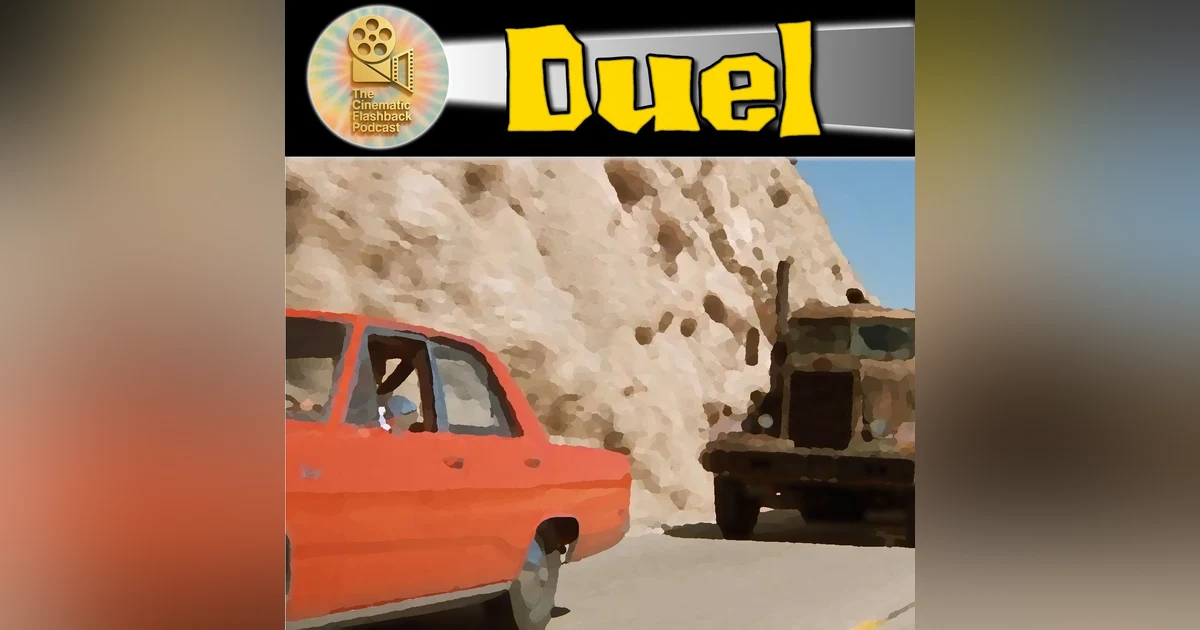

In this episode of the Cinematic Flashback Podcast, Chuck and Matt continue their Origin Stories month with a look at Duel (1971), Steven Spielberg's breakthrough television thriller starring Dennis Weaver.
What begins as a routine business trip through the California desert turns into a terrifying game of cat and mouse when an ordinary salesman finds himself relentlessly pursued by a mysterious tanker truck. With a simple premise and minimal dialogue, Spielberg creates a tense thriller that still holds up more than fifty years later.
The hosts discuss:
• How Richard Matheson's real-life experience inspired the story
• Spielberg's early career and the road that led to Duel
• Dennis Weaver's performance as David Mann
• The truck as the film's true villain
• The differences between the television and theatrical versions
• The film's connections to Jaws and Spielberg's later work
• The practical filmmaking techniques that helped create the suspense
They also talk about the ABC Movie of the Week, the challenges of making a film on a tight television schedule, and why Duel remains one of the most memorable made-for-TV movies ever produced.
As always, it all comes down to the final question:
Does Duel groove through the decades… or lose its beat?
Links & Contact Website:
https://www.cinematicflashback.com
Contact Us:
https://www.cinematicflashback.com/contact/
Listen to Previous Episodes:
https://www.cinematicflashback.com/episodes/
Leave a Review:
https://www.cinematicflashback.com/reviews/new/
Read the Blog:
https://www.cinematicflashback.com/blog/
Subscribe:
https://www.cinematicflashback.com/follow/
Share the Show:
Tell your movie-loving friends!
Other Podcast You Might Enjoy:
- Surely You Can't Be Serious Podcast
- 30 Something Movie Podcast
- A Film By Podcast
- Dockingbay 77
- Def Dave's 1984
- Accidental Legends
- Phasers Set to Stun
- Children of the 80s
0:01 I want to cut it out right, just just cut it out. Okay. So wow, now come on, I mean, please, I don't. Let's not play games. Well, how are you talking about? I'm called please? Do you think that I won't? You know, mister, if you think you can take that truck, if you wis and just use it as a murder weapon, just killing people on the highway, you're wrong. You've got another thing coming.
0:46 Welcome to the Cinematic Flashback Podcast. Get ready to hop into the wayback machine as we journey through the wild, bolt and unforgettable films of the nineteen seventies. Each episode, do we break down a classic movie or forgotten Jim seeing how it performed then and now, and wrapping things up by asking did a groove for the decades or did it lose its feat I am your host, Chuck Bryant, and today we are reviewing Steven Spielberg's nineteen seventy one thriller Duel starring Dennis Weaver. This is our second film in our Origin Stories month, where we focused on the first films of directors in the seventies. Last time, we looked at George Lucas's THHX eleven thirty eight, and this time we are focusing on Steven Spielberg and I am looking in my rearview mirror and writing my bumper is Matt Sargent. Matt, welcome back Burg.
1:43 I'm coming right up with you. Chuck. Yeah. Oh, I'm so happy to be doing this origin series because it casts a lot of light on how these directors we might call their formative films that certainly they weren't watching the movie of the week or something with the family and would have been a movie that we would have watched. I'm surprised that we didn't see it. It probably came out at some time or something or other that we weren't watching, because back then you didn't have DVRs or VCRs or anything like that. You watched it when it was broadcast. Matt, in our very first episode of the Cinematic Flashback, you used a phrase that I had never heard before. It was appointment scheduling television. What did you mean by.
2:24 That, Well, it's like, you know, you knew when when mash came on it was at a certain time on a certain day of the week, and everybody made sure they were available. I mean that went up until my college years because we watched Magnum Pi on Thursday evenings at my apartment in Harrisonburg. My best friend from college and still very very good friend of mine, probably still my best friend. He would come over to the apartment and we'd watch Magnum Pi. And a lot of people had shows like that obviously, you know, there were soap operas that were on every afternoon that people watched. That sort of thing very common. Sometimes the ABC movie the Week was actually a theatrical film that they had cut for television. That's how I saw.
3:04 A lot of the films were rated are, but they had been sanitized a little bit. Yeah, they sometimes sanitize them for content, but also they would cut them to fit into the available time slots and commercial breaks. So one hundred and twenty minute movie with commercial breaks might be way too long to broadcast, so they would cut out. So that's where a lot of and I believe I remember hearing stories about directors saying, I won't put my film on TV because it'll they'll just chop the butcher it, yea. And they feel like they've already cut it to the bone to tell the story they want to tell, and they just can't imagine cutting anything more out now. I think we've all seen a few films that could bear with a little cutting out in the middle. So again, an artist in this craft might sometimes not always be compatible with selling.
3:52 So well, great, I'm sure we're going to talk more about made for TV movies today since this is the topic of movie that we're watching. Matt, who do we have talking to us today? Well, I'm happy to report that we have Maddie B. Nineteen and that is not me. I did not make a suit about that. I did not make a pseudonym to make a comment. Guys, listen to last episode. We had a comment that was a little more critical. This one's a little more positive. So we like to mix in the good with the bad. So here we go. So he brings a quote from one of our favorite films, Dirty Harry. He left us five stars, thank you very much and says quote, do you feel lucky? The podcast is informative, fun and insightful. If you're a fan of seventies films, you just hit the jackpot. The logo is really good as well. Thank you, Maddie B. Nineteen for that review. We really appreciate it. We hope you tell your friends that you like the podcast and you find it somewhat pleasurable to listen to and somewhat informative. That's what we're here for. To have a little fun and to sort of spread the good word of some famous seventies films and a new light and sometimes some maybe not so well known seventies films.
5:02 So that's the mission. That's the first time anyone has ever commented on our logo. To be honest, I think I found some clip art and it eventually evolved where I thought of putting a TIEDI item behind it. That's the evolution of that logo. I feel strongly that our listeners are going to now take some of our podcast, go to an ai and generate us a new logo and then post it on our reviews and we will look at each of those logos and have some fun with them. That's very good. You guys can use your own tokens to generate those logo or send us the prompt you know exactly. So we are looking at Steven Spielberg's first film, and I know, Chuck, you always have a lot of information with a little bit of backstory. How did this movie happen?
5:53 Matt. To rightly discuss how this movie happened, we have to go back just a little to nineteen six when Sid Sheinberg joined the television division of MCA and Universal. Now Sid is important for a couple of reasons. One, he became one of the key figures of modern television entertainment by popularizing the concept of quality made for TV movies. The other reason is because of a short twenty six minute film that he watched called Amblin, directed by this young English major attending cal State Long Beach. That student, as you may have guessed, was Steven Spielberg. While Amblin may have been his first film shot on thirty five millimeter film, it was not his first film. Spielberg had been making movies since he was a kid, and what Sid Sheinberg saw was talent, and he offered Spielberg a seven year contract to come work for him in television.
6:49 His first television episode was for the Rod Sterling anthology series called Night Gallery. The episode Spielberg was a sign was called Eyes and Joan Crawford. I remember more than anything else, the first day of shooting. The crew had a very antagonistic reaction to my involvement as the director of the show. Because in those days we're talk about nineteen sixty nine, the crews the average age was fifty to fifty five and sixty. And these crew members who worked with all the great directors, they worked with capperin Sturges, they worked with Hawks and Ford, they worked with CB de Mill And I remember Joan giving a speech and standing up and saying, I have great respect for this director. I've worked with him before a Small White Life, and I want you to treat him as well as you would treat me. Well, we're all professionals. And I don't forget that speech he gave to the whole crew. And from that moment on, not only did the crew should be better, but Joan treating me like I've been directing for fifty years. She I guess just imagined I was George Kukoor.
7:50 But Spielberg is only half of the equation. For the second half, we have to leave the seventies and go back to Friday, November twenty second, nineteen sixty three, the day that JFK was assassinated. Writer Richard Matheson was playing golf with a friend when he heard the news. The idea for Duel came to me on the day that President Kennedy was assassinated. A friend and I were playing golf over in Filmore, and when we came in for lunch, we heard about the assassination, and we were so distressed by the news that of course we forgot about the golf game and started going home. And as we were going through this narrow pass on the way back home, this huge truck started tailgating us, and we went faster and faster. He went faster and faster, and we were screaming out the windows, with as much fury about the assassination as about him trying to kill it.
8:49 And finally my friend pulled off into a dirt siding and his car spun around, and this truck went flying past, and we were really shaken up by it, but having the true writer's mind, within a few moments, I thought, ah Man gets chased by a truck, and I wrote on an. Envelope That incident led him to write a teleplay called Duel, but no studio wanted it. Matheson adapted the story to a novel lette and found it published in Playboy magazine in March of nineteen seventy one, and this is where Nona Tyson, Spielberg's assistant, spotted it and brought it to his attention. But Spielberg was considered too inexperienced. Fortunately, he had advocates like Sheinberg and Duel's producer George Eckstein. Based on his television work, Spielberg was already employing techniques by two of his heroes, John Fordes and Howard Hawkes. He would use wide shots to establish a scene and then close ups to tell the narrative. The film was so affected that Universal later financed additional scenes so it could be expanded into a theatrical feature for overseas distribution. Today, Spielberg's production company is still named after his short film Ambling and the relationship between Spielberg Sheinberg. In Universal, it became one of the most successful director studio partnerships in Hollywood history, producing films like Jaws Et, Jurassic Park, Schindler's List, and many more. And Matt, that is how this film happened.
10:20 That's an amazing story, and it's cool to get that background on how it kind of came to be and that it was a little bit of a test case and they picked the right guy. It would seem as a director. The story is is that he only had ten days to shoot duel. That's amazing, and he did it in thirteen and because of how efficiently he shot the first three days and they were seeing how quickly he was shooting that thirteen days was not a problem. That's amazing. And I mean it goes to the thing. It's like it's a TV move it the movie. The budgets are smaller, the time frame that you can shoot in. And we talked about the size of the screen. Nowadays, people don't realize that when you were watching film, you know, something on TV in the nineteen seventies, you weren't looking at a four K image. You were looking at you know, with five hundred and twenty five lines of resolution or something like that on a sure you know, it was just not of high resolution screen. So the idea of wide shots is exactly what they're saying. You always had close ups. That's why the soap operas and personal drama films where you had close ups of everybody face has worked really well because that worked great on that format.
11:28 So it was a real it was a real trick for him to get something this exciting in that format and have it so well received by the by the watching public so well. With that said, I think we're just about ready to get into production details. But before we could do that, we need to take a quick break. Back and amatic flash back the.
12:10 Movie of the Week presenting the world premiere of an original motion picture produced especially for EBC. Tonight on the Movie of the Week, you are man hit that car head on Dennis Weaver, Open Jack, I've read why why is he doing this?
12:51 Feel welcome back. Let's go through the production details. Duel originally aired on November thirteenth, nineteen seventy one, as part of ABC's Movie of the Week. It was later given an international theatrical release by Universal, with additional footage bringing the running time from seventy four minutes to ninety minutes. And what is remarkable here is that Duel was made for around four hundred and fifty thousand dollars. The film was directed by a twenty four year old Steven Spielberg and what essentially was his feature film debut. The screenplay was written by Richard Matheson, adapting his story that had originally appeared in Playboy magazine. Earlier that same year. Duel would be Man's last short story. The cinematographer was Jack Marta, and Spielberg insisted on shooting out on a real desert highway in California, even though the production team thought that the schedule and budget were just too tight to make that practical. The entire movie was shot in roughly thirteen days.
13:51 As a note, Matt Spielberg would make this same decision later when he decided to shoot Jaws not on a production studio backlot but out on the open ocean. Yeah, and Martha's vineyard right exactly. The score was not composed by John Williams. That relationship would start in his next film, The Sugarland Express. The score was composed by Billy Goldberg, who had already worked with Spielberg on television projects before Duel. Spielberg did not want a musical score. He wanted noise. For my money. This score reminded me a lot of Bernard Hermann's music from Psycho. And there is very little dialogue in this movie.
14:32 Yes, it's definitely a movie of action and things happening. Necessarily, Also, this movie is limited to really to the main action that's going on, so we don't have a very big cast. Yeah, it's just a few people, and will lead off with the main character, Dennis Weaver playing David Mann. And as you say, he is an every man, and I think the name of the character David Mann is meant to that. At the time that this movie was made, Dennis Weaver was appearing in the TV show McCloud. He was Sam McLeod, the lead character in that show, and they stopped production for McLeod for the thirteen days that it took to film this. I was speaking about this film to a friend at work and he said, oh, Dennis Weaver, he played Chester on gun Smoke, And that blew my mind because growing up as a kid, Gun Smoke was one of my favorite TV shows and I remember Chester vividly, and I did not put it together that these two characters were played by the same actor.
15:35 Picture me the same way, because I'm thinking two hundred and ninety episodes of gun Spot. That's amazing. And I've always liked Dennis Weaver. I though, yeah, you know, I I of course remember him from all of the regular stuff he came upon later because you know, being my age, you know, I sort of realized these things when I got older and he had kind of you know, moved out of you know, Gentle Ben and McLoud and unspoken was in sort of featured actor on the love Boat and stuff like that or whatever. Maybe I don't even know if that happened, but my guess is probably because that's sure they would. Yeah, everybody went through the through the love Boat. But yeah, I've always thought Dennis Sweever was a great actor. I mean clearly from this just this little list we have of Chester on gun Smoke, Tom Wedlow on General Ben, which another show I watched as a kid, forty six episodes of McLeod obviously he was the main character. Is amazing. I mean, that's that's a huge television repertoire right there. That's years and years of working actor. You can't not be good to be engaged that long.
16:42 So, Matt, we don't have a lot of actors. I did want to recognize the truck driver because we only see an outline of him and we see his arm, but we never really see him or interact directly with him as a character. But he was played by Carrie Lofton, and Carrie was an American professional stuntman, a stunt coordinator and an actor. He was called the greatest car man in the business, and he was in such movies as stunt coordinator on Bullet he was involved with our favorite car chase scene in The French Connection. Duell got him his most iconic role for the main character, truck, and because of that, he got cast as the stuntman for over thirty movies and television programs that involved trucks, including White Line, Fever, Smoky in the Bandit as well as its sequel, I don't know if you remember BJ and the Bear, the TV show A hundred. Was also one of the drivers for Sylvester Stallone and Over the Top, and he also drove the green Goblin truck in Maximum Overdrive.
18:00 How cool is it to actually end up going out of a long career being the truck guy. I mean, like, like, there's enough movies that are out there about semi trucks that you can make a successful career being the guy. Yeah, well, you know there. I remember this is where my age will show. I remember being in the nineteen seventies, and of course this movie must be one of the main reasons why you were out. We would every summer go on these long trips to Cape Cod from northern Virginia, so it's like a twelve hour drive. When you were in a VW bus which only went about sixty miles an hour, so it was like a twelve hour drive. So you're out there with the trucks all the time, and you know, you're like, oh.
18:41 The big trucks. Everybody scared of the truck. Yeah. It took until I was an older person driving myself on the highways to realize that truck drivers, you know, professional truck drivers are really really good drivers. They generally don't cause any trouble. It doesn't help them in any way. To be kind, I'm not trying to murder, you know, not at all, but I mean did most of the driving car public thinks that's the case, but they clearly aren't because they need to get and deliver their load. They don't need any of this nonsense of an accident or something happening or the police being called on them. The other thing that's starkly apparent in this movie, just all the quick aside, is the lack of phones. Like nowadays, this wouldn't happen because you just get on your cell phone and go, hey, this, This truck is harassing me and the next thing you know, the police would be swarming.
19:31 But back then you can barely find a payphone. Our dear listeners know that Matt and I do have a thing about phones in the seventies and how these movies today would have to find a different stick to make them. You'd have to be in some kind of Oh, there's a nationwide cellular outage, and then we can have this movie. Anyway, Let's move on to a couple of other actors which I actually got were kind of they tickled me. And there's not everybody else is a bit character, right, there's really nobody else in this film. They're only in it for like a second, yeah, or you know, a scene or two to kind of set some more thing. But really they're not recurring at all because of the nature of the film is they're driving through the desert, so I mean, anybody they're running into, they're sort of going to interact with and then they're going to drive off, you know, going on. But the one of the funniest one in The Funniest Ones is Lucille Benson, and she is the lady that runs the snake a Rama.
20:27 Oh that that was a great scene. That was a great scene that that that's playing into your phone booths scene, because that's that's where the truck comes crashing through the phone booth while Dennis Lever is trying to make a call. Yeah, that is actually in my recollection of the film, that was the first really overt murderous intent. Sure in the film. Everything else was a guy running up on your bumper, angry that you pass them type of behavior. Maybe there was a bump I can't because they ran into the it ran into the fence. But I mean basically though. Pushing him into the train. All of that could have been like, oh I bumped you by a mistake, you know, But this one was he literally. But the funniest part about this is, and I always do this kind of thing, I kind of like to look in the background of scenes. Yeah, and the scene at the at the Snake Rama, which is a gas station but also has all these cage snakes in the background, there's an old time Corse drawn carriage type thing that's titled Doctor Stringfellow's or Juvenator Medicine show movie, Wow medicine show thing. It's a trailer back there. You can barely see it. I pause the movie to look at it because I were like, that seems I wonder if that's real. I wonder if that is a real thing, because it was like, it looks like it's something from you know, the old days. What turns out that that wagon actually came because it was part of a scene from another show in the Night Gallery. Here in an
21:57 episode season two, episode nine of Night Gallery, which aired in November of seventy one, the same year Duel was released, and the segment in that show, Forrest Tucker plays doctor Ernest Stringfellow, a fraudulent Old West medicine man. So oh that's cool. Why help you missed too? Or you go to total out in back for surely something for your car? Well you can put one effle, you can get in a tank, all regy. Would you mind checking those Radiator hosts out they.
22:39 Take a look at nice nights if you have so. Steven Spielberg has a kind of a paying it forward where he will reuse different actors or different nods to previous movies in future movies. In the movie nineteen forty one, there's the scene where John Belushi's wild Bill is landing his plane out in the desert and he lands at snake a Rama. It's the same gas station. It has Lucille Benson as the lady who fills up his gas tank with ethel up so.
23:20 Along with Spielberg's callback for gas Mama in the film nineteen forty one. He also has two actors that appear in this film, Amy Douglas and Alexander Lockwood. They're an elderly couple in the car that you know that is encountered along the way. And it's interesting Spielberg would later place both those actors in Close Encounters of the Third Kind, which is a cool got a callback, you know. That's right. These two characters I want to believe were involved in the dual incident and then later would be the same characters involved in the Close Encounters incident. That's that's how I want to believe that were in.
24:01 The same universe. Yeah, yeah, they're in the same universe. Okay, man, I think I think we've covered all of our actors. Oh no, no, no, I beg to differ. We have more really we need to talk about. Okay, And that character in this film actually had auditions, and that character is the truck. They auditioned a truck. Yeah, so there's actually two trucks. One was destroyed at the end of the film, obviously, So tell me about this audition. I'm curious. Well, it turns out Steven Spielberg looked at a variety of different trucks that it might be used and tried to pick one out. And Steven Spielberg really favored the traditional look of an elongated front truck.
24:45 He felt like it looked more like a face. It had the big dark windows as eyes, had the big long snout. You know, it's a very almost feral type of look to it, kind of aggressive, very hard to see into it. And from the angle this shot, and we'll talk a little bit about that, there was a lot of low angles kind of from the bumper and from the bumper when that truck is very close, you can't even see the driver. Yeah, you just see that giant radiator type front end grill of the truck. So it was very effective and I think he made a great selection. The other part about the truck is at it it looks in disrepair. It looks very rugged, and it has the words flammable written all over it. Very disconcerting for someone being followed by a truck full of some sort of explosive liquid.
25:31 Now you saw all the multiple license plates on the front. Spielberg said that they were suggesting that maybe this driver was perhaps a serial killer, and that these plates were possibly his trophies from other vehicles that he had run down. I actually looked at it and thought, oh, I guess it's back in the days where you had to get a truck license for every state you operated in. But then I thought about that, and I'm like, I'm not sure if that's a thing. And that was exactly my thought as well. All just watching some behind the scenes, Yeah, well that's cool, Matt. It's November thirteenth, nineteen seventy one. You and your family are sitting down in front of the TV. Your dad's got the TV guy and he's reading it about this movie called Duel. What are you guys about to tune into?
26:16 I think it was probably went more like, we're sitting down to see a nice, lovely movie with that great actor that we love so much, Dennis Weaver, and probably going to be something along the lines a gentle Bend or a reprise of his role in Gunsmoke and the movie starts and you're like, we're not in Kansas anymore anyway, So here, let me read you. This Duel is a stripped down suspense thriller about an ordinary salesman driving through the California desert who finds himself relentlessly pursued by a mysterious tanker truck after a seemingly minor encounter on the highway.
26:56 What begins as irritation slowly turns into paranoia and survival as Steven Spielberg transforms an everyday stretch of road into something tense, isolating, and deeply unsettling. Minimal dialogue, practical filmmate making, and mounting suspense turn a very simple premise into one of the most effective thrillers of the nineteen seventies. All right, when we come back, we're diving into our thoughts on Duel, but first we need to take a quick break. Don't go anywhere. Would you like to hop into the phone booth with Bill and Ted, go back in time with Huey Lewis, and dive into the totally tubular world of the nineteen eighties.
27:38 Welcome to Children of the Eighties, the most excellent podcast that takes you on a nostalgia fuel journey through the Rattus decade in history. Join June and Lindsay. As we transport you to a time when Neon ruled, big hair was gnarly, and the music was like totally radical. Children of the Eighties is the ultimate time machine to relive the most epic decade ever. So grab your walkmin dust off your VHS tape, then join us or a righteous blast from the past. Get ready to rewind, reminisce and rock out with Children. Of the Eighties. Subscribe now wherever you get your podcasts and let the eighties magic begintic flash. Back Welcome back. From here on out, We're gonna be talking about the movie and that may contain spoilers, so be aware. If you haven't already watched Duel and you don't want the spoilers to ruin it for you, hit pause, go rent it at the usual locations, and come back right here and continue playing. I think you may get more out of it, although I don't have a problem if you want to listen to the spoilers. It's still a thrilling movie even if you know how things turn out.
28:43 Matt, have you ever heard of the Hitchcock bomb analogy, I have not. Okay, Hitchcock tells it this way. Four people are sitting around the table talking about baseball. Five minutes of it, it's really dull. Suddenly boom, a bomb goes off, blows the people the smithereens. What did the audience have? They have ten seconds of shock. Take the same scene and tell the audience that there's a bomb under the table and that it's going to go off in five minutes. Now the whole emotion of the audience is totally different because you've give them them that information. Now that conversation about baseball becomes very vital because the audience is saying, don't be ridiculous, stop talking about baseball.
29:25 There's a bomb under there. You've got the audience working for you. And I think that Steven Spielberg must have taken some lessons from Alfred Hitchcock, because I feel he's set that story up at the beginning in the same way. What do you think? I agree? I agree. I think the radiator hose is definitely the bomb in this story. Oh yeah, at least it's what do they call it, Chekhov's gun, It's Chehoff's radiator hoses. They introduce it in the first act, so you know in the third act it's going to come to play. Right, Actually it's in all three acts because oh y, he has a snake of rama. Lady, check the hoses, or at least he says, check the hoses, and then shortly after that they almost get run down. But you know that's I don't think she ever gets to check the hoses.
30:11 Well, this film has a lot of inner dialogue, and man, I note before you've talked about inner dialogue with relationship to movie like Dune. Does this work because he's the only guy in the car. Well, you never know. You just never know. You just go along figuring some things don't change ever, like being able to drive on a public highway without somebody trying to murder. Yet, and then one stupid thing happens twenty twenty five minutes out of your whole life, and all the ropes that kept you hanging in there get cut loose, and it's like there you are, right back in the jungle again. All right, boy, it was a night Marember, it's over now.
31:00 I felt that there could have been a better way to do this, but based on the fact that it was a TV film being filmed in thirteen days with limited technical support and things like that. It's probably the best way to get the inner conflict out into the open without having to put more payphones along the road where you can talk to his wife and tell her what's happening and tell her what he's planning. And it would have made the movie too long in terms of minutes, because again we're trying to fit into a TV movie timeframe. So I think it was really the only answer, and it works because you at least get a peek into what he's thinking. The other reason why we can relate to this is it's a simple premise. Who has not been on the highway and you're either afraid of the traffic that's coming on, or maybe you're a little worried about that truck that's riding up closer. It doesn't have to be a truck, it can be anybody. I mean, it's going to be years before the term road rage is invented, but I think all of us today who've been in that situation can relate to the main character of this story.
32:04 Oh one hundred percent. It's definitely very relatable. I will say there was a bit of a frustration because one of the things is like and you brought it up because you compare kind of the similar type of thing with Jaws, right as the shark being the truck, Well, the shark in the truck and you're in the shark's environment with the boat and you have a maniacal captain who won't leave the ocean. Right. Sure, in this case, David ban needed to just turn around and go the other way. He wasn't going to make a sales meeting, that was clear. I think this movie would have been better if he had turned around and the truck continued to follow him, because it would have shown that he had no escape. Right At My point is it goes on and on and on and he never even tries to disengage or drive to the nearest police station.
32:53 Hey, but you know what, you bring a really good connection point. You actually talk about the same in a way of Jaws. That came to my mind. At the end of Jaws, the shark has pulled the orca, right, and so there's all the salt water that's inside the orca's engine and they're trying to bring the orca into the shallows where they're going to drown them right, and this is where finally the Orca grinds to the halt and they ultimately put Dreyfus into the cave. So in the scene where the radiator hose, he's trying to get to this pass because he figures that he can get to this pass, the truck won't be able to catch him and he'll be able to escape on the other side. However, that's when the radiator hose. That's when the bomb goes off and you see all the smoke. So to me, I was like going, ooh, that little red Valiant car just starts to spew smoke so much like what the Orca does. It's just kind of grinding down. That Valiant car was truly valiant. I mean, even after the radiator has has exploded, he still gets gets.
33:56 A lot of it gets over the head. And Yeah, we were looking at it and my wife said, oh, he put it in neutral, but wasn't the steering wheel lock up. I'm going to assume that it. No, No, the steering wheel lock is on the key ah and neutral is neutral. Now she put it in park, and she may have confused that with putting it in park, which does engage the lock, so neutral's fine. In fact, I was surprised that he didn't reach down to turn the engine off to let it cool off. But oh yeah, that was There's lots of a panic that happens in this film beginning. One of the things too, it's not going to strike people funny today. But when he gets in the car near the end and he puts the seat belt on right like, I mean business now, it's like, because nobody wore seat belts in the seventies, it was unusual to put your seat belt on.
34:45 It's crazy for me. The most seventies thing of this whole movie. How about David Mann's glasses. Those sunglasses were perfect. I want a pair of those sunglasses right now. Yeah, eat them. They're great. Oh yeah, they're so great. Definitely. Kerrie Loughton, I said, had worked previously on Bullet. Also on Bullet was a small camera car that they had built that sat about six inches above the ground so that they could put a camera in it and then track with the various cars in Bullet. That's what makes those scenes with the car chases so good. And Spielberg uses this the same car in Duel, and that's how he's getting all those low shots where he pans from like first he's beside Dennis Weaver, and then it accelerates and you're now in front of the truck. Like you were describing, You're already starting to see Spielberg develop his own cinematic language that he has, and talking about the pacing a little bit, it does seem to have built in pauses, whether it's little points along the way. I felt that there were some sequences in the movie version that brought it down a little bit too much. What did you think?
35:59 Yeah, I think that it was handled well because you know, the normal situation will be a car can outrun a truck. I mean, we've all been in a car going up uninclined. The car is going to make it up the incline. The truck is shifting down into lower gears and creeping over. Now on the other side, they're going to come barreling down because they want to make up that time and the energy and stuff. But with the car, you're definitely going to outpace him. So in the movie you see that he outpaces the truck. He thinks, yeah'm done, you know, and he pulls in and then the next thing you know, the truck comes barreling up, which is great because it's like, oh, all right, he's okaya. Oh nope, here's the truck again. So there's that pause that helps relieve the tension and then immediately start to build it again, right, because you can't just have tension tension, tension, tension, intention people will fatigue at that tension level and it will be no longer interesting because it just sits there at that high level until the ultimate resolution at the end of the movie.
36:51 People would just get bored and turn it off. You have to relieve it and then build it again, just like I think, now you can. You can help me with this, Chuck. Sure. I think the same thing happens in music. Build. You build tension in the music, then you release it. Then you build, and then then you release it, and then you build to a crescendo, and that makes it much better. Right, Matt, you're speaking my language. I figured it would be something you would do about So I think you're right. And what you're pointing out is in the theatrical release they put some more of that tension breaking that is a little bit longer and maybe stretch the movie time out, right, But maybe didn't help that pacing, but I don't hate it. We know that in the theatrical release there's the whole bus scene with the children in the bus and him trying to push the bus and a bunch of stuff, and then the truck actually saving the day to help the bus.
37:44 All of that kind of brings a lot of nuance into the idea of maybe this truck driver isn't all bad, or maybe he has a soft spot for children. Who knows what it is, but it clearly puts in some questions, which is a good thing, right. I will say though, that I think in the theatrical release the version of the movie I watched, the entire first few minutes was like a POV. It was just the front of his car from his driving position right right right. It was a car at that level of his bumper. Yeah, and just driving through the neighborhood and no words at all are being spoken. That was a pretty cool way to start out the movie. But I don't believe that happened in the TV release, and I don't think it would have been well received in the TV release because you're not and I think there's this probably if if we had Steven Spielberg gone, We asked him, he'd probably say, you have to capture your TV audience in the first five minutes or they are gone, right, and Mike, unlike a movie theater where you have a certain amount of grace because you've paid a ticket and you're sitting in a seat, you're gonna give it more time before you absolutely just get up. And I think with a TV you change the channel, you get up and do something else. So I think you have to capture him sooner.
38:58 We need to take a quick break, but we'll be right. Back and flash back, welcome back. Why do you think this truck works so well as a monster? Well, it's it looks like a monster. It's very dingy. It's covered in oil, and it's not exactly rusty. It's just dark, right, yeah, just dark everywhere. It's like brown, right, yeah. It's like a dirty brown, but not dirty oil streaked. Yeah. Yeah, obviously the truck sat in the makeup chair. You make them intimidating, right, It. Needed was a big, snidely whip black mustache on the front.
39:39 You have David Man's car is a is a It's called a Valiant. I don't recall the manufacture of the value Plymouth I think was it a Plymouth value? I think you're right, Yeah, I think you're right. Spielberg wanted a red car, right, and so that you would have these nice distinctions between the truck and his car. Now. I think we've talked about previous how much we liked the Mad Max series. Am I remembering that right? Yeah? Well, I'm sure because I would have definitely said I liked him a lot. Well. The camera movements in Duel directly influenced George Miller and how he set up his roadshots. Every time I would see the camera start up high and it's the truck is tracking in front, and then the camera would kind of dolly in and come down low in front of the truck as and you're kind of focus on the grill and on the headlights. I'm just sitting there thinking to myself, this looks like Mad Max to me.
40:31 Well, the other thing that will remind you of Mad Max is the liberal use of speeding up the frames, oh, to make it look like things are going faster, and that was used all through Mad Bax. You're like, wait, that's the wind is not blowing the same it was blowing before, and they do that in this film. But they, I have to say, Steven Spielberg used to a deaf hand with this, and only in very small shots can you detect that the truck isn't really going seventy miles an hour but thirty five at two times the frame rate or whatever. Now, Spielberg, in order to get it done in such a short timeframe, they had a block of road that they were able to use. It was enough road to where he could film going one way and then set the crew up and then go the other way. Genius, and it would look like a completely different road because now you're seeing the other side. I thought that was brilliant.
41:22 I usually can pick up on those sorts of things, as I'll see the same thing go by on a road that went by before, because I typically try to notice those things. I did not notice on this film. So he did a wonderful job on that. To finish up talking about this truck, I think they gave this truck a big personality. In the end, when the truck goes over the side of the ledge and it's in its death throes, I don't know if you picked up on its death scream. It's almost a primal sound of a beast. Yeah, it was like a. The most thing I noticed was that the driver's side door was open. Well, we saw that too as well, but yeah, no, I definitely heard that sound of wrenching metal with an overtone of something organic. That same sound effect was used in Jaws when the shark exploded and the carcass was going down inside a cloud of blood, and you heard that same sound of everything. That works better in the theatrical version. That scene works better because you have the expanded screen on the side and you see way more of that truck flipping over, and it's great.
42:40 We didn't get our big kaboom with the flame, but I think we got a great death. David Mann is waiting to see if the driver comes out, and eventually Stephen teases us for a little bit until he shows us the blood dripping from the steering wheel, letting us know that the killer is dead or is he. I don't know. I don't believe it, knowing what we now know about Spielberg, I think we could make an argument that maybe he didn't know it at the time, But Duel was a dress rehearsal for Jaws in much the same way that many of the elements of THHX eleven thirty eight we would see echo again in Star Wars. What do you think about that?
43:21 I agree. I think you definitely can see some of the parallels between Jaws and Duel. I mean, certainly on a smaller scale, not a large cast of a bunch of people moving, but definitely this every man battles the monster. You have the policeman in the little town of Amity, and do you have David Mann doing battle with this big truck. I think there's some argument to be made in this that you could have just turned around and left, But I like to believe that he tried to do that and it still was following him, so right right, I. Think it still would have chased him down, because one of the things with this truck that made it insidious was that David did some of the things that I would have thought about. Hey, let's just pull over to the world's greatest diner. Yeah right, Chuck's Diner still there?
44:10 Still there, dude. One day we're gonna have to make a road trip. Yeah, that would be fun. We got to add an East Coast movie. Then we have to drive so far. Yeah, I think it's fun to watch the theatrical version, which is much easier to watch, and the smaller screen version, which is definitely there's no fluff in it, right, it's it's bam bam bam. It's all action. The only scene of release is at Chuck's Diner, a little bit of trivia, the scene where Dennis Weavers spins out and hits that white fence in front of the diner that was reused in another very popular nineteen seventies television show, The Incredible Hultrill.
44:50 They lifted that scene directly put it in, much to the chagrin of Spielberg, who. I was going to say it clearly can't imagine him being okay with that. He was definitely not happy about that. Yeah, I'm sure it made it into whatever riders he had later foul shout, not use my films. One last thing, and I didn't know if you put this together or not. The final scene of THCHX eleven thirty eight is when THCHX is finally gotten outside of the city underground City, and he is now standing in front of the sun. The final shot of duel is David Mann sitting down in front of a setting Sun as It's going Down. Two directors who had their first movies end nearly in the same identical thematic way. Their next film would be Sugarland Express for Spielberg. George Lucas's next film would be American Graffiti, which was a very big hit. But the films both directors would do next would cement them forever in movie history. Of course, George Lucas comes out with Star Wars. Steven Spielberg comes out with Jaws. Everything about them that we ever need to know, as started in these early origin stories that we got a chance to cover Matt, it's time to ask the question does Dual groove through the decades or has it lost its beat?
46:15 So this was a tough one for me because, like I said, I did not see it in the nineteen seventies, and I watched the theatrical release, which is a little unfair since it was released originally for the TV. But I won't be honest with you. I enjoyed it. I did enjoy it. I really liked it. I think it's well worth seeing. I think with the added color of it being Steven Spielberg's first kind of real movie. Even though it was a small budget for a small screen with a small timeframe. I think given those challenges and what he comes out with is a real eye opener. And clearly the studio must have been like, ah, we got a hot one. Oh yeah, this guy knows what's happening, you know, because this was a great movie shot in thirteen days. The budget was probably minuscule, and you know, yes it was made for TV. But I guarantee you people in their living rooms were riveted to this because it was a good movie, good pacing, good like all the things we talked about about, the suspense and the things like that. So I think, yes, it grooves. I enjoyed it. I think if you're a fan of Steven Spielberg's this is a must watch. You should definitely watch this because it will really help you appreciate the strides he took, but the kernel of genius that was already there.
47:34 Is it the greatest movie that's ever been filmed? No, not by any stretch of the imagine it is the greatest movie of the seventies, No, not anywhere close. Is it something that should be in your repertoire if you want to speak semi intelligently about Steven Spielberg and his later films, and I think, yeah, it absolutely, you should definitely see it. I'm actually a little ashamed that I haven't seen it till till now. So dear listeners, I will call out to you and say, I make it your task. If you have not seen Duel, you should watch it and you will enjoy it. And that's about all I have to say about that. Okay, Forrest, so go ahead. That's about all I have to say about that. Now, Chuck, I have the feeling that you have something to say about this, and I think it's probably positive.
48:21 You know, I tend to be very positive in a lot of films. It's very hard for me to spend time with a movie and spend time with how how that film came to be, and it's sometimes it's hard to look at it critically because you begin to understand the constraints in which film was being made at that time. And you know, we've been taking a look at these two origin stories with George Lucas and Steven Spielberg, and for me, both of them are just really incredible directors. They're incredible artists, but each had a different approach. Now, Lucas was coming from the Film School of usc he was working with a major studio. He had major studio money to be able to do THCHX eleven thirty eight, and to some degree, he had a bit of ambition because he wanted to make this movie THCHX eleven thirty eight in the way that he wanted to make it, and the result was a film that nobody really could relate to. Spielberg, on the other hand, was given an opportunity to move from directing television shows to directing and made for TV movie. I believe he made the most of it. He even went against advice. He didn't want to film this at the studio using rear projection. He wanted to film it on the road because that would look more real. And he made the same decision with Jaws.
49:46 Filming on the open ocean looks more real and more convincing than the studio water tank. And what Spielberg turned in was not your ordinary TV movie. Cinema had a language, but Spielberg's movie have their own language, and it was being developed in dual Spielberg connected with the audience at a primal level in a way that I don't think Lucas did. It's not that I didn't like THCHX eleven thirty eight, but I can understand that that movie is going to have very limited appeal. Duel doesn't suffer from that. You can show it to anyone and they are going to connect to the plight of David Mann. So yeah, for me, Dual grooves Mad. Did you have any final thoughts?
50:30 Yeah, I would say that, as usual, you were able to put that into words much better than I was, and I agree one hundred percent. I did not care for TCHX eleven thirty eight very much. I think it was, like you said, interesting to watch as a development of George lucas As film unto itself. Man, right, it's a film. It's a work. Yeah, it's a work. But this film it was entertaining and it was exciting, and it was it was fun to watch. It was not it was an ad. So yeah, I one hundred percent agree with you. I think it proves I think that really differentiates Spielberg and Lucas individually. I think I think Lucas tends to he's more concerned with how a film is made, you know, whether it's how the sound and or the cameras say what you will. The impact that George Lucas has had on movie technology is just it's beyond anything. I mean, what we have today in our movie theaters are all directly responsible by George Lucas in one way or another.
51:37 You can you can trace it all back to George Lucas. Spielberg, on the other hand, always knows that you're connecting with an audience. And what makes Raiders of the Lost Art so good is that it's the combination of these two guys coming together and making arguably one of the most exciting trilogy of movies of the nineteen eighties. Yeah, I was going to say, maybe it had something to do with George Lucas being a film studio a student right, a studied film and Steven Spielberg being an English major who basically gets pulled out of college. And absolutely so you have someone who is story focused and you know, like we see with Steven Spielberg, and we see someone who is a little more of the kind of avant garde filmmaking type of stuff, which I, yeah, I think makes some difference.
52:34 So yeah, can I even go further back to even illustrate the same difference you just said when George Lucas was growing up, he was into cars, so he was he was a mechanic on cars. He was souping up cars for racing. He's very engineered minded, right, Spielberg was making movies right, So that right there just shows this difference between both of the these incredible talent and artist and directors and influencers right from their Have you seen the movie The Fablemans. Yes, Yeah, that is a semi autobiographical movie that Spielberg did that kind of tells a little bit of the story of things that were in his youth as well.
53:18 Yeah, that's a great that's a great movie, by the way. I mean, I really enjoyed it. It's a lot of fun and great actors in it, of course, and kind of it's a nice like look back on someone's past. And honestly, we talk a lot about the seventies. That movie actually has a lot of what do you call it kitsch from the seventies. That absolutely, the living rooms and stuff is very well done. And so earlier I had mentioned how Spielberg was using a lot of techniques that he had learned from John Ford, or he. Had learned from Howard Hawks. Howard Hawks was the director of The Searchers, which you and I are going to go see together at the Narrow This summer awesome. So at the end of the Fablemans, the young protagonist is me john Ford for the first time, and he gets the he gets the opportunity to work as a movie director, and he walks out and all is ended. So okay, Matt, that wraps up our origin stories month. Coming into July, we're going to keep on trucking with two films that embraced the nineteen seventies trucking culture and turned eighteen wheels into symbols of rebellion, survival, and life on the open road.
54:30 First up is Jonathan Kaplan's nineteen seventy five film White Line Fever, a gritty, blue collared action film heavily influenced by Sam Peckinpah and starring Jan Michael Vincent along with several familiar Peck and Pop basses, including Slim Pickens, L Q. Jones, and R. G. Armstrong. Then we're gonna move to Peck and Pah himself with nineteen seventy eight's Convoy, starring Chris Christofferson and Ali McGrath, where the trucker movie becomes a full blown outlaw road epic. Fu'll buy CEBE Radios, Anti authority energy and just pure seventies Americana. So grab your CBE Radio, keep the hammer down, and join us for keep on trucking mop here on the Cinematic Flashbacks ten four.
55:19 Good buddy, thanks for tuning in. Let us know what you thought about Duel. You can reach us at Cinematic Flashback dot com and don't forget to leave us a rating and a review. It might just get read on the air. If you enjoy the show, help us grow by sharing it with your friends. Also, if you haven't done so already, go ahead and hit the subscribe button. That way you'll never miss an episode. And if you're one of our listeners on YouTube, thank you and be sure to smash that like button and hit subscribe as well. Join us next time as we hop back into the wayback machine and head once again to the nineteen seventies for another classic. See you then, Last Seventies, Stay the wign just Little Whiplagus All