
 Spotify
 Amazon Music
 Apple Podcasts
 iHeartRadio
 PlayerFM
 Podchaser
 YouTube
  RSS Feed
 French Connection II (1975) — Addiction, Powerlessness, and Descent in John Frankenheimer’s Crime Film
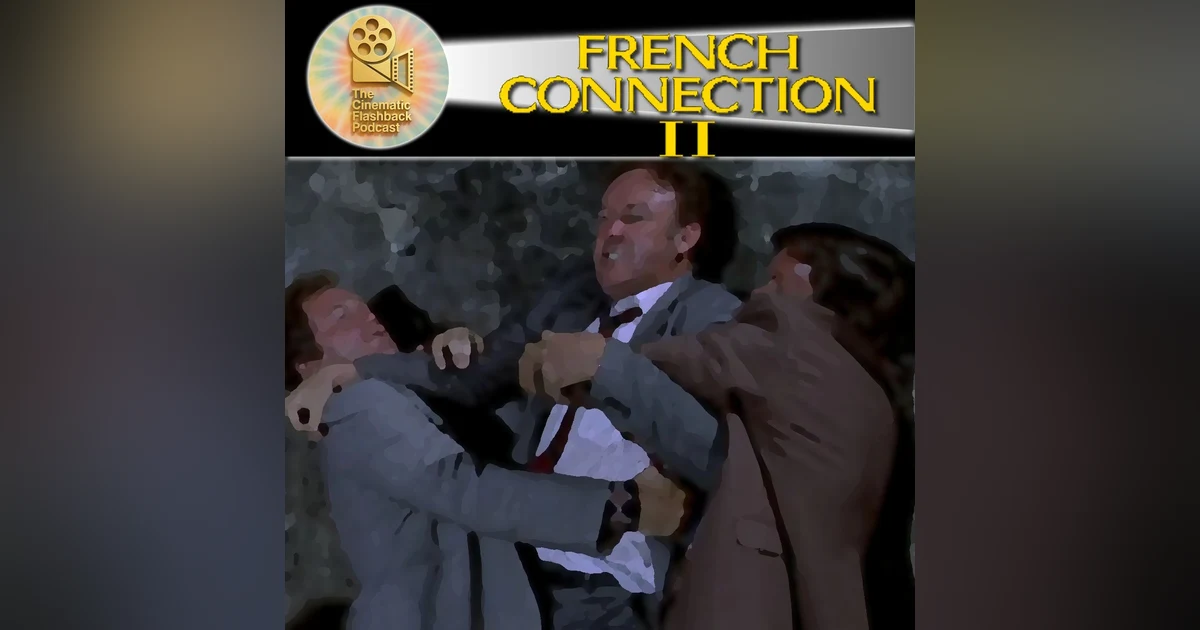
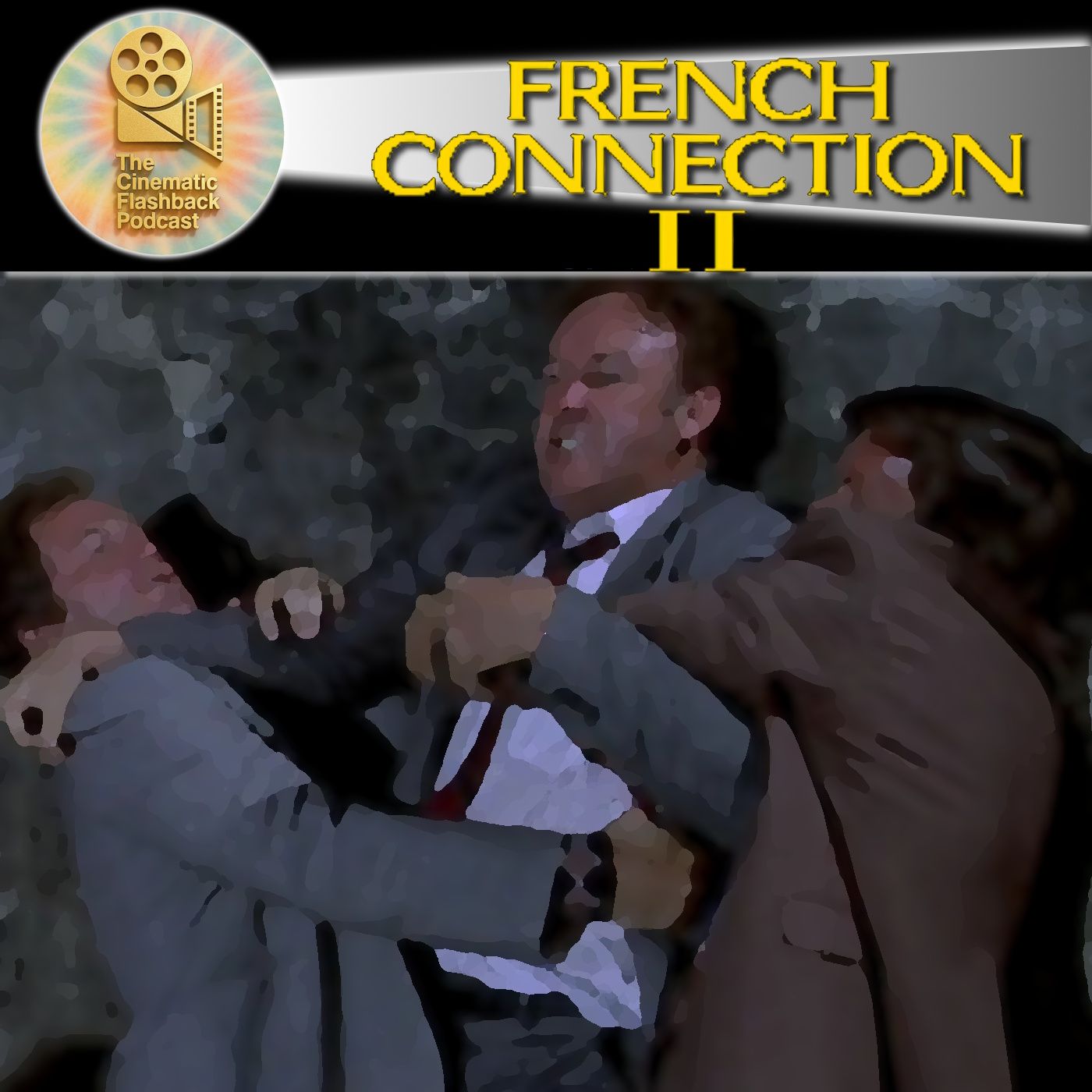
In this episode of The Cinematic Flashback Podcast, Chuck and Matt revisit French Connection II (1975), directed by John Frankenheimer and starring Gene Hackman as Jimmy “Popeye” Doyle and Fernando Rey as Alain Charnier, and explore why this sequel takes the story in a darker and more psychological direction.
The discussion focuses on how the film deliberately shifts tone from the original French Connection. Instead of repeating the gritty, documentary-style realism of William Friedkin’s film, Frankenheimer creates a more controlled and structured experience, placing Popeye Doyle in an unfamiliar environment where he is stripped of his authority, language, and cultural footing.
Chuck and Matt talk about the film’s strongest narrative choice: turning Doyle into a “fish out of water” by moving the story to Marseille and removing subtitles during large portions of the French dialogue. This forces the audience to share Doyle’s confusion and isolation, mirroring his lack of control over his surroundings.
They explore the reversal of power between Doyle and Charnier, noting how Charnier appears stronger and more in control on his home turf, while Doyle becomes increasingly vulnerable — emotionally, physically, and psychologically.
A major portion of the episode is devoted to the film’s darkest storyline: Doyle’s kidnapping and forced heroin addiction. Chuck and Matt discuss how this unexpected descent becomes the emotional center of the film, showing a side of Popeye that is rarely seen — broken, powerless, and in recovery — and giving Gene Hackman one of his most challenging performances.
The conversation also covers:
- The contrast between the gritty realism of the first film and the more traditional cinematic style of the sequel
- The absence of Doyle’s original partner and how that changes the character dynamic
- The new French police counterpart, Barthélémy, and his skepticism of Doyle’s methods
- The way the chase sequences echo the original film while evolving into something different
- The moral ambiguity of the ending and whether justice truly feels complete
They agree that French Connection II may not be as iconic as the original, but it remains a bold, unsettling, and surprisingly effective sequel that grooves through the decades by taking real risks and deepening its central character instead of simply copying what worked before.
Links & Contact Website:
https://www.cinematicflashback.com
Contact Us:
https://www.cinematicflashback.com/contact/
Listen to Previous Episodes:
https://www.cinematicflashback.com/episodes/
Leave a Review:
https://www.cinematicflashback.com/reviews/new/
Read the Blog:
https://www.cinematicflashback.com/blog/
Subscribe:
https://www.cinematicflashback.com/follow/
Share the Show:
Tell your movie-loving friends!
Other Podcast You Might Enjoy:
- Surely You Can't Be Serious Podcast
- 30 Something Movie Podcast
- A Film By Podcast
- Dockingbay 77
- Def Dave's 1984
- Accidental Legends
- Phasers Set to Stun
- Children of the 80s
0:01 Very soil. We can kind of lay at the office. Aren't you why you Popeye? I'm sean Ye's place. Sally remembered it. It's a hotel Colonade used to be the Hotel Tanger that's on a roo. Wrap up two, You got it? Stay where you are? Okay? Oh, Henry, bring some water. A lot of it. Welcome to the Cinematic Flashback Podcast. Get ready to hop into the wayback machine as we journey through the wild fold and unforgettable films of the nineteen seventies. Each episode, we break down a classic movie or forgotten Jim by exploring the who's who of each film, diving into the premising plot, seeing how it performed then and now, and wrapping things up by asking did it groove through the decades or did it lose its feat? Today we're going to Marseille to take care of some unfinished business in nineteen seventy five. The French Connection, by director John Frankenheimer and starring Gene Hackman is Jimmy, Popeye Doyle and Fernando Ray as Alan Charnier. And joining me again back on the mic is my co host Matt Sargent. Matt, It's great to have you back, and hey, also, welcome to season two. Can you believe it?
1:20 I cannot believe we're in season two. That's amazing. And we're starting off season two with a sequel to the first film we did, the French Connection, And if you guys have been following along, you probably know how I feel about sequels. There's only one good sequel, and that's Aliens. That is correct. Hey, listen. I wanted to either do French Connection two or Magnum Force, the second Dirty Harry film, because each of those I thought were pretty good films to talk about. We're still going to get some more Harry Callahan, but yes, I decided to go with Yeah, I decided to go with French Connection two because I like Gene Hackman. I know you like Gene Hackman, and this is kind of an interesting film that comes underneath the header of did we really need a French Connection too? And I couldn't remember the details of this film, so I wasn't really sure if I liked it or not, and I was very curious to see what my reaction was going to be.
2:25 After we watched The French Connection, which I thought was a wonderful movie. I'm exactly in agreement with you on this, Chuck. I vaguely remembered parts of the movie that I remembered, but I did not remember we're part of this movie, if you get what I'm saying. Like certain vignettes I knew, but I didn't know they were this movie. And as much as I had bad mouth sequels, this was actually I thought an entertaining movie and very interesting, and I love that a lot of it was in a foreign language without subtitles, which is kind of unusual. Usually they really pander to American audience, especially nowadays, they either dub everything or there's subtitles. And there is a good part of this movie when they're speaking French that they are not putting any subtitles in you just having to figure it out.
3:16 That right there is what really sold me into liking the film. That when the director decided to do that no subtitles, we're gonna make you feel as out of place as we're gonna make Popeye Oil feel in Marseille. Yeah, yeah, a fish out of water for sure. And that was a cool part of this movie is that he is in his element, you know, at which we saw in the French Connection, you know the original. He is the master of his domain. He knows the ins and outs, he knows the bad people, he knows what to say, and even in this movie, he tries to trot out his patented do you pick your feet in Gipsie and it just falls flat, which I thought was a really great thing to do. Now, I would never have had the guts to even try that line being in a foreign country, but it just cemented the fact that he was definitely a fish out of water in this particular film.
4:13 So you know how the original French Connection came from an actual real case. French Connection two is a totally made up story about Heroin going missing. Well after the real French Connection bust, the New York PD did lose large amounts of that Heroin quietly checked out of the property room and it was replaced with flour millions of dollars in drugs just gone. So to borrow a little bit from Charner, let's just say there were plenty of people who preferred taking the money instead. Well, who knows what happens today, but we would think nowadays it would be a little more difficult to slip into the evidence room and switch things out. But it was the wild and wooly seventies for sure.
5:03 For sure. Well, this episode comes with a spoiler warning. If you want to watch the film, go ahead and do so. It's not currently available to stream for free, but it is readily available to rent at all the usual locations. So let's go ahead and check out the trailer for The French Connection two. French Connection two the only film that could follow The French Connection. When Gene Hackman created the character of Detective Popeye Doyle in The French Connection, his performance won the Academy Award for Best Actor. Now twentieth Century Fox presents Gene Hackman in a new look at the legend of Popeye Doyle in the pursuit of the French Connection, an incredible chase that leads to.
5:53 Marsee, France, the crossroads of Europe and Africa, the beginning of the Raguera, the world's busiest sport for the trading of heroine, and the headquarters are for out one the French Connection, But Marseille is in Manhattan. Book. I'm going to be a lamp post in New York and the president of France. But I came over for one thing, and one thing on that gets shown, and that's what I'm gonna do. A trap is set for a land Chaangnier, the French Connection, and Popeye is the bait in an extraordinary game of cat and mouse, a game where there are no rules and there are no winners until the bait gets hooked.
6:39 I must say, mister Doyle, that to work the one person I did not want to see him. A car honest, quite stupid, quite honest. Not what you or set up one night? Whose idea wasn't. This is Popeye's revenge. The final chapter and the pursuit of the French Connection. Why don't you go back to New York and kill for lists? Is that's what you do best? In nineteen seventy one, The French Connection won the Academy Award for Best Picture of the Year. Only one film could follow it, Gene Hackman in French Connection two.
7:31 French Connection two was released on May twenty first, nineteen seventy five, and was distributed by twentieth Century Fox. With a budget of four point three million, A grossed twelve point five million worldwide, which was a good return back then. Critics received French Connection to positively, praising Gene Hackman's performance and the film's grim intensity, even if it could not quite escape the shadow of the original. The movie was directed by John Frankenheimer, who also directed The Manchurian Candidate, Seven Days in May Ronan and Black Sunday. Alexander Jacobs wrote the screenplay. He was also known for The Seven Ups with Roy Scheider, and this was one of his last screenplays. The story was by Robert and Laurie Hamil.
8:22 Robert went on to write the story for Flight of the Intruder, which also starred Gene Hackman back in the eighties, and Don Ellis was back to compose the soundtrack and Claude Renoir was behind the camera, and he was also a director on movies like The Spy Who Loved Me. It's amazing when you start to tie the people together with the various films and how they weave in and out. It's super interesting to see how their careers progressed and is great with us sort of focusing on the seventies because there was that whole new class of people in some of the old school in that mixing. Very very cool. This is one of the best parts of looking at these nineteen seventies movies. Is that kind of collision of worlds.
9:08 I find it neat when we come across another director or someone who made the film and we've already covered one of their films before. So whether you liked it or not, you know it was it's good. You know, it's neat. Okay. Actors returning is of course, Gene Hackman is Jimmy Popeye Doyle, and Fernando Ray as Alan Chernier. We got a lot more of him in this movie as he was in his element in Marseille. I thought that Gene Hackman he seemed more confident in this film, and I don't know if that's how we was playing Popeye or if that was just him having more experience since the first outing.
9:52 He's great actor. Let's just hands down, Gene Ackman is you know, Oh yeah, he's He's amazing, and in some of the parts to the movie where he's really encumbered by what he's portraying, it's amazing that he portrays it like so well. It seems to me you talked about is it Fernando Ray was that? Yeah, Fernando Ray is he was really good in this. He was just just swarmy enough, you know, kidbetzing with the American NATO general and having lunch and fine wines and beautiful women. He was a little like Goldfinger in that realm, you know what I mean, you know, a little a bad person but kind of a nice guy. It seemed like.
10:41 I think last time we described him as a bit of a dandy, yes, but like in this one, he just seemed I don't know, he just seemed like like someone's grandpa, you know, just very rich grandpa. Yeah. The actor who portrayed him, I mean, he did a great job. I thought it was funny because you know, at a certain point he has to kind of walk fast to get away, and at no point does he lose his cool. Yeah. I actually really really liked the guy who played the police counterpart to Gene Hackman. Yeah, that was Bernard Fressan as Barta. Lea May, Barta le May. That was It was so funny because ja Hackman shows up, He's like, well, bartle me, bartle me.
11:23 This is what was funny about Popeye is is he comes over there. He is the typical loud, rude American who really thinks that if you if you speak slowly and loudly in English, people will eventually understand what you mean and nope. The bar cafe scene is hilarious. It's one of the best scenes ever where brilliant. He can't make any time with these young ladies, so he forces the bartender to drink with him and gets the bartender hammered. It's it was funny because he's asking him for well, he starts with bourbon and then he says jack Daniels and Jackie. The bartender can't understand him, and so he says jack and then he says key for what and he goes, yeah, yeah, yeah, jack Key, Jackie, Jackie Daniels.
12:15 It was funny. It was just so that was just a great showing him out of place, and yeah, it was good. It was good. I definitely enjoyed those scenes and it was well done. So and then that guy you said. That Bernard pres song, Yeah, he. Was really good. I really liked him. And then the last guy was the heavy was Leotard as Josh. He was good too. Of course, Sharnier's original henchman. He didn't make it off the elevated train in the first film, and Cloudy couldn't make the trip over because Roy Scheider was out in Martha's vineyard making jaws, so he wasn't available, so they had to come up with some new French counterparts. And just like the Orige Henchman, he doesn't really have much to say. He's either making drops net or you know, he's shooting this submachine gun and basically being the muscle.
13:09 Yeah. Yeah, but still it was an unusual actor choice for him because he's kind of tall with curlyish hair. It didn't really look like a bad person, which I thought added to the foreignness of the scenario. Right. He wasn't your typical American heavy, you know henchman. He was kind of a suave, tall, good looking Frenchman. You know. It was a good choice in my opinion. I think the other point that you made about, you know, like Roy Scheider wasn't going to be there as his partner. First of all, I think that's why they said it in Marseille, because obviously they're not going to send two you know, American policemen overseas. Yes, and as we find out later, they're really sending him over there to sort of be how you say, bait. He is one of the lines that the French policeman says.
13:57 We'll take a quick intermission here, just time to grab some popcorn or top off your drink. You're listening to the Cinematic Flashback podcast. Stay tuned. The show continues right after this, and we're back. Hope you enjoyed that brief intermission. Now let's roll the next reel and get back into the conversations. I wanted to talk about sequels in the seventies because this is nineteen seventy five, and I think that some of the things that we've talked about before about sequels, they honestly were kind of rare, yes, but they were often seen as a cheap cash in, right, and we see that all the time.
14:39 It's not just a sequel, yeah, much more nowadays than yeah back then, and even nowadays, they go into they assume there's going to. Be three or more. Back in the seventies, sequels weren't strategic. Maybe they were a little reactive, you know, so like, hey, we could make some money here doing. This, right, right, They really hadn't glombed on to the fact that this was a definite way to cash in. You've built the characters, you've put in the time to develop the rapport with the audience and give them their backstory. Now it's time you just throw a story together that's pretty sparse and it'll still come out pretty good. And I think that's where my attitude about sequels really comes from, is later than this timeframe, is that when they were clearly just cashing in for a second one. And it's great for actors. You get in one of these franchises, you know, basically you're set for life because you're going to be in three Star Wars films. You're never going to have to work again. You might never be able to work again, but that's fine because you're you're now taken care of. You get so associated with a particular role. Yeah, I mean, look at Mark Hamill and Star Wars. We had all of those movies, But you know, do you remember them from virtually anything else?
15:48 Yeah? I do not. The only thing I remember him from is that he went to Annandale High School and was in the school play there, and my wife went to Annandale High School. So did you see Corvette Summer? Now you didn't see Corvette Summer? All, Okay, good gosh, I'm going to send it to you. It's a fun film. It's not deep but it's fun. It's like a early Mark Hamill film. One last statement, mark Hamill really made his career playing a villain in a superhero series. Really? Oh? Was this where he was a voice actor? Yes? What villain was he? He was the Joker for many years in the animated Batman series. That's right, and he is amazing. There is a video of him doing Heath Ledgers lines from The Dark Night, but in his Joker's voice, and it's amazing.
16:40 Oh, I'll have to look that up. I'm not discounting Mark Hamill's talent by any stretch of the imagination. I think he's a really talented dude. Now I'm playing with you. Back to seventy sequels. Sure, So here's some examples. Let me know if you've seen any of these. Beneath the Planet of the Apes nineteen seventy, when. Arthur Jacobs approached them to do the sequel, Charlton Heston, who was so proud of the first one, absolutely refused, but they kept throwing money at him and he said no, no. Finally he agreed to do five days work at huge money, with the caveat that. At the end of this picture, he destroyed the planet so that they could not make any more sequels. What can I tell you how many actors get to destroy the planet. That's what Chuck wanted to do, and that's what he did. This is a very entertaining sequel. This is trash.
17:29 The first one's actually a good movie. That is a sequel to the Best Picture nominated science fiction film from nineteen sixty eight. Okay, how about The Godfather Part two? Francis has said that this film was the first major motion picture to use Part two in its title. Paramount was against using Part two in the actual title. According to Francis, the studio's objection stem from the belief that audiences would be reluctant to see a film with such a title, as the audience would supposedly believe that, having already seen The Godfather, there was little reason to see more of the same story. The success of The Godfather Part two began the Hollywood tradition of numbered sequels. Obviously, yes, and I've already mentioned this one, Magnum Force.
18:13 Magnum Force begins with what would become part of the formula, Harry going about his day, wreaking havoc in Vignette's appetizers for the main course of mayhem. Every Dirty Harry movie has a catchphrase. The first one was do you feel lucky? And in this one it's a man's got to know his limitations. Harry Callahan had no limitations. This movie made a fortune, and he'd be back for more, and so would all of us. And I was in the front row. Clearly a good sequel. I think this is an early example of franchise building, right. And to my point that I was saying before, you know who Harry Callahan is, you don't have to rebake that, yes, and you get to take it from there, which can be very powerful. And I think they did other things with that character.
18:55 We've got to get this one in. Yeah, Yeah, we'll definitely do that one. Airport nineteen seventy five. New motion picture inspired by the film Airport. With a cast of the screen's greatest names, Charlton Heston, Karen Black, George Kennedy, Gloria Swanson, an award winning singer Helen Ready as sister Ruth. Would you be. Forgiving of your human imperfections? No, never seen it. If you said yes, I was gonna laugh because both of us bailed on Airport are and then kind of a little bit later, and this is an example of everything that could go wrong Exorcist two, nineteen seventy seven.
19:37 I mean, what do you think about this? Is he of a filmmaker who you can't always. Control what your legacy is. Well, I mean, you know, I don't know if that quite applies to him, because he was, you know, when he did his wild movies. They are so wild and so out there. You know, I don't know how you conceive without at least thinking that some. People might laugh at. I think it was taken completely by surprise by Exorcist to the Heretic. Well, yeah, that's that whole. There's that line that Paulin Kal said that if you watch Exorcist to the Heretic with the sound off, you might think it's a masterpiece. Giant budget, major director, total disaster, and also just a terrible name. All right, right, we're doing it again back in the breach. Yeah, So with that set up, I have to ask what about French Connection too.
20:34 We chatted a little bit before we started, and I will say this to me, this French Connection too seems like the end of the first movie. It is definitely different than the first movie. What do you mean by that, Well, I mean it's like just the end of the first movie. It's like the first movie ends and this one picks up. Gotcha, gotcha. So here's my beef with it is the whole point of the French Connection is that you get to the end of the movie and there's no there's no night in Shining Armor, there's no bad guy gets taken down, there's no everything's happy and all that's right with the world, right, all of this moral dilemma has resolved itself into the greater good. None of that happens in French Connection, which is beautiful, it's great. It's how life is. You get the French Connection too, and you still sort of are being led down that same path of things not really resolving and people getting away with stuff until the very end, and then somebody gets murdered and then the movie ends, and it's like, for me, it's wrong now. I think what the question you're asking is, this isn't like a cash in of the same kind of chase movie. I mean, it's character driven, but it's not that gritty showing the underbelly of police work type thing that's going on. It's definitely more a darker and more psychological and reflects that Frankenheimer directing style.
22:01 I think you bring up some good points the ending of French connection. If they didn't show that little what happened to them afterwards, if it ended right there, you wouldn't know if Papa got shot or Sharnier got shot and what happened from there, because it didn't answer that question. But we do see that in the Where are They Now? That Sharnier escapes, he goes back to Marseille. And what I was afraid of in this film was that it was just going to be a retread of the first story. And it is not. It isn't, and I think it's because Frankenheimer was wise to not try and be William Friedkin right, you know, so he's not trying to make it gritty. It's not all this handheld all the cameras that are all locked down, it's very traditional. They're on sets a lot, whereas the previous film was filmed at the bus station, filmed in the train station, filmed at the police station, at the l at the l everything was there. The other thing is I wasn't sure what they were going to do with Popeye, because if he goes to Marseille, does he do the same thing that he did before? Because in French Connection he's a force to be reckoned with. He walks into a bar and there's like thirty people in that bar, and it's just him and Cloudy and they're all afraid of gets over here. They take all of that away. You can't carry your gun, you're here as a guest. You don't know the language. They grow his character by pushing him into some darker territory than the way that you make a sequel to a film like French Connection two is you have to lean into your star,
23:36 Gene Hackman. He elevated what could have been a cash grab into something different. They were smart to lean into Gene Ackman, such an amazing actor. French Connection two takes a different tonal shift. Did that throw you off at all? Yeah, it definitely seemed like a very disjoint from the first movie to the second movie. But I think that's not a bad thing. As they go, it's just not more of the same. I certainly think part of that shift is borne out by the fish out of water dynamic of Doyle. Right, he's a man about town, in New York, he comes to Marseille. He can't even pay the cabby the right amount of money, right, And it's clearly a different thing, which is how the movie opens, So you know, instead of pussy footing around with it, they clearly make it. This is different, something's different happening here, which I think is refreshing in a sequel, because sometimes a sequel, and I think we've seen that in you know, in other sequels, it's just a rehashing of the same dynamic, the same heroes and villains, And this is not that.
24:43 I mean it, certainly it has the same villains and some of the same dynamic, but the way the story goes and is not the same the. Way Frankenheimer films the show. It's not gritty, it's not handheld. Everything is more locked down, and it feels maybe what you might expect from a typical movie. Yeah, yeah, definitely, definitely it's a little more I don't want to say this in a bad way, it's a little more corporate, a little more of what you're expecting. Well, yeah, there was there was nothing like. You didn't walk away from this saying, oh wow, they did something different. I think with the first one, we were kind of describing how the way that freaking moved the camera was everything was. It felt more like a documentary in some areas, riding along with Popeye and Buddy as they were going into these bars and making these bust Yeah, you brought up the fish out of water. I thought that that was a great way to level the playing field. It was interesting that there are no French subtitles. Did that throw you are?
25:44 No? I liked it because I'm a big fan of foreign language movies and I don't mind subtitles, but I think it's interesting when you get to a point in a movie where they're speaking a foreign language, you really don't need the subtitles. And I think that was done well in this movie because you got the gist of what they were talking about, even if you didn't get all the words. And you know, I think we all know enough a few French words to be able to understand some of what they were saying. You know, there was a few curse words that got thrown around that you know, if you're any teenager growing up, you probably learn them, Oh, definitely, But you know, I thought it was great. I applauded that decision because it again it put you in that same position of not really knowing what's going on. You're a little bit taken by the tide of what's happening around you. Anytime you're the audience, you get to see more than the protagonist gets to see. But in this particular case, it puts you in a little bit of that same position of being, you know, a little bit of a fish out of water if you don't know how to speak French.
26:47 It also kind of had some fun scenes in there. He goes into that one bar and he's trying to order yes, or he's trying to hit on the girls, or he's going about the town and he can't communicate what he wants because outside of Bartilo May many people speak English. I will tell you that when I was in France in nineteen eighty, a lot of people spoke English, but he generally didn't want to speak it with you. My sister in law and my niece have been to France quite a bit, and you know their attitude is if you just give it a try to speak French. The French people are very forthcoming and trying to help you out, and they're just very happy that you're trying to speak the language, even if you're hacking it. It is a beautiful language. That was the other part of listening to this movie is you get to hear people speaking of French and it really is one of the most beautiful languages to hear spoken.
27:39 Oh yeah. One of the other things in the film that was different from French Connection is that now you're in Charnier's backyard, you're in his playground. The dynamic has switched a little bit. He now knows all the ins and outs of Marseille in the same way that Popeye knew all the ins and outs of New York. And I felt that Sharnier came off much stronger in this film because he had that control. Yeah, he was more suave and smooth, and even when he was being hurried, he was only walking fast, you know, he was not running. I know the scene you're talking about. Yeah, And it was great. I mean, I think this was the whole point of the movie. It's the point of how they filmed it. And this dovetailed into having a different director. It wasn't this director trying to make himself look like Friedkin. It was, Hey, this is a whole new movie in a different country. That's sort of a different dynamic, but with some characters we know. So there's some touch back to the first movie. To me, if you had tried to do anything else, it wouldn't have worked as well.
28:45 Will Paul's here for just a moment. Think of it as a real change stick around. There's more cinematic flashback coming up right after this, and we're back. The lights are down, the film's rolling, and the final act begins. Let's jump back into the cinematic flashback podcast. You know, one of the things that I found missing in the first film the way in which Popeye and Cloudy worked together. You could tell they had been working together a long time. They even socialized after work, and I kind of missed that relationship and that dynamic. I said, God, I was requested to help you. I didn't request that you came here, but naturally I wanted to know who you were.
29:26 I found out after this big arrest it disappeared. I read in the papers that somebody stole you a heroin right out of the police headquarters. Was it your friends and my friends are still on the force. How many men have you killed? Being interrogated here? Five? Five people killed it seems quite a lot. Bartolo May is the French policeman who is is not really agreeing that they should be using Doyle as bait to pull Charnier out.
30:07 Yeah, it's sort of thrust upon him as well. Yeah, I think your point is well made, but I also think it goes yet more into the fish out of water. If he had had his buddy cop with him, they would have been working together and having that foil and the part of having Popeye have to deal with this guy who really has kind of a low opinion of him, thinks he's some kind of cowboy that gets other policemen shot and killed, sort of puts Popeye Doyle on his back foot, which I mean, I think that pretty much goes for most of the movie until Doyle's innate capabilities as a detective really shine through. And that's sort of in the last yeah what do you call it? Act three of this movie, when he.
30:51 Pulls up Popeye's record, he says, oh, you've killed five people and two of them were policemen. You know, you knew we're you stood with Bartolo May right from that moment. I think that was actually probably written that way on purpose to kind of give you a little bit of we're on Popeye side and this guy shouldn't be such a jerk, and you have to know all the details. But then when you really boil it down, it's like, maybe he makes some bad decisions. Question. Yeah, was there any old tech that stood out to you? And eld radios were gigantic. They were like as big as the guy's head. It was hilarious with a six foot antenna, I think on the thing it was it was so funny to see that. And I do have to say for our younger listeners, if they watched this movie, they'll be like, yes, what the heck is that When you pull out your little tiny phone and you have your watch that has a bluetooth on it that you can talk on it.
31:47 This was high tech of the day. You know. It was probably World War two surplus radios that the police were using or something like that. But it's just it was hilarious. I will say there's a few shots that were. Taken from above in the opening scenes when they're shooting the yacht. Yeah, clearly those scenes were shot out of a helicopter. You know, you can tell for the last ten years most of what used to be. Helicopter shots are almost one hundred percent drone shots now. So when we look at movies nowadays, we're like looking at these, they're like, oh wow, how do they get that? It was like, well, it has a drone that's literally flying twelve feet above the guy as he runs through the streets. You could never do that with a helicopter. You'd have to do it with a truck and a camera on a gimbal. Now they just do it with a drone.
32:31 So it's funny to see some of those old scenes. I see it in old movies all the time. He's clearly a shot from a helicopter. Well, let's talk about some of this story here, because the first thing we have to talk about is Doyle's kidnapping and his forced addiction. Yeah, that is probably, for me, one of the most horrific sense that really has been done in a film. It's really, really, very disturbing to me. It got arc really fast. Yeah, it's really dark. I was not expecting that. No, I didn't remember it was from this movie, Okay, but when it started to come on this movie, I was like, oh man, I know exactly what was going to happen because I remembered it was so sort of disturbing to me as a young person when I saw it.
33:18 Doyle is kidnapped by Sharnier and he knows it. Doyle is too hard boiled to give up any information, so he's going to addict Doyle to heroin and then withhold that heroin to get the answers, and so over a period of weeks they basically hooked him up. And in the most horrific part of the whole thing for me is at first Doyle's fighting it, and then after a few scenes, you see the guy walks in and Doyle's pulling his sleeve up and putting his tie around his arm so the guy can give him the shot. Yeah, and it's just sad. It's so sad. He's absolutely addicted to it. Okay, So here's how naive I was. Part of me was hoping, oh, no, Papa is going to be able to resist this, or he's going to be able to get out, and no. You can see in his eyes as the drug is starting to take its.
34:05 Effect, you pretty much see he's not even tied to the bed anymore. He's just laying in there and the old lady's taking him to the bathroom. They questioned him at the end and they realize he doesn't have any information for him. Yeah, they're really upset because the whole city's being turned upside down looking for him, right, and it's cutting into their action, So they need to let him be found. Sure, it's pretty clear their intention is they wanted him to be found dead, and they dump him off in front of the cops, barely alive. And then a whole harrowing scene of him being detoxed, which just is brutal. The forced addiction and then the recovery. Again, I didn't know that this was in the film, and I didn't expect it to take up such a major part of the film.
34:49 Yeah, I would say that was all of Act too. It was act too, right, the kidnapping, the withdrawal, and then kind of his rebirth. But there was some really great scenes for Hackman. He's given that scene to speak with Bartolo May about baseball. This is an opportunity for you and me to learn a little bit more about who Popeyed Oil was before he was a cop, right, and then the reason why he ended up becoming a cop. Well, it was and uh a kid, you know, with the Nuns and the Confessions. I was a ballplayer, ballplayer, a ball player and baseball layer. Yeah, no one had a try out with the Yankees.
35:37 Uh. They sent me down to the to the miners. And the bottom bottom problem was. That the kid there and he was fast and he played shortstop at the time. You get the ball. And I saw this kid, I just immediately took the test. For the cops, that kid was making Mantle. What they needed was a chase scene that would rival the chase scene from the French Connection. You remember where Doyle gets into that car and he's chasing after the L underneath. It filmed with no permits, you know, the whole thing, and we get a foot chase.
36:26 I mean there are echoes of the French Connection chase scene because he's running in a car that's following the L. Yeah, the L's much faster, but he has to get in front of it and then run up the stairs to the L and try to get on the train. And in this particular chase scene, at a certain point, he's chasing a boat that's going down the harbor. So he's running down the side of the harbor and he turns in to see if he can get to the point where he could jump to the boat, and clearly he can't. He has to run back out down there, Yeah, down the pier and up again and chase, chase, chase. I did not think about that. Sharnye first gets on an electric street car, yeah, and so Popeye is running after this street car and then Sharanya gets off of it and gets onto his yacht.
37:13 Yeah. So now Popeye is chasing down the yacht, right, so it's like he's out doing the chase scene almost. Even though it was echoing the French connection. It was a good chase scene. But I think the payoff at the end is a little depressing to me. I always thought the French harbor patrol would stop the yacht right when Doyle gets to the end, like he's running and running and running. But in the meantime, the French cop has called the coast guard of the French and there's a very natural sort of thin spot in that those boats come out with their lights on and that's it. He gets them. But that's not how they ended. Bob Boy Doyle pulls out his gun and just shoots the guy, and it's a little bit of what our French policeman was saying, is like, you're just gonna pull out your gun and you're gonna shoot him, literally in the first scene of the movie, and that's exactly what he did.
38:05 I actually really agree. I thought it would have been much more satisfying if Charnia comes to justice they got him. In fact, in not catching the guy, they couldn't take apart this whole network. Maybe he's just a big player because it clearly he's buying tons and tons of high quality pure opium from the Far East. Well, this could have become the French Connection franchise. And there was one more chapter in the French Connection, was there? It was a nineteen eighty six television film starring Wait for It, Ed O'Neill. Well, you accidentally killed the federal officer in the controversial French Connection case. Now, the major suspects in that case avaded capture. Said you notice any similarities at all between your actions then and what happened today. Yeah, today, I didn't kill a federal officer and the suspects did not evade capture. Listen, how do you justify Lieutenant paul Is recommending you for a departmental citation?
38:58 I don't have to you consider yourself a good cop. Hey, mister, let me get something straight. I'm a police officer. I'm concerned with the law abiding citizens of the city. And now when you address me. You call me detective or sir, but don't call me a cop. I don't like it. Only a cop calls me a. Cap married with children and modern family over him. And modern family and modern family is what it took to not make me think of ol Bundy every time I see them. Right, But I don't have a desire to find that film. Matt, are we ready to ask the question? Yeah, I have an answer. I'm not equivocating on this. In the wayback machine and rolling. Back years to Mat.
39:38 Did French Connection to groove through the decades or did it lose its beat? I have to say that it grooved through the decades. It was a pleasant surprise. When I watched it. I was not expecting as an entertaining movie as it was. Maybe film critics and people like that would pooh pooh it, But I'm just a regular Joe and I liked it. It was interesting, it was a little bit dark and part of it so you're bought into it and you're concerned with characters, and I liked it. It was entertaining. I do reserve that I think the ending would have been much more satisfying to bring Sharnier to justice. I think it is a movie that you can definitely still watch and still be entertained and even be amused at the differences between the movie made in the seventies and movies made in the twenty twenties.
40:31 It's even amusing to see the differences in how two films are made. Yeah, oh, between just these two. I honestly thought, Matt, that I was gonna hate this film. I really like the French Connection. I really like learning who William Freakin is. I love seeing Gene Hackman, and I like seeing Roy Scheider before Jaws. I just like so much about that film, and I just thought that French Connection two is going to be a big letdown. And I thought I was really going to say, yes, Matt, you're right, sequels, they shouldn't make them. But when the French Connection two got to the point where they were addicting Popeye to the heroin, the movie got very interesting to me because it went in a direction that I was not expecting. I felt like I did after I watched Pellam one, two three. I didn't know anything really about it, and I really enjoyed it. It was a little slow for me getting started, but by the end I really liked it. So yeah, I think it's still definitely grooves. I enjoyed it.
41:39 I have to one hundred percent agree with you on all your points. You did reiterate the difference between French Connection and French Connection two, and I do have that same thing where I just think sequels are usually not that great. This was a little less of that to me. I'm sure there was some of that. I'm sure it was a big payday for the stars. And that's okay because because I think he turned in a really stellar performance, especially during some of those when he was recovering and when he was addicted to Heroin amazing. We have another Gene Hackman film coming up on season two. I talked about it last year. It's called Scarecrow with al Pacino. I can't wait for you to see that film.
42:20 I'm just excited to see what you think about Scarecrow. Yeah. I don't think I've ever seen that. I don't even know what that movie's about. You're gonna like it. It's a great character performance. It's pretty good. It's pretty good. I'm a huge Gene Hackman fan, and I think I first recognized him for being a sort of a powerful actor on the movie Crimson Tide. Him and Denzel Washington not seeing eye to eye. Denzel is an actor's actor for sure, but to be able to go toe to toe with Gene Hackman, I think that's somewhat made Denzel Washington's career, but it also showed Gene Hackman to be just a really amazing actor. I agree. Well, that is season two, episode one in the books.
43:03 All right, man, that's good. I think we wrapped it. We didn't go as deep in stuff what we sort of went and did some other stuff, so I think it's good. Matt. Thank you again for joining me for season two. We have lots of good films coming up. And thank you listener for joining us today. Have you seen French Connection two? Tell us what you thought about it on Cinematic Flashback dot com. We appreciate your feedback and comments. Please subscribe so you don't miss an episode. Share us with your friends and we would appreciate a review. So join us next time. As we dive into another seventies classic. Thanks for hanging out with us, and we'll see you, then see you, and then kind of a little bit later.
43:43 And this is an example of everything that could go wrong. Exorcist two nineteen seventy seven. Giant budget, major director, total disaster, and also just a terrible name. All right, here's the best sequel. Name ever, Alien aliens, Exorcist and Exorcism, not Exorcist too right, we're doing it again back in the breach. Yeah,