
 Spotify

 Amazon Music

 Apple Podcasts

 iHeartRadio

 PlayerFM

 Podchaser

 YouTube
 RSS Feed
Newman & Redford’s Perfect Con — The Sting (1973) A Masterclass in Deception
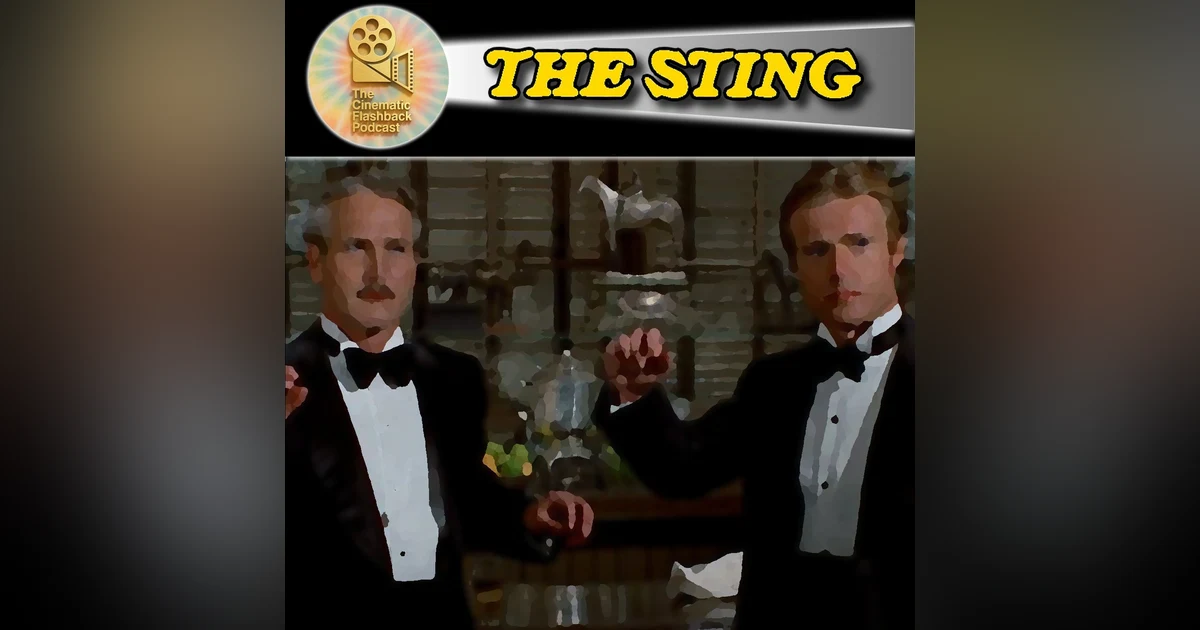

If you love smart storytelling, unforgettable performances, and movies that play you as much as you watch them, this episode is for you.
In this episode of the Cinematic Flashback Podcast, we dive into The Sting—the Academy Award-winning classic that redefined the con artist genre. Directed by George Roy Hill and starring Paul Newman and Robert Redford, this 1973 masterpiece blends charm, deception, and precision into one of the most entertaining films of the decade.
Set in 1930s Chicago, The Sting follows two grifters pulling off an elaborate long con against a ruthless crime boss—but as the layers unfold, the real question becomes: who’s actually in control… and who’s the mark?
We break down:
- The difference between a heist movie vs. a con movie (and why The Sting is in a class of its own)
- The film’s play-like structure and how it pulls the audience into the con itself
- The unforgettable performances of Newman, Redford, and Robert Shaw
- Why the film’s perfectly orchestrated storytelling still holds up decades later
- How the twist ending works—and why even savvy viewers still fall for it
Whether you're revisiting a favorite or discovering it for the first time, this episode will have you second-guessing everything—just like a great con should.
👉 Listen now, and don’t forget to join us for Paper Moon as our “Art of the Con” series continues.
Links & Contact Website:
https://www.cinematicflashback.com
Contact Us:
https://www.cinematicflashback.com/contact/
Listen to Previous Episodes:
https://www.cinematicflashback.com/episodes/
Leave a Review:
https://www.cinematicflashback.com/reviews/new/
Read the Blog:
https://www.cinematicflashback.com/blog/
Subscribe:
https://www.cinematicflashback.com/follow/
Share the Show:
Tell your movie-loving friends!
Other Podcast You Might Enjoy:
- Surely You Can't Be Serious Podcast
- 30 Something Movie Podcast
- A Film By Podcast
- Dockingbay 77
- Def Dave's 1984
- Accidental Legends
- Phasers Set to Stun
- Children of the 80s
0:02 You stink, mister, he'll be a sap. It's not her I want. If you're too dumb to save yourself, there's no sense dragging her down with you. It's over, Hooker. You can save me a lot of trouble, but I'm gonna get Henry Gondorf. Whether you help me out or not. You wait till the chump is played. Hell, yes, we don't care about the mark. He deserves what he gets, I mean completely played. You come in before we beat him and I'll kill. Him, all right, Hooker, But you try to take it on the lamb and we'll shoot you down on sight.
0:49 Welcome to the Cinematic Flashback Podcast. Get ready to hop into the wayback machine as we journey through the wild, bold, and unforgettable films of the nineteen seventies. Episode we break down a classic movie or a forgotten jim, seeing how it performed then and now, and wrapping things up by asking did it groove through the decades or did it lose it speak? I am your host, Chuck Bryan, and today we are taking a look at nineteen seventy three's The Sting, the Academy Award winning film directed by George Roy Hill, reuniting Paul Newman with Robert Redford and bringing Robert Shaw along for the fun. And what would a great con be without my partner in crime, Matt.
1:31 Sergeant Matt. This is our first film of our art of the con pairing months where we're going to dive into the criminal underworld of the con artist. And we have two films from the same year on tap, The Sting and Paper Moon. I think The Sting will be recognizable to everyone as a classic nineteen seventies Jim So in this episode, I think maybe we're celebrating a landmark film more than uncovering one for our audience. Death This would come underneath the heading of big films that you and I typically don't cover quite as often. You might remember last season we reviewed The Great Train Robbery.
2:13 That was the one with Sean Connery Donald Sutherland and the scene stealing Leslie and down, and I might call that more of a heist movie, even though it had some con elements to it. It seems to me that a con or a confident scam centers on deception and possibly slight a hand to trick the quote unquote mark into giving the valuable that money or you know whatever to the con artist or the team. While a heist is a direct in your face, no deception, hold up, possibly with a weapon. There's really very little subtlety in a heist versus a con which is nothing but subtlety. I think the perfect con convinces you that you were not fooled. You simply lost your money and made may be a fair game or something that happened, or or maybe you're happy to get away with your freedom and maybe not with your money. But that's sort of the trick is you want them to not be aware that you were fooled. I think that's the best gone because then they're not going to come back after you. Yeah, Chuck. Do you have any other examples of heist versus con movies?
3:23 Well, there are two films that always come to mind, and I don't know if you remember. It was a nineteen eighties film called Dirty Rotten Scoundrel with Michael Caine and Steve Martin. These were two con mens who were continually trying to out con one another, only to find out that a third party was conning them the entire time. The other film was one from nineteen eighty seven by David Mammont called House of Cards, where the main character, she's a psychiatrist and she gets drawn down into the world of grifters. What about you. I always think of a film called MATCHI Men. Oh yeah. The other one I was thinking about is maybe Rounders with Matt Damon. Okay, I mean it's kind of a con film, but it's really a type of con called a card hustle. Okay, okay. It's much like a pool hustle or you know, which we of course saw in the Color of Money and other films about pool hustles. This is a card hustle. It's the same thing. You you fool the person into believing you're not that great of a player, and then you just happen to win the entire pot. They're very hard to be subtle and not people around the table realize that they lost all their money to the person they've never seen before. That is basically the summary of Rounders.
4:42 Now you've just introduced Rounders, the Hustler, and of course I think the bridge maybe between the Hustler and Rounders being the Color of Money, both of those starring Paul Newman. We have our heist films, and now we also have our hustler genre. Yeah, I each of these is that whenever you watch the films, and why they're so entertaining is because you're brought into the world that they're building and you become a participant in the game itself. Yeah. I would like to point out one thing that drives me crazy about, for instance, the Mission Impossible films. Right back in the day when it was a television show, the Mission Impossible was was great to watch because everything worked like clockwork, right. Mission Impossible often did cons there they're basically fooling people. It was it basically cons but they're doing it for the government, which was going to unavow.
5:41 But the thing about the TV show is everything was perfect. You know, things happened, bang, bank, bank, bank, bang, and at the end it all was revealed and your like, amazing. They planned everything. The movies, on the other hand, is chaos. Everything goes wrong, and yet they still succeeded. Me bananas, because that's not the point of Mission Impossible. It was supposed to be this perfectly planned set of occurrence is not. Something goes wrong and everybody does whatever they want to do and jumps out of a plane and saves the day. That drives me nuts. Anyway, just a dog pile on the Mission Impossible movies.
6:22 And I apologize for anyone who loves Mission Impossible. I don't think we're saying that we hate it. We're just saying that there's certain elements of it that, you know, just seems to be kind of so. For instance, every time you get invested into somebody and then they rip off their face and they're wearing the mask, I think that is so cheap cheats, right, it's cheap and it's cheat. Yeah, but yeah, no again for what they are, they're hugely entertaining, but you have to forget about their history of being the original Mission Impossible, right, because that was cool, because everything, and this is what I love about the sting, right, Yeah, it is, in my opinion, nearly perfect. The only thing that kind of throws it off with some of the people trying to get why's and stuff like that, but it is planned to a te executed. I love it for that, all right, Matt. Do we have any listener feedback this week? We certainly do, and it appears that our dear listeners are clamoring to be called out in this segment. We are featuring one we got from Neil ka Left directly on our website. He gave us a five star review and said that he is a former Navy sailor who never watched the Last Detail quote. Thank you for the great content and trivia that comes along with your reviews. When I saw that you did a show on the Last Detail, and as a Jack Nicholson fan who had never seen this movie before, I made sure to watch it before listening to your podcast. Keep
7:53 up the great work end quote. You know, one of my favorite things about doing this podcast, Matt, is when somebody lets us know that they have never seen a film before and then they go and watch it. That actually means a lot to us, more than you'll ever know. And thank you Neil for the kind words. Thank you for using that feature on our website. You might be the first or second to actually use that and we appreciate that so much. So thank you so much. Amazing and thanks Neil. Kay be like Neil and post a reviewer comment. Heck, we hope that you can give us some pointers as well. Read them all, tell us what you like, how you listened, and where you're coming from. I know we have some international listeners, let's hear from you, Matt.
8:37 What I found interesting in researching the Sting is how it developed through ongoing relationships rather than it being a standard studio package. What I mean by that it really started as a meeting between actor turned producer Tony Bill and a young film school graduate named David Warre. Ward had a screenplay called Steelyard Blues. Bill asked the next logical question, what's next? Ward went on to describe a story about a young con man whose best friend is killed by a powerful figure, and he decides to take revenge by conning him out of everything he has with the help of an experienced grifter. Bill liked the idea and asked how it ended. Ward's reply, that will be my surprise. Bill partnered with Julie Phillips and Michael Phillips to move Steelyard Blues into production, and they established relationships with producers Richard D. Zannak and David Brown. Ward's been about a year writing the Sting, and when he had completed the script, Bill and the Phillipses brought it over to Zannak and Brown, who by then had moved their company to Universal Pictures. Ward was initially considered to direct when Tony Bill and the Phillipses brought the script to their good friend Robert Radford. He loved it, but he thought that it needed to be in the hands of a more experienced director. The script was then passed to
10:10 George Roy Hill, who agreed to direct and brought it to Paul Newman. With Hill directing and Redford and Newman attached, the film moved into production. Well, I think we're ready to get into production details of this film. The first we need to take a quick break. We'll be right back. It's the manic flash back the show. It's the cinematic flash back the show. She picked him clean. You never remember that? Remember that sting experience? How good you felt? Now? The sting, winner of seven Academy Awards, including Best Picture, is back. Chicago was the place to be in nineteen thirty six. In those days, the Big Con was a dying art until the first class script on the Lamb from the FBI and a young gaffer from Joliet joined forces to con the Big Mick.
11:10 He's not as tough as he thinks. Neither are we. Paul Newman is Henry Gondolph. There wasn't a Connie couldn't run, and there wasn't a sucker. He couldn't gaff. Robert Redford as Johnny Hooker, a young drifter with plenty of mocks. Three grand on the ranch. Jimmy, but he's a sucker for lady Luck. Tough luck kid and a sap for lady love. There's the big evening hook. Let's tell you hippie. Bucks on me nail. Robert Shaw's the mark in the underworld. He's the big mick names Lonigan, Dald Lonagan. It starts with the sucker.
11:52 You only fifteen grand. Tal then you bait the hook losses quite a card player, mister Kelly, how do you do it? It cheats your play him. On the wire. The wire's been out of day for ten years. That's why I won't know it. Now he's ready for the Sting. He's there. Let's get on it. Listen to me. Don't go back to your place tonight. Five hundred thousand dollars to win Lucky down.
12:36 Paul Newman and Robert Redford. This time they might get away with it. Welcome back. Let's get into the production details. The Sting was released on Christmas Day, nineteen seventy five. It was produced to the Xenig Brown Company and distributed by Universal Pictures. With a budget of five and a half million, The movie would go on to gross two hundred and fifty seven million at the box office. Tony Bill, Michael Phillips, and Julia Phillips were the producers. The Phillips were a husband and wife team and were the producers of films such as Taxi Driver in Close Encounters of the Third Kind.
13:19 The story was by. David s Ward. The Sting was shot by Robert Sertiz, who had recently worked on the Last Picture Show and The Cowboys. It was edited by William Reynolds, who had completed his work on The Godfather. Marvin Hamlish arranged the music of Scott Joplin, as well as providing additional music cues. The Sting went on to win seven Academy Awards, including Best Picture, Best Director, Best Original Screenplay, Best Art Direction, Best Costume Design, Best Film Editing, and Best Scoring. There was a less successful sequel in nineteen eighty three, starring Jackie Gleeson and Mac Davis. The Sting was also adapted as a stage musical in twenty eighteen and starred Harry Connock Junior as Henry Gondorf. It had a pretty Broadway try output never opened. The film not only did well at the box office, but it was critically well received by The Chicago Times, The New York Times, Variety, and the Los Angeles Times. The review in The New Yorker by Pauline Kale found it to be totally mechanical. Today, the Sting continues to fare well on sites like Rotten Tomatoes, with a ninety three percent score with an audience rating of ninety five percent on over fifty thousand reviews. Andrew Saris of The Village Voice summed it up as pure popcorn, like this is hardly worthy of serious analysis. Fortunately, the stars have not lost their charm and authority. So Matt, let's talk about the stars.
14:49 I'm going to start out and talk about Paul Newman. He plays Henry Condorf. Gondorf is the maaster. He's cool, he's controlled, and always two steps ahead. Now, this plays to Paul Newman's care He played in movies like Cool Hand, Luke Butch Cassidy, The Color of Bunny, The Hustler, all of those films where he plays that same sort of very put together guy, although when you first meet him in the movie, he's had a bit of a rough night. Can I make a slight confession? Sure, I don't know if I've ever seen Butch Cassidy and the Sun Dense Kid. Honestly, Paul Newman has never been one of my favorite actors until the moment he steps through the train card door into the card room and sits down in front of Robert Shaw.
15:31 So, I am, guys, I was taking a crap. The name is Shaw, Mister Shaw. I met mister Jamison from. Chicago, Client Lombard, Philadelphia, mister Lonigan from New York. Pleasey meet you, mister Clayton Pittsburgh. Any of you guys want to make a little book in Chicago. I'm the guy to seat. Yeah. He was hilarious, isn't that? And that whole scene. I fell in love with him right there. I'm like, I get the Paul Newman charm. Now here's the thing with Paul Newman. I I get where you're coming from. Paul Newman, He's never been my super favorite. Because I'll be honest with you, I mean, just listening to that list of starring roles, he literally was playing someone very similar in most of those movies except for Butch Cassidy. The Sundance Kid is he's a little bit different in that movie. I do have to say that I'm not sure if we can be friends anymore.
16:20 Not seeing the Butch Cassidy and The Sundance Kid is very close to saying you have never seen The Godfather. You definitely got to see that movie. You will love it. You will love it. It's a great movie. It's got a very iconic end. Yeah, I'll check that out. I'll let you take. Robert Redford as Johnny Hooker looks like he missed you. Yeah this time anyway, good night, missus Hillard. I I was wondering if you might want to come out for a while. Maybe I have a drink or someone. You move right along, don't you.
17:01 Hey, I don't mean nothing by it. I just don't know many regular girls as all. Can you expect me to come out just like that? If I expected something, I wouldn't still be standing here in the hall. I don't even know you. You know me, and just like you, it's two in the morning and I don't know nobody. Okay, time for confession number two. Robert Redford also falls in that same category of actors that I really knew more from the eighties The Natural or Out of Africa, and even in more modern times when he had that role in Captain America Winter Soldier, I never quite got it.
17:41 I would see him, I'm like, Okay, yes, he's charming, he seems very well put together, but I just I don't know. I never really quite got him, just like Paul Newman in this film is like, I see it because he was so good as Johnny Hooker. I get it. I see it in him. What do you think of Robert Redford. I'm of the same opinion, I think to some extent, but I think his body of work billies a great deal of talent and obviously went on to found the Sun Dance Film Festival. Yeah. Really, I think impacted the industry in a super positive way, definitely for the Independence. But honestly, you know, he's not exactly my favorite actor. But I did really like him in Out of Africa and The Natural.
18:32 I was too young, let's say not too young. I was too immature at the time to really understand Out of Africa. I do like him in the Natural just because The Natural is such a great baseball film. Maybe one of the best baseball movies, if not the best. Any film that can make baseball not boring. Yeah, we're definitely going to get some calls on that because there are people out there who just love baseball. We've been to a. Couple of Nationals games to get and enjoyed the ride more so than the game. Anyway. That brings us to Robert Shaw, one of my favorite actors. It's back a cooler price. Come on, we'll be in the station in another hour. The other guys are the big losers. You're still okay, tixs.
19:13 Me that Clayton nines. I'll cut it in on Clayton's steel and Clayton gets nothing. I want them out of earlier. I'm going to fust that fast bucket. In one play, Life cut way too short. I think we spoke about that before. He died very young, in fact, fifty to fifty one or something, early fifties. So he plays Lonigan. He's a high stakes crime boss who's actually in the process of moving into what we would call more legitimate businesses, but when described by the people that know him or know the information about it, he's not really moving to be legitimate. He's just using it to make him look better, which is part of the whole stick that helps them get a handle on him. He's he wants to appear this way. So we've actually covered a few of Robert Shaw's film was gonna say Jaws, the Taking of Tellham one, two three, Black Sunday. In Jaws, I burned him down about what is a guy who's on the Indianapolis have a British accent.
20:16 But even in Black Sunday, I think you and I kind of were like saying, Okay, Robert Shaw's good, but we don't buy him as an Israeli Masad agent. Okay, Now Robert Shaw is Irish and his character in this movie is Irish. Yeah, it's perfect. I fully bought him in this film. So the remaining actors are more of the supporting cast. Charles Derning as Lieutenant William Snyder. He had a huge career with well over two hundred credits, and he shows up from everything from Dog Day Afternoon to TUTSI. You might not know his name, but when you see his face he's he's like, Oh, he's that guy. I actually recognized his name. Charles Darning because he's played in Tons of Stuff television as well as move as well as stage. Yeah.
21:03 Oh oh, hi, there Snyder does a matter of things. A little slow down of the Bunco department tonight. Huh somebody who lose the dominoes us. Good blood money today? Hooker, you need a friend, Go find yourself a shop in the row. Something else we heard about Snyder is that he is a member of the Bunco Squad. So I'm not sure if you've heard of the term Bunco before. Yeah, I definitely heard that before. Bunko was a dice game that was used to swindle players. The term Bunco became synonymous with a confidence game where someone was about to be swindled. Police departments in major cities began forming these Bunco squads, and these units would investigate everything from fraud to phony psychics to fixed gambling.
21:53 Lieutenant Snyder was a playing closed detective responsible for investigating con artists like Johnny Hooker, and he was pretty crooked himself. I am today years old when I learned that the Neighborhood Bunco game is the same game that gave the name to the Bunko squads. That's hilarious. And to be clear, is there any way that she did bunko. I could be making a killing reselling knickknacks and wineglasses from my neighbors. I am sure that your your neighbors. I am sure that the ladies at the church group, I am sure that all of them are playing this game above board. That is so funny. I didn't even put the two together that Bunco, being that I did know that Bunko was a dice game, you know, in the thirties and twenties and stuff, and I knew this game that's played in the neighborhood is a dice game. I never put two and two together together. Just yeah, that is hilarious.
22:46 It's just so funny. Thanks Lace. Let's see what we got here. Let's see horse Face Lea, Slim Miller Suitcase, Murphy and the Big Alabama in from New Orleans, Crying Jonesy and the Boone Kid from Denver, Jeffy Burke and Limehouse Chappie from New York. Well, these and the guys outside should give you thirty or more to choose from. Good Dookie, haven't done at Santa's Old Pool? Will before six o'clock. We're gonna run the route tonight. Okay, Twist, but. If this thing blows up, I remember, I can't tell you know good downtown kind of his Federal dookie.
23:27 If this thing blows up, the Feds will be the least of our problems. Then we had Harold Gould who played kid Twist. Many people may remember him from The Golden Girls as Rose's boyfriend Mina. That's funny. That brings us to Ray Walston, who plays JJ Singleton. You will, yeah, I think so. I get a conducer a seno. Did you find out the deck? He usually plays with a tali Ho fan or a tally Ho circle. I got your on a beach. He likes to call deck low eight Sonias. That's a nice work. JJ Walston had a long career, but a lot of people jambram as Uncle Martin from My Favorite Martian And I bring up one which is funny because he played the iconic mister Hand in Fast Times at Ridgemont High, and I'll be honest with you, his portrayal of mister Hand is flat out the funniest thing in the world. And I recently was watching Ten Things You Didn't Know About Fast Times. H huh. The character mister Hand was directly a person. This person was exactly how Ray Walston played. That was Cameron Crow that wrote that.
24:42 By the way, really I didn't realize that it. Actually supposedly is responsible for a national surge in pizza's being delivered to classrooms and sausage it is. And finally we have Eileen Brennan as Billy. I'm looking for a guy named Henry Gondor. No, you sure dated Luther Coleman, Sammy, are you looking? Yeah?
25:23 Why didn't you say so? You heard about it the last. Night we saw her on The Scarecrow. She was also in the Last Picture Show. She ran the cafe that was owned by Ben Johnson's character Sam the Lion. And she also was in the film Private Benjamin, for which she won an Academy Award for and she reprised that role in the TV version of Private Benjamin. What did you think of Eileen Brennan as Billy in the Sting? Yeah? I think it was a great role and it was really funny because when I picture the people of the nineteen thirties, how she was dressed and how her hair was done, and a little bit of how she spoke really set the stage for me, so I thought it was a great casting choice, and I did not remember that she appears later as part of the con when I watched it the second time, and I was happy to see her then participate further in the con and it was neat and she was great in this, really an amazing actress.
26:31 She and Charles Darning actually had worked together previously on stage, and I believe this might have been one of Charles Dirning's most early films. And he was very nervous until he was working with Eileen. And in the scene where she gives him the small little glass of beer, which basically is drink it, get out, he was supposed to take the beer and just put it onto the bar, but he accidentally spilt it on her hand, and Eileen, just being so in the moment, just flicks it off. That's funny. I remember that scene very distinctly, so it was it really. It obviously rang very authentic. Matt. Could you give us a summary of The Sting just in case any of our listeners have never heard of this film before?
27:14 Yeah? Sure. The Sting follows two con men in the nineteen thirty Chicago who set out to pull off an elaborate long con against a powerful crime boss after one of their own is killed. Gondorf and Hooker agree that the only way to get a person like this is by taking what they value money. Hooker says the classic line when asked why he wants to get Lon again, because I don't know enough about killing to kill him. This strikes Gondorf as the perfect and answer. Hooker will use what he knows to get back at Lon again. This leads us into a carefully orchestrated game of deception where no one is quite who they seem, and every move is part of something bigger.
27:54 Let's go ahead and take a quick break, and when we come back, we're getting into the con. Manic flash back the show begin. Hey, this is Matt and I'm dark. We're just out here riding our bikes circle in the cul de sac, talking about the movies, music, and TV shows that we all love and remember, but just as easily could have fallen by the wayside and been forgotten. These are the tales of creative chaos, last minute miracles and lightning strikes no one saw coming. So settle in because every legend has a backstory, and sometimes the best ones start by mistake. This is where we talk about and discuss the accidental legends.
28:43 It's a summatic flash back. The shop. Boss is quite a card player, mister Kelly, how does he do it? It cheats, But in that case, I'll keep my money and we'll just have another game. You don't have any keep. Shaw has been planning to beat your game for months. You've just been waiting for you to cheat him so you can clip you either, right. I want to take over his operation, and I need you to help me break him. Welcome back. As of this recording, the Sting is not available on AD supported streaming services like tob, but it is available to rent at all of the usual locations. We are now going to talk about the movie, and as such we may give out some details about the film that might be considered spoilers. So this is the official RB spoilers ahead to beware.
29:32 Matt Let's start off by asking is this thing even a crime movie? Or is it something else altogether? Well, I see how that question could be asked about it, because you know, it's almost it almost appears like a play or a performance, you know, with the title cards and the white transitions, you can almost imagine, you know, a dancing girl walking across the stage holding a card as you scene goes from one to the other. But maybe that was part of the for the time you know that, you know, maybe before the time of talkies and things like that. So yeah, I think, sure, I think there's some question there. I like it because I think it adds some levity to what could be a pretty I mean, parts of the movie are quite dark.
30:18 You know, somebody gets murdered, they get you know, a friend is murdered. It's not great. So yeah, I think when we compare it to other movies that we have reviewed, like take, for example, the French Connection, that is just absolute real world. It's realistic, it's gritty, it's grimy. But this it always felt like it was constructed and, like you said, almost as if it was a. Stage play. Something that came to my mind was with the music of Scott Joplin, and that music was a little bit anachronistic to the timeframe, but it works and it makes it feel like a musical comedy.
31:01 Yeah, I think you definitely can get that feel from it. I would agree with what you're saying. You know, when you compare it to something like the French Connection, which is shaky cameras and incredible chase scenes and high high tension. This is not that there is some conflict. There is some tension, but it's much more like the con. It's well planned. It evolves very step wise with a lot of control, I think, and that may be it's reflecting that the film itself is trying to reflect that situation, that it's portraying this long con. I like that idea that George roy Hill is. He's constructing this movie of course, and he's opening up each segment to bring us along so that I almost feel like that I was participating. So whenever it would say I think it was like baiting the hook right, well, you knew that this segment was going to be about Gondorf getting something over on Lonagin to get him interested in pursuing the con. But I do think that the movie it's not all fantasy or made up narrative. I think that there's some things that are realistic in it that it cared about, primarily the period costumes, the social settings of the Great Depression. Although I think when we review Paper Moon, the setting of the Great Depression will be better realized and in the sting, it's just more of a setting that's established early on and then after that it kind of disappears. But one of the things that I thought was interesting in researching was that a lot of the cons that were pulled in the movie
32:33 that we see were actually based on real cons that had taken place over the years. So I thought that was all really really good. Yeah, I agree, and you're right, the cons that we're done are are cons. I mean, honestly, some of these cons were probably pulled in Roman times, the confidence game and all of those things that were doing on the small time, where things that have been done universally, and like you can point out when we are going to go see Paper Moon, you're going to see even more of those sleight of hand type cons and that sort of thing. Oh yeah, but the real point of this movie is this long con, this large. You know, this is really cast of characters. And when I say cast of characters, that's a play comes to mind, because they are playing roles, they have fake names, they have I'm going to be the Patsy, I'm going to be the drunk, I'm going to be this, I'm going to be that.
33:23 So you know, I think, you know, it's it's reasonable that you're kind of seeing this movie almost as though it's a play being done for for our benefit to see it. As we talk more, the idea is Lonnigan's hooked into the con, But are we also hooked on the con? I mean, we think we know what's happening, right, we think we're in on it, and you know, just beware there's more going on than is shown to us, which is the whole point of a con, right, Like we're shown just enough to fall for it, and in some respects the movie does that to the audience as well. I think, did you remember the film when you watched it? Yeah? Sure, okayn't remember the details, but I knew how things generally turned out.
34:09 Right, And that was kind of the same with me, is that I remember there was something, but I didn't quite remember it until literally like the last minute or so. Yeah. Same here. I thought at one point I actually had the movie figured out, and it turned out I didn't. Because there's an FBI angle that gets set up late in the show where they approach Hooker to portray Gondorf. That was an interesting angle that I wasn't seeing. But I felt like the movie gave me a lot of confidence and what I was, what I thought I knew, and then it pulls the rug out from underneath me. Well, I think it was good, you know, because you know I don't. Probably everybody listening to us has seen The Sixth Sense, so you know I'm not giving anything away here. But when you rewatched the Sixth Sense, all the clues were there, right right. All the clues are there for the big reveal.
35:01 You just weren't paying attention. And to some extent, that's the same here. All the clues were there that this this. FBI angle at the end was gonna play out the way it played out. But if you didn't quite pay one hundred percent attention, you were duped. It's easy to slip by. I think that's part of the genius of this film is that although we were in on it, we even the sharpest among us, are fooled ye by that little twist at the end, which is which they got us too, and we we saw everything. It was neat. It reminds me earlier we were talking about the writer when he was selling the script and or he was pitching the story for the script. He was asked how it ended, and he told the producers that that's a little something he wanted to keep for himself until the script was finally finished because he had an idea of where it was going to go. But you know, he just wanted to make sure that the surprise was held for the very end. So to some degree, did you ever felt like afterwards that maybe you were the mark?
36:02 Yeah, exactly. And I think that's part of it is even you know, we think we're so smart and then we're shown we're not so smart, and it's it's it's fun. The difference is with Lan again, everyone wants him to get his come uppance, and then it's almost a bit of a laugh once we realize. I mean, I didn't walk away feeling like, oh man, I just felt like I was manipulated. I just at the end, like kind of like you said, like it all the all the marks are there, everything is there. It's just maybe you. Didn't see it because you had already thought you'd figured out what was going on, and so your mind was already. Racing to the ending of the movie. Yeah, and you totally missed it. Well, and I think nobody watching this movie has any love for Loan again, right, he's is definitely he is a one dimensional bully. Right. He's a bully, yeah, plain and simple, And everybody hates a bully, right, and everybody wants to see a bully. Get has come up? Yeah, and you're worried that it's at the last minute things aren't going to go right. That's sort of a little bit of the tension that's built.
37:02 Well. Talking about Hooker and Gondorf, what kind of character growth did they actually have in the show? Is Hooker the same guy at the end as he was at the beginning? What did you think? Well? I actually think he did evolve because at the beginning of the show, once he got some money, he'd immediately go out and blow it right and be, you know, just be silly with it. At the end, he doesn't even take his cut because he's like, I'm just gonna blow it. Oh, I'm just not going to take it. Okay. To me, that shows some growth. I think he's a pretty is not exactly two dimensional, but he's pretty pretty thin. Yeah, in my opinion, And I. Think though that it goes to show that Hooker was never in it for the cut. He was never in it for the money, right, Yeah, he was in it to get He was in it for revenge. Yeah, because Lonigan's men had killed his mentor and good friend and good friend. Now, Gondorf felt to me like he grew quite a bit because when we first see him at the beginning, he's laid out drunk. His whole goal was he wanted to pull this con off because he wanted to get back into his glory days when he used to work the Chicago racket.
38:13 Yeah, I think one hundred percent. I think Gondorf was playing the washed up athlete, you know, with one last shot, and this was his opportunity to show that he could go out on top. Also, Hooker's friend was Gondorf's friend. Yeah, he was not happy with him being hurt and his family being hurt. So yeah, he was in it for a little bit of revenge too, but he was not unwilling to make the money. Yeah. I would kind of hope that maybe and we never get to see this, And unfortunately there was a follow up movie called The Sting Too, with Jackie Gleeson and Mac Davis, but we never get to see Hooker and Gondorf work together again. Would you have like to see another Sting? Up or another sting chapter of another job.
39:04 I don't think so. I think that's one of those you can't get lightning in a bottle twice. I think it would have true. I think it would have been flat personally. That's probably why they didn't do it. I'm sure they were offered lots of money for it, lots and lots of money to do a sequel, and they probably just said no. In the future, there will be this guy who does a podcast who hates sequels, and I do not want to piss him off. Well, if you ever want to get angry, just watch the Sting too. I think I've actually seen it because I'm a fan of Jackie Gleeson. But who's not. But it's like, how far can you get into it? Yeah? Exactly. But now here's another question.
39:45 What actually takes Lonigan down? Oh? I mean it's because he's a bully. His ego is anger, you know, just his I mean being a bully is like he needs to be on top of everybody and he can't stand it if he loses. So that's how he get the hook in it right, make him lose, right, and I mean embarrassing him by taking his wallet and then pretending like he didn't have the money to pay his gambling debt. That is just that that just slap in the face. That whole sequence on the train has to be my favorite sequence of the whole movie, starting with Billy picking his pocket and stealing the wallet. Yeah, to JJ telling him exactly how Lonagan is ultimately going to cheat him.
40:26 I JJ already knows that he's going to deal him a cold deck, right, and he tells him this is this is how he likes to deal, and and all of that happens just like they said. For me, it was just so satisfying to see something so well done, even to the point to where you begin to doubt that Gondorf is actually going to be able to out cheat Lonigan right in that sequence. I mean he had We saw the cards and yeah, if Lonagan hadn't cheated, he would have won. Yeah, So it was it was cool to see that he didn't win because yeah, Dondorf cheated better. And it even even says it later, which is a funny clip in the movies, like how can I call him out for cheating better than me?
41:13 I would say that that this scene made me a believer in Paul Newman and just really really liked him in this particular film. I like how they draw lo Again. If they would have made Lonigan more in different shades of gray or kind of this nebulous, you know, neutrality that so many villains are painted with today, I don't think it would have played as well. One hundred percent agree. I think he definitely needed to be a little bit larger than life. He needed to be that that bully that you ran into in grade school that you could never get back at. That was all part of it, and it's also it feeds in well to how to handle him, how to how to set the hook with him, because that personality type is susceptible to that situation that was going to cause him to make him stake.
42:00 It was his greed for money, and he already had, He already had a lot, right, But it was his greed for money, his need to win, that ultimately made him susceptible to be conned. And I think that's true in real life, that sometimes a con will work because it might play into our foibles. You know. Sure, I would point out that he was not above revenge because he was mad that Gondorf stole from him. So he was very happy to take money from Gondor, so that definitely played into his part. He wanted he wanted revenge too. He wanted revenge for the embarrassment of the train. I mean, this wasn't any old scam. They were going to run and he's going to win a batch of money. It was against Gondorf, right, and that that also drove him because he was avengeful. I mean, he was basically everything bad. Right. It's a bully avengeful.
42:51 He's greedy, he's prideful. But at the same time, you know, the way the con works, of course, is that Gondorf and Hooker are actually going to do the same thing to him. They're going to take everything that he has and leave him just standing there asking what happened. Or better yet, standing there going wow, I'm so glad I got out of that place and didn't get Oh my gosh, you're right, I forgot about That's like, you didn't care about the money. So that was the whole beauty that he didn't go back and say, these guys stole my money. It was like, I barely got out of there. So this movie was I mean, it was big, you know, it was really big at the time, and it landed really, really good with the audiences. I think some of that had to do with the way in which Gondorf and Billy and Hooker and all of those characters were drawn to where you knew that they were the good guys, and then Lonigan and his crew were painted with the brush of being the bad guy. So it was very black and white and you knew who to root for.
43:52 And I think that played into the timing of the year that it came out. I mean, we're still kind of at the tail end of Vietnam, the Watergate has happened, and people are looking for escapism from all of this doom and gloom that's happening in the country. You bring in a movie like The Sting and it's romanticizing a period of time. There's going to be wrong that has been done, and that wrong is going to be rectified by the end. I think that that really connected with audiences in nineteen seventy three. Yeah, I think you're absolutely right. And I don't think we can say enough about the score and the music. Yeah. I mean I lived through it. I remember is that tune was playing everywhere. Every kid learned how to play it. It was crazy. So yeah, it was just a coming together of all those things. Also, you know, it was two pretty big stars, oh, coming together in a movie. They were both big stars in their own right. I mean it may were even bigger after this film, but before that they were quite quite famous. So you see it.
44:57 We go to a movie. Now you have you know, Brad Pitt and anyone else you know, in the same movie. You're gonna go, Oh, it's gonna be a great movie. We'll go see it. So there is a little bit of that going on. I think everyone coming already came I think predisposed to want to like this film just because it was by George roy Hill. It started Robert Redford, It starred Paul Newman, and both of these had starred in that film that I haven't yet watched, Palled Butch Cassidy and The Sundance. Kid, Yeah, which was really big. Well that's one of my cinema sins, and I'm going to correct here, really really soon. I don't think we can be friends anymore. Well, I don't know about you, but I really got involved in this film. I went along with it. I think I had a big dopey smile on my face.
45:41 For most of the time, I really felt like I understood what was going on and that I was a part of it, and I was one of the gang that was there, and yeah it was. It was one that I really really enjoyed. Yeah, me too. As we said before and we'll probably say again, but yeah, it had all the elements. The pacing is correct, the setup was correct, what was made clear to the audience was made pretty clear, and parts that weren't made clear just added that little bit of spice at the end to where like, oh they got me too. Yeah, it still turned out okay, and oh it was all part of the planet. Like I said before, what I don't care for about Mission Impossible nowadays is the idea that it's chaos and it's not all planned and orchestrated. This movie really shows that orchestration.
46:27 Will pause here for just a moment. Think of it as a real change stick around. There's more Cinematic flashback coming up right after this, and we're back. The lights are down, the film's rolling, and the. Final act begins. Let's jump back into the Cinematic Flashback podcast. Matt time to ask the question does the sting groove through the decades or did it. Lose its beat? This is easy, a walk in the park, a home run with the basis loaded. This still grews. And even if you have seen it before, I promise you you will see new things in it. And you watch it again, I think we did a good job of not giving away the con Watch this one for sure, you will enjoy it and thank us gratefully for reminding you about this film. What about you, Chuck? Did this one work for you? Or only lift your wallet? Oh that's funny, Matt.
47:18 So, I think that what I really loved about George roy Hill's film is just how freaking thoroughly entertaining it is. I was entertained. I mean, the name of the song was The Entertainer, right the Scott Joplin ragged that composer Marvel and Hamlish played throughout the film. Speaking of the music, how cool is it that Joplin's music was rediscovered by a whole new generation. I mean, if anyone grew up taking piano lessons as a kid, you probably played this song, and if not, you heard it, So thank you mister Hamlish. The Entertainer even hit number three on the American Top forty on May twenty fifth, nineteen seventy four. That is incredible from an artist who lived nearly a century before.
48:05 If I was going to say anything negative is that sometimes I felt the film's running time was a little long. There were a lot of moving pieces and a lot to keep in your head. And even though the film is rated PG, can we just agree and call this a seventies PG because there is a scene in a burlesque show that might be a little awkward if you're watching with younger viewers, just be aware. But with that said, there is such special chemistry between the actors. It was more like you were watching an ensemble play where everyone was just really there to make the other guy look great. And the payoff to this film, I'm just going to tell you it's satisfying. So yes, for me, the Sting is still grooving through the decades.
48:48 Matt Any final thoughts, Yeah, I would say possibly the only R rated thing was when someone got shot right in the forehead. But even the burlecue scenes were pretty tame as these things go. I mean, there were no nude scenes at all in the movie, So I think you're you're probably reasonable to watch this with an early teenager or older. Sure, sure's a little bit of risk gainess, but I don't think bad to compare to what you see in music videos nowadays. So wait a minute, do. People still watch music videos these days? Come on that same what you see on the YouTube's what you see on the instagrams. We're so it. Well we're showing our cards.
49:29 Yeah, well, hey, join us next time as we review our second film from our Art of the con month. We're staying in nineteen seventy three with Peter Bogdanovinc's film Paper Moon, starring real life father and daughter Ryan and Tatum O'Neil. I have not seen this movie before and I am looking forward to it and speaking up Bogdanovich, I want to direct our listeners over to a film by podcast with Brad Kozo. He and I recently took. A look at the script for the Last Picture Show and it also starred Eileen Brennan and she is just showing up all over the seventies. So head on over there and let me know what you thought of that episode. Thanks for tuning in let us know your thoughts about the movie. You can reach us at www. Cinematic flashback dot Com, and don't forget to leave us a rating and review. It just might get read on the air. If you enjoy the show, help us grow by sharing it with your friends. Join us next time as we hop back into the wayback machine and head once again to the nineteen seventies for another classic. We'll see you then.
50:33 Where the Euros were gritty, the buildings were bowled from the est to those every twistic flashback show. Again, Chuck Man, get this off to the department right away. That's you.