
 Spotify

 Amazon Music

 Apple Podcasts

 iHeartRadio

 PlayerFM

 Podchaser

 YouTube
 RSS Feed
Night Moves (1975): Gene Hackman Can’t See the Whole Board in Arthur Penn’s Neo-Noir
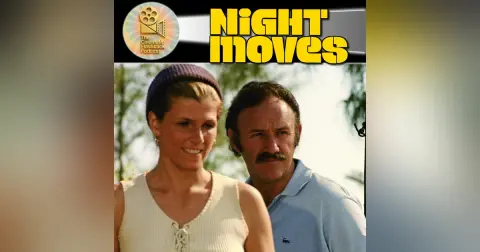
Gene Hackman stars as private investigator Harry Moseby in Arthur Penn’s Night Moves (1975), one of the most fascinating neo-noir detective films of the New Hollywood era. What begins as a routine missing-person case gradually becomes something far more complicated, as Harry discovers that following the clues doesn’t necessarily mean understanding what’s really going on.
Chuck and Matt revisit this overlooked 1970s movie and explore how Arthur Penn takes the classic film noir private detective and drops him into the uncertainty and disillusionment of 1970s America. They discuss Gene Hackman’s complex performance as Harry Moseby, Jennifer Warren’s mysterious Paula, a teenage Melanie Griffith in one of her earliest film roles, the striking cinematography, and the chess metaphor that runs throughout Night Moves.
They also look at the film’s unfortunate 1975 release timing alongside Steven Spielberg’s Jaws, Penn’s description of the characters as “mourners of the Kennedy generation,” and how Night Moves developed a reputation as one of the standout neo-noir films of the 1970s.
Does Arthur Penn’s dark and deliberately elusive detective story still groove through the decades, or has it lost its beat?
Hop into the Wayback Machine with Chuck and Matt and the Cinematic Flashback Podcast as we revisit Gene Hackman in Arthur Penn’s Night Moves (1975) and continue our journey through the unforgettable movies of 1970s cinema.
Links & Contact Website:
https://www.cinematicflashback.com
Contact Us:
https://www.cinematicflashback.com/contact/
Listen to Previous Episodes:
https://www.cinematicflashback.com/episodes/
Leave a Review:
https://www.cinematicflashback.com/reviews/new/
Read the Blog:
https://www.cinematicflashback.com/blog/
Subscribe:
https://www.cinematicflashback.com/follow/
Share the Show:
Tell your movie-loving friends!
Other Podcast You Might Enjoy:
- Surely You Can't Be Serious Podcast
- 30 Something Movie Podcast
- A Film By Podcast
- Dockingbay 77
- Def Dave's 1984
- Accidental Legends
- Phasers Set to Stun
- Children of the 80s
0:01 You beating yourself? That's a position from a game played in 1922. Can you play? I know the moves. Black had a mate. He didn't see it. Queen sacrifice. And three little knight moves. Check. Check. Check. Oh, that's nice. But he didn't see it. He played something else and he lost. Must have regretted it every day of his life. I know I would have. Matter of fact, I do regret it. I wasn't even born yet.
0:46 Welcome to the Cinematic Flashback Podcast. Get ready to hop into the Wayback Machine as we journey through the wild, bold, and unforgettable films of the 1970s. Each episode, we break down a classic movie or forgotten gem, seeing how it performed then and now, and wrapping things up by asking, did it groove through the decades or did it lose its beat? I am your host, Chuck Bryan, and today... We are reviewing Arthur Penn's 1975 film Night Moves, starring Gene Hackman, Jennifer Warner, and Melanie Griffith. Joining me as always is my pal and co-conspirator, Matt Sargent. Matt, how are you doing? Chuck, I am well. Just getting done with a very large party at our house for my daughter's birthday. I cooked some pork barbecue and a couple of briskets.
1:34 Yeah. Where was my invite? You should have been. It seemed like everybody came. We had about 60 people in the backyard. Oh, wow. Rented a tent. I mean, it was a big day. Nice. Nice. It all came out pretty good, the food. I cooked the proteins, but we bought our sides and stuff from a place near us called Pungo Boys Barbecue. Oh, Pungo Boys is amazing. excellent. Yeah, they're very good. If you are in the Hampton Roads area, you need to go to Pungo Boys. Yeah, if you're staying in Sandbridge or something like that, definitely go out and grab some stuff from Pungo Boys. I can't say enough. They're only open Wednesday through Sunday. So be aware if it's Monday or Tuesday, you're out of luck. We got some really excellent coleslaws. And then we also got this mac and cheese, which was amazing.
2:19 So anyway, we had a lot of fun with that. Everybody had a really good time. It was It was hot, but not too hot. Yeah. So it was fun. So I also want to report that I have been invited to a book club. Uh-oh. Have they heard this show yet? I was like, OK, I'll be in the book club. But they invited me to the book club. It's from the party. It actually happened at the party. They decided they're going to do this. And I was going to say it's my first book club. It's really not. My wife and I belong to like a couple's book club before. OK. We got out of that because these people in this book club really started to focus on self-help books. Oh, OK. Yeah. And I'm not saying I don't need self-help, but I'm not really a fan of detailing how the book impacted me to a group of strangers. To me, it was too much like some sort of Kmart brand group therapy.
3:09 So we were out. Dude, I would be there with popcorn to hear you give some of your opinions on those books. But the one we're reading now is Lonesome Dove, and that's quite a book. That's a thick book. That is a thick book. Anyway. Well, hey, look. This month, we're talking about two neo-noir films. These are just a classic detective stories that have been given a distinctly 70s twist. We talked about neo-noir in season one with Chinatown. Right. I have to admit that Chinatown was one of my two favorite movies that we covered. The other one being McCabe and Mrs. Miller by Robert Altman, who is famous for taking a genre that is traditional and reimagining it for the 70s. So if you remember in McCabe and Mrs. Miller, he moved the Western from the dusty Southwest to the rainy Pacific Northwest. Yeah. What the two films that we're going to look at this month is going to ask is, what happens when you take someone like a Sam Spade or Philip Marlowe and drop them into the 1970s? In most of these types of film noir, they always have a detective who has been hired to solve a case, but really there's always a bigger question, which is, What's really going on here? And if you remember in Chinatown, Jake was originally hired to find a missing man, but
4:41 it turned out to be about power and corruption. Right. One of the hallmarks of new Hollywood cinema, especially in the early 70s, sometimes these movies would not give you answers. They wouldn't resolve it, say, like a film from the 50s or the 40s. They would just tell you, forget it, Jake, it's Chinatown, and then roll the credits and pull out. Forget it, Jake, it's Chinatown. This month, we are exploring Harry Mosby in Night Moves, and then we're going to get Robert Altman's take on on Philip Marlowe himself, played by Elliot Gould, in The Long Goodbye. I was excited for these films because, believe it or not, I had never seen either one of them.
5:27 I guess I was right there along with the other people who missed Night Moves, and I'm not sure what happened to me about The Long Goodbye, why I missed it. After watching Night Moves, obviously, you know, Gene Hackman, just off the hook. We're going to get into him real fast. This is the Gene Hackman fan club. Every other movie is a Gene Hackman film. Well, I mean, when you talk about the 70s, you can't leave him out of the conversation. I only knew Gene Hackman really from Superman as Lex Luthor. When I was six years old, my father said to me, Get out. Before that. He said, son, stocks may rise and fall. Utilities and transportation systems may collapse. People are no damn good. But they will always need land, and they'll pay through the nose to get it.
6:16 Remember, my father said, land. Wow. I'm really surprised that he was Lex Luthor. I think there's a little bit of pay in the bills on a couple of those, although bring somebody into that kind of film, whether they mean to or not, they're going to make it different. I think the issue with Gene Hackman is he can't stop being Gene Hackman, and he's going to bring that depth and that gravitas, I guess is a great word. But I really have gained a new respect for him in seeing these films. Sure. Matt, who is talking to us this week? We have a comment that was left on our Facebook page by James Buckley. He was responding to our White Line Fever episode, and I quote, I don't think I have ever intentionally seen this one. That said, I do remember the CB my dad had in his Jeep and how he and my uncle would use it to coordinate family trips. The next year, however, I do remember going to the drive-in with my parents to see the horror film Shadow of the Hawk. which starred Jan Michael Vincent and creeped out six-year-old me to a high degree. Another fun episode, guys. I love the Dick Miller shout-out. His quirky shop owner roles will always be favorite scenes from The Howling and The Terminator. Well, that was really nice, James.
7:34 And just for you, I'm going to give you a flashback thank you. Are you ready? Breaker19Breaker19, you got your ears on Jim James? Come on back for the flashback. I got a message for you. We hear you five by five and five miles wide. Good luck, good buddy, and thanks for giving us a holler. Flashback signing off. Matt, I never know what you're going to say. I think I underestimated the nostalgia factor that listeners had with CB culture. So I'm glad we had a whole month to explore that. Yeah, I agree. There must be a deep seated need for humans to communicate.
8:15 I agree with that. We're trying to scratch that itch with the cinematic flashback podcast. All right, Chuck, you've been doing the homework. What did you find out? How did night moves happen? So, Matt, it all starts with Scottish writer Alan Sharp. Instead of adapting one of the great literary detectives, Harry Mosby was completely Alan Sharp's creation. Where were you when Kennedy got shot? Which Kennedy? Annie Kennedy. Why do you ask? It's one of those questions everybody always knows the answer to. Penn described the characters of Night Moves as the mourners of the Kennedy generation. This is an America that is dealing with the assassinations of John F. Kennedy, his brother Bobby, and MLK. And I think that's what he saw in Sharp's screenplay. It wasn't simply another detective story. It was an opportunity to tell about the people living in 1970s America.
9:16 Warner Brothers paired Penn with Gene Hackman. Hackman had already established himself through films like The French Connection, Scarecrow, and The Conversation. Bruce Surtees handled the cinematography, Dee Dee Allen edited the film, and Michael Small composed the score. Production took place in California and the Florida Keys, giving Night Moves a visual identity that distinguished it from the detective films audiences had grown up watching. When Night Moves was released in the summer of 1975, critics generally admired it, although audiences were slower to embrace it. its reputation grew steadily over the years, and today it's widely considered one of the greatest neo-noirs of the 1970s. And Matt, that is how... Night Moves happened. It was a remarkable screenplay, a visionary director, a phenomenal cast and crew, and most importantly, the right moment in American history for a film like this to be made.
10:13 Yeah, when you watch it, you certainly see that convergence of that amazing talent. And it's cool to hear about the behind-the-camera people, which I find very interesting. Yeah. Let's take a quick break. We'll be right back. It's a cinematic flashback. Let the show begin. It's a cinematic flashback. Let the show begin. I think Harry would like me to leave. I don't think that's necessary. I think Harry thinks it is.
10:54 Harry thinks if you call him Harry one more time, he's going to make you eat that cat. Gene Hackman is Harry Mosby. Hello, Harry. In Night Moves. Oh, come on, take a swing at me, Harry, the way Sam Spade would. He's a private investigator. My daughter, Deli. Would you believe Delilah? Well, she's gone. How long gone? Two weeks. Go find her. Making a living. Well, let's say 125 a day in legitimate expenses. From other people's lives. You can get cheaper. Can I get better? You're hired. Making a mess of his own. God, you're really prime, Ellen, you know that? I catch you screwing another guy and you attack my lifestyle!
11:35 Your lifestyle has nothing to do with it! Night moves. It's a mystery. I'm looking for Deli Grasner. Deli isn't around here anymore. Where the suspects are also the victims. I want to know what I walked into. Ask your wife. Well, are we going to talk about it? Well, it's your ball. Run with it. Where the questions. All right, what's it all about, Mosby? Is there still much smuggling going on around here? The dogs have fleas. Where were you when Kennedy got shot? Have too many answers. Where every clue is a lie. I've been listening to your ping pong talk long enough. What was in Marv Ellman's plane? Drugs?
12:16 Was it drugs? Night Moves. Check. Check. Ah, it's a beauty. It's a game where every player is a pawn. Harry moves me, isn't it? Every move is a wrong one. And the winner loses everything. I want to know what it's all about. I told you what it's all about. You, what the hell are you all about? You're asking the wrong question. Gene Hackman in Night Moves.
12:57 And welcome back. Night Moves.com. It opened up on June 11, 1975 in New York and was followed July 2, 1975 in Los Angeles. Right between those dates, something happened. On June 20, 1975, another movie opened on 464 screens across North America. Within weeks, even that had expanded dramatically. And that movie changed the business. It became the highest grossing film of all times. A record it held until Star Wars came along. Matt, you know what we're talking about. Jaws, of course. And I have to give my younger self a pass on missing night moves.
13:45 Yeah. Because clearly I was watching Jaws. What's in the theater next door watching Jaws? We had almost the same story with William Friedkin's movie Sorcerer, which opened up like a couple of weeks right after Star Wars. And nobody went to see Sorcerer. Everybody went to see Star Wars. Yeah, yeah. Two really good films by two incredible directors. Both overshadowed by the new directors in the mid-70s. That guy named George Lucas and, oh, what's his name? Steven Spielberg. Yeah. Well, I think the other part about it is, I think this is indicative of that transition between old film system and new Hollywood. No one realized how huge.
14:29 Yeah. Otherwise, they would have strategically released their films not today. At those times. Oh, yeah. The strategic releasing dates of films was a huge deal. And it happened after this. Two great films were 100% overshadowed by these blockbusters. One last production note. Night Moves was shot in 1973, but wasn't released until 1975. We might give our hypothesis for that later in segment three. We've already talked about Arthur Penn and Alan Sharp. Night Moves was produced by Robert M. Sherman. Cinematography was by Bruce Sertes. We saw his work in Dirty Harry. He was a frequent collaborator with both Clint Eastwood and Don Siegel, so if you watch Any movies by either of those two directors in the 70s?
15:21 It is probably being shot by Bruce Sirtis. Editor was Dee Dee Allen. She was a frequent collaborator with Arthur Penn. An interesting later credit, she edited The Breakfast Club. Does Barry Manilow know that you raid his wardrobe? Don't mess with the bull, young man. You'll get the horns. Now, that's amazing. Yeah. Music was by Michael Small. To my ears, he sounds a lot like Lalo Schifrin, and it sounded to me a lot like the soundtrack from Dirty Harry. I made that same mistake when we reviewed Clute, and the music from Clute was also written by Michael Small, and we're going to get to hear him one more time this year when we review The Parallax View in November. Production Companies is Leighton Productions. They only made two films in the 1970s. One was, of course, Night Moves, and the other was a little film, I'm not sure if it did very well, called Rocky. Have you heard of that one? Yeah, just a little bit. Nightmoves was distributed by Warner Brothers, and sharp-eyed viewers may notice that this isn't the traditional WB Shield logo. It is their stylized Warner Brothers logo that was used during this era. This was designed by Saul Bass. Now, he was famous for his title sequences like Vertigo and Psycho, but his bread and butter was made in designing corporate logos. And if you can remember the Geffen Records logo from the 80s with the orb and the cut in G.
16:49 Yeah. Saul Bass did a lot of logos for a lot of your favorite brands. Matt, who is. Starring in this film? Well, of course, the 10-mile-tall Gene Hackman playing Harry Mosby. What's it about? Just wanted to ask him a couple questions. You sound like you might be the police. My name is Harry Mosby. I'm a private investigator. Tom's stepdaughter, Deli, is missing. Ran away from home. I'm looking for her. Critics rank Harry Mosby alongside Popeye Doyle, Harry Call and Little Bill Daggett. One of my very favorite films. He played such a great, terrible character. I distinctly remember coming back from seeing that film and going into the office I worked in and somebody else went to see the movie the same. And I said, oh, they're going to win the Oscar for that film. She's like, I walked out.
17:44 It was terrible. I'm like, you are insane. That is the best Western film that's probably ever been filmed. And it won the Oscar, so. It did indeed. Our next actress, Jennifer Warner, who played Paula. What'd you do before this? This and that. I taught school. I kept house. I waited tables. I did a little stripping. A little hooking. And I tried a lot of water. Sounds kind of bleak. Or is it just the way you tell it? Do you ask these questions because you want to know the answer or is it just something you think a detective should do?
18:26 I'll be honest with you. She looked exactly like a girl I went to high school with. It was striking. Wow. And she was from Florida as well, the girl that I went to high school with. You know, maybe it was the sun tan and the sun kissed hair or whatever it was. But yeah. Yeah. Night Moves was her breakout film role. She came from a respected stage background, including work on Broadway. She went on to become a successful writer as well as a director and taught future filmmakers at USC's School of the Cinematic Arts. Amazing. So we get to see one of the very first roles from an actress who we have seen over and over again in many, many roles, Melanie Griffith. She plays Deli.
19:07 Did you come to get your shirt back? No, no. Okay. No, I came to tell you that I'm a private detective. I heard about your mother. Take you back to L.A. Are you kidding? No, I'm not. Well, you can forget it. Mellie Griffith is the daughter of Tippi Hedren from The Birds and Peter Griffith. No relation to Peter Griffin from Family Guy. Melanie was born August 9th, 1957. This movie was released in June of 75. So she would have been. Almost 18 years old. 9th 1957 this movie was released in june of 75 so she would have been almost 18 years old but if you remember earlier i said this movie was filmed in 73 so when this movie was being made in the fall of 73 she had just turned 16 this movie could not have been made nowadays yeah finally i We wanted to talk about John Crawford because even though his screen time is not that much, he has a lot of impact inside this film. He is no relationship to Joan Crawford, but they did appear in the 1965 film, I Saw What You Did. And the other reason that I wanted to point him out here is that he had a very small role as the chief engineer in the Poseidon Adventure. He was the mayor in the next Dirty Harry film that we will cover called The Enforcer. And you saw him probably in
20:40 just about every classic TV series of the era. That was John Crawford. Well, I got to confess something. Okay. I'm actually related to Joan Crawford. To Joan or John? Joan. Oh. And that's not a great thing to be related to because she was a pretty horrible person. But we didn't know it at the time. But my middle name is Crawford. Really? Yeah. And it's because my mother's mom's maiden name was Crawford and her cousin is Joan Crawford. So I was named after my grandmother Crawford. But we we emphasize the John Singer Sargent relationship. We do not emphasize the Joan Crawford relationship. Still, that's that's cool, man.
21:23 She wasn't a peach. I will respect your family for bearing the lead. I think I can understand why that is page 12 news. Exactly. It's in very small print. I do want to talk about the honorable mentions. Yeah. Because we see James Woods. Oh, my word. Yeah, he was great in this. He played Deli's sometime boyfriend who got beat up by Marvin. Yeah, by this stuntman. He played that really well, and it was great to see him in a young role. It was neat. We also saw Susan Clark as Ellen Mosby. Harry's wife. And Edward Binns as Joey Ziegler. He's that stunt coordinator. And then Janet Ward as Arlene Iverson. That's Deli's mother.
22:05 And when you watch the film, look out for her. She's a horrible character as well. Oh, but she was played so well. Oh, yeah. No, the actress did a great job. Yeah, yeah. There's a scene at the end that I thought she was really great in. So. Anthony Costello as Marv Ellman. Marv Ellman. His character has a very distinctive laugh and the guy is a complete jerk in this. Yeah. Yeah. So. Well, Matt. This was an obscure movie to get because we would have to wait until 1992 before we could actually walk into our local mom and pop video store to find a copy on the shelf. And when it finally did arrive, it was released on VHS and also on Laserdisc. And I happen to still own a Laserdisc player. So maybe if you could reach up there, grab what I'm sure is the only copy they have, flip it over and tell us what it says on the back.
23:01 OK, so this is what it might say on the back of the box. We're taking some license here to make it maybe better than it was. So here we go. Washed-up pro football player who is now a Los Angeles private investigator, Harry Mosby, played by Gene Hackman, takes what seems like a routine missing person case of tracking a rebellious teenage girl to the Florida Keys. As he digs deeper, the draw draws him into a web of deception, infidelity, and buried secrets where every answer only leads to more questions. Directed by Arthur Penn, Night Moves is a haunting, neo-noir that trades easy solutions for moral ambiguity featuring one of gene hackman's finest performances.
23:48 You know on the surface this feels like it should be a straightforward detective story but arthur penn has something much more ambitious in mind night moves isn't quite the movie you think it's going to be and when we get back we'll tell you why right after this quick break. Flashback let the show begin. This is abc. Sunday the hardy boys in a race with death then a visitor from beyond all galaxies who are you a demonic messiah with the power of life and death this man is some kind of a god is this the end or a new beginning for battlestar galactica then a world premiere movie.
24:33 Those girls are the hottest thing around every guy's secret fantasy Wants to get the inside story. The movie that tells what it really takes to be a Dallas Cowboy cheerleader. Watch tomorrow starting at 7 on ABC. It's a cinematic flashback. Let the show begin. If I go up on the mainland now, I get nervous. I gotta come back down here, put my tank on, go out and sit on the bottom for a half an hour. Just to get my head straight. Is there still much smuggling going on around here? The dogs have fleas. Cuba's only 90 miles away and it's getting closer. Hell, there's always a buck to be made.
25:17 How are you? You figured on getting her to go back with you? Oh, it's simple enough. It's just one complication. What's that? You. Me? Why? You're her stepfather. You back her with the cops tonight. Oh, hell, you're not going to. The cops, are you? Well, that would be my next move, yeah. Oh, hell, you don't have to go that far. But I've come to take her back to Arlene. She's not going to like that. Oh, yeah, but the cops. My God, she's just a kid. I wouldn't want you to. She been giving you any trouble? What kind of trouble? Well, I mean, uh, trouble you wouldn't want the cops to know about. Well, she, uh. Open the door. Thank you.
25:57 Harry, you're a pretty straight guy. And I'm gonna tell you, I want that kid the hell out of here. You see, I got pretty foolish with her and I... Well, you've seen her. God, there ought to be a law. There is. Welcome back. From here on out, we're going to be talking about our thoughts on Night Moves. So if you haven't seen it yet, consider this your spoiler warning. We may mention things that would ruin the story for you. Night Moves is available to rent or purchase through the usual digital services. If you are a collector of physical media, we recommend the Criterion 4K release of the film. Not only do you get the 4k restoration but you also get a commentary track as well as other extras you.
26:46 Know i i bought the criterion edition i have it right here nice when they released it last year i i had never seen it but i bought it purely because number one it starred gene hackman number two It was set in the 70s. And that was all I had to hear about the film. And I bought it last year. I watched it. And I've been trying to get it in our schedule ever since. Where did you buy it, if you don't mind my asking? Criterion has their online store. You can go there. They have an excellent product. subscription-based service if you want to subscribe and watch classic movies directly from them. Or you can purchase their films. Best to wait for sales near Christmas. The movies with the 4K tend to be a little bit more on the expensive side. Sometimes if you're just trying to collect a film that you really, really like and they have the edition of it, I think it's worth investing in to have that.
27:42 Yeah, and it's not like it's going to, like when you bought VHS tapes, it's like after a few years, it's going to start to degrade. If it's a DVD or whatever, it's basically there for eternity. As long as you can find a player. It took me some doing to replace my Blu-ray player. So you said that this was your first time seeing the film. Yeah, yeah, it definitely was. I really did enjoy it. There were some parts that were, you know, a lot of low talking. And I've noticed as I've gotten older that I can't hear it when people talk low. And I don't want to crank up the sound because, you know, my wife might be upstairs sleeping when I'm watching the movie or something. So other than that, it was really cool because it was much more than what it appeared.
28:25 Sure. So that was cool. It wasn't just a straight detective. What's going to happen? And then you start to really put things together with the name of the film. I had no idea what I was in for. I wasn't sure by the end exactly what I had seen because I thought that this movie was about Gene Hackman's character, Harry Mosby, getting hired to find a girl who had run off and to bring her back to her mother. But there was ostensibly this whole other thing that was going on that you don't find out about until the last few minutes of the film. And I kind of ended with that feeling that I had at Chinatown of like, what did I just watch here? I 100% agree. It was definitely much more there than there. what is portrayed but i'm reminded of something i saw on the big bang theory where one of the characters declares that in raiders of the lars the hark you're not doing this one again are you i know but it's but i i now hold every movie up to the fact that if the main character wasn't in the movie would the movie work out the same way and here's the difference if harry bosby did find the girl, everybody would still be alive.
29:44 It's funny because it's true. Well, there's a lot of neat little references in this film. If you are a film nerd, Harry's wife invites him to go see an Eric Romer film. The Romer film that they. Went to see was My Night with Maude, which really is a film about a man and a woman staying up all night and talking. So it really has not a lot of actions. There's a scene in the movie later on where Gene Hackman and his wife are literally sitting up at night talking.
30:27 Yeah, exactly. I found it kind of funny that they had this one comment and then later on in the film, they were basically doing what the movie was about. Right. He didn't think it was like watching paint dry. I think when you pull the thread on what was going on with him playing the chess games and the name of the movie... You may not notice it. So if you do listen to us before you watch the movie, look for this. He pulls out the chessboard and he's asked, what is he doing? Because clearly it's one person playing a chess game, but he's not playing a chess game. He's doing what a lot of people do. He's replaying a match and watching chess. How it evolves. The interesting part of the game he's talking about is a very famous game where the one player was basically on a whole nother level. Meanwhile, the other player was basically battling this small battle, not realizing that the larger pieces were being moved to ultimately crush him. So there was like a game within a game and he totally missed it.
31:26 So the idea that he was playing this game in chess and then this case and the larger conspiracy around what was happening, he didn't understand it. It's paralleled. The other last thing was night moves. I guess there was night moves, just things happened at night a lot because there was infidelity. There was, you know, some level of sex and that sort of thing. But there was also the kidnigget moves. Kidnigget. Kidnigget. And one thing I do want to point out about Bruce Surtees, the cinematographer, Gordon Willis, when we reviewed Clute, we said that the lighting was so well done that it just really emphasized shadow and light. Well, Bruce Surtees is definitely giving him a run for his money. If you've seen a film where they have shot day for night, you always recognize it. He was shooting night for night.
32:16 And so the blacks are really, really black where they're shooting. The 4K restoration is gorgeous. On this particular item. I will also point out in that part of that cinematography, when they're in that area of Florida, they're sort of at that ramshackle building where they're sort of living, they're gaps and screens they really use that to good effect because you can sort of see beyond what's happening and into the room or out of the room into what's going on it was very effective very yeah very effective. So i thought the set design was amazing in this one it was really good i really felt like i was down in florida and even even the way that the light looks i mean some people have criticized the film that it looks washed out welcome to florida To me, it rang true. I didn't really ever have a problem with how the film itself looked.
33:06 Yeah, no, I agree. So one of the things, though, that you talked about with this move where he was not seeing what was happening on the chessboard, he executed what the player made. It was three moves with a knight. He had the guy in check, but he didn't see that he had him in check. And he eventually went on to lose that match. And he said he never saw it. And he said, even to this day, he goes, I don't even see it. And that is exactly what the whole movie is about. The A plot is him finding Deli and doing the investigation and following the clues. The B plot is something that is much different. And we'll get into that in just a little bit. We started talking about Gene Hackman as Harry Mosby. Let's talk a little bit more about the character of Harry Mosby.
33:48 Is he a good detective? I don't think so. You don't think so? I think he's passable because if you listen to the critique of his wife, he's just taking pictures of people that are being untrue to their spouses and basically what the worst of our conception of private eyes are, is following people to their trysts with their extramarital affair and all that kind of dirty, nasty stuff. This is exactly what the Raymond Chandler's characters would do. Yeah. Yeah, but you asked if I thought he was a good detective, and I'm answering, he was able to chase down where this girl was, and that was sort of okay, but he was so oblivious most of the time as to what was going on.
34:32 And that's my point. There's two sides of Harry Mosby, I think. He's good at following clues. In terms of a detective, he gets enough clues from Arlene that leads him to New Mexico, where he meets the stuntmen. He meets Joey Ziegler. He meets Marv Elman. He meets Quentin. That ultimately leads him to Florida to find Tom Iverson, which is where he meets Paula and then eventually sees that Deli is there. And then the trick, of course, is then to get Deli to come back with him. to Arlene's house and complete the job. But he completes that rather, I don't want to say quickly, but I still think there's about 30 minutes left in the film by the time Deli gets back to California. And I think what you're saying is what's beautiful about this film.
35:18 And it's what makes him. A flawed character. He is great at following clues, but he is... terrible at seeing the bigger picture of what's really happening right in front of him. Yeah. Yeah. I think we see that with his own relationship. He literally makes his money following people around who are cheating on their husbands. And ultimately, he's being cheated on and only just happens to run into it. To come across that. She accuses him of following her. the sad truth is he didn't even think to follow her. He just happened to see her with this other guy. This is why I think he's a bad detective. Anytime somebody is standing to inherit a ton of money, the idea of returning that person to the person who would benefit from getting all that money is probably a bad idea just on the face of it, right?
36:11 Yeah. Deli's going to inherit this huge fortune. Her ne'er-do-well mother, who doesn't really treat her very well, doesn't seem to really even like her, will get all the money if Deli's out of the picture. So the idea of getting Deli and bringing her back is ridiculous. Why did you do that? And then you just walked away and drove away while the girl was screaming. I mean, I. That was the part where I'm like, you're just obtuse, dude. I mean, well, they were they were definitely having a large fight. I think that's where Quentin was was accusing him. Why would you bring her back? Right. Right. And he was the only one speaking sense. He's like, why would you bring her back to this? These people that that basically were using her and then, you know, I mean. I think this is the beauty of Gene Hackman is that he's playing a role that, you know, OK, you can sort of walk in his footsteps to a certain extent. You got to go, what are you thinking of here? And your job. I will also point out, when you talk about it, his job was to locate the girl. It wasn't to bring her back. It was to locate her. No, it was to locate and bring her back. Well, I think he could have gone back and said, she's with your ex-husband. Go get her yourself.
37:14 Let's talk about the film's femme fatale, which was Paula, played by Jennifer Warner. You realize the entire time she is not working with Harry Mosby. Yeah, no, she's deep in this conspiracy business. You know, you hope while you're watching the movie that she's sort of not part of it. I think you hold out hope that she's not part of it, but it becomes very clear at the end that she's accomplice. She knows it all. So this conspiracy, the concept is first introduced when Harry is getting the job to go to Arlene. And there's this artifact from Mexico that are currently very valuable. There is a smuggling operation that ultimately involves many of the characters inside of this movie. And you don't really know who's involved with it, to what extent. I'll be honest, Matt, it's never really definitively said except for a couple of people.
38:08 Paula being one, Tom Iverson being the other, Marv Ellman being the third. The final piece of the puzzle is revealed in the closing scene of the film. And this is what Mosby is not seeing in this whole film. And Paula is doing her best to keep Mosby distracted. Who are you getting out of it? Me? Oh, some change. A little more fuel for the flight. Bus ticket for the next stop after Key West. I got into it because I got involved with Tom. And I got involved with Tom because.
38:51 He was the only man around who got nicer as. He got drunk. But in the very end, in the ending scene, she gives up the ghost. She tells what's going on. She takes him out to find, you know, basically discover what they're doing. It has to do with pre-Columbian artifacts and things like that. So, you know, everything starts to come to a head. But I'll be honest, at the end of the movie, it's a very exciting scene. I don't think we should spoil it. And in the ending scenes, you may do what I did, which is I had to go Google it and say, what did I see? What did I just watch? What did I see? And it does help because it's a little bit obscured because of that. We talked about before the lighting and the underwater photography. and stuff like that. So the closing shot of Gene Hackman looking down through the glass bottom boat and the cameras looking up at him.
39:38 That is one of my favorite shots ever. That is such a wonderful, wonderful shot. And I could care less with what he's looking at so much, although that that revelation opens up a whole nother line of questions in my mind as to what was being involved there. Yeah. Well, let's move over and talk about the other actress in this film, Melanie Griffith. She was 16 years old when this film was made. Tropical fish. It's the Alaskan fingerfish. It's very rare. And that's the dorsal view of the Alaskan fingerfish. What about all those sharks after swimming?
40:19 You're worried about sharks with Deli in the water? Yeah, so I think in this film, the character of Deli is a lost soul. I think she was a very liberated 70s teenager. Yeah, I don't think that disagrees with my statement of being a lost soul. What I think is she didn't have any grounding. She didn't have any basis for morals and whatnot. And you can call it liberated, all that stuff like that. But what I'm arguing is her real dad is out of the picture. The stepdad's in and out. She's clearly, like you said, liberated and having lots of boyfriends and basically being a searcher, in my opinion. The long and short of it is I think she's just a pawn. Again, the night moves thing. She's a pawn being moved around by the larger chess pieces on the board.
41:05 That's my personal opinion. She's definitely being used by the men on the board and her mother, as well as the girl who is down there with Gene Hackman. Paula. She's manipulating her as well. I didn't think that she was part of the smuggling ring. No, I don't think she was at all. I think she was around it to where... At one point, though, there is something that happens right on her dive that reveals something about one of the characters. And I think at that point she has become a liability. I think you're giving her more credit for being in control. I think she was like I described. She was a pawn being moved around the board and then ultimately sacrificed. I actually don't think we're as far away as it might seem.
41:47 Yeah, no, no, no. I will say this. I think Melanie Griffith did a great job based on being a 16-year-old playing with Gene Hackman. Just to hold your water with that guy on the screen is pretty amazing. I had no idea that she was the daughter of Tippi Hedren. That blew me away. She didn't want to be an actress. She wanted to be a model. And then she thought she was auditioning for a modeling gig and got hired for Night Moves. This was filmed in 73. But when it came out in 75, she was in three movies that year. I said, I think I had a theory of why it was shot in 73 and released in 75. I think it was to get her closer to 18 when the film came out. I think all the women in this movie were interesting characters, which is pretty cool. Even Deli's mom and the actress who played her did, I mean, I think an outstanding job of playing this detestable older woman who ultimately is disturbed at the end.
42:38 Get out of here, you son of a. You get it all here, don't you, Arlene? What? You get it all. What's that supposed to mean? That's supposed to mean that I don't like you, Mrs. Iverson. I think Adele never had a chance with you as a mother. She was on a downhill slide right from the start. What does that make me? You know, Adele isn't the only kid who ever. Had it rough. Arlene Iverson. Yeah. She is a quintessential piece of work. Her final scene, it shows she kind of maybe cares about Deli, but at the same time, it's hard to understand or believe that when you're half in the bag.
43:24 Well, speaking of being half in the bag, I think it's time for us to take another break. We'll be right back. It's a cinematic flashback. Let the show begin. It's a cinematic flashback. I think we finally cracked the case on Night Moves, which means it's time for the question we always ask. Did Night Moves groove through the decades or did it lose its beat? I have to say once again that I have no direct knowledge on how this film did back during its release. And as you know, on many of these films, I actually saw them when they were released or very, very close to the release time. This is not one of them. I was clearly in the other theater getting jump scared by a mechanical fish and a mannequin head missing an eye.
44:09 Yeah. But I can say this was a great film and it was a crying shame they did not release it earlier before Jaws was released. It would have been a great after Christmas release with the interesting themes and the filming in Florida. They really missed the boat on this one. Boo. The pervasive dysphoria that settled over the country after Watergate left Americans distrustful of institutions they'd once taken for granted. And I think this is reflected in the film. From the friends telling lies to marriage infidelity to murder, the themes are bleak. But I have to say, I would have probably loved it back in the 1970s, but I may not have 100% gotten it. And I certainly really enjoyed watching it now in 2026, so I think it definitely grooves. But Maybe it's not for younger audiences based on some of the nudity scenes and things like that.
45:02 Like I'm talking about young kids, obviously teenagers at this today's don't really care. They'd think we were just being brutish. What did you think, Chuck? I think we have uncovered two really great Gene Hackman performances this season. I absolutely loved Maxie and Scarecrow. But I have to say, I think Harry Mosby might be the more complex character. Both Penn and Sharp took the classic detective story and they planted it squarely in the early 70s. And I think there's an aspect of that decade that I hadn't really seen. considered before. And this is the impact that those assassinations of JFK and Robert Kennedy had on America. When director Penn described the characters in Night Moves as the mourners of the Kennedy generation, this completely reframed Harry Mosby for me. He's a man who remembers a time when the world made sense, or at least it seemed to. Now he's living in a post-Vietnam, post-Watergate America where institutions have failed and his marriage is collapsing and every answer uncovers yet another layer of deception.
46:09 Harry is not Sam Spade. He's a detective who never quite understands the whole board, and I think that's exactly the point. I also just loved Jennifer Warren as Paula. She is one of the most fascinating characters in the film. She's mysterious, she's intelligent, and she's never quite what you expect. She was a wonderful twist on the classic femme fatale. I definitely didn't catch everything on my first watch. I don't think you're supposed to, but both times, the final sequence and the final reveal was absolutely haunting and left me with a lot more questions. So for me, this is no surprise. Nightmoves grooves to the decades. Matt, do you have any final thoughts?
46:54 No, just that usual, you were able to describe sort of the genuine sort of core greatness of the film much better than I am. But yeah, I agree with everything you said as well. And I do think there was definitely a callback to kind of the general dysphoria of the age at that time. And I actually remember it because I remember Watergate. I remember my parents after Watergate. I remember kind of the general, hey, this isn't supposed to happen in America. We're America. And really, I think this reflects it incredibly accurately. It's definitely one that helps us to understand what was impacting the filmmakers of that time. I think we see it a lot in Arthur Penn. Arthur Penn actually did work for JFK, so he was very close to that group, and I think that it impacted him and the direction of his work. If you haven't seen Bonnie and Clyde, pull that one up again. That was a good film, and considering everything you and I have been talking about with regards to the ending of the Hays Code and how much freer these movies started becoming. His work on that was really good. He made a lot of good films early on and then kind of trickled off into retirement, I believe. But he was really good. And also Gene Hackman is in Bonnie and Clyde as well. And I think you enjoy- I think you would enjoy his performance in that. I actually have seen Bonnie and Clyde, but it's been some time. It's definitely up for a rewatch.
48:27 The one movie I haven't watched yet is I have not watched Easy Rider. Oh, yeah. I have that on my list of things to do today if I can get the lawn cut. Yeah. Okay. I think we're ready to wrap up this one. Join us again in two weeks as we continue our Shades of Noir month. We'll be returning to the films of Robert Altman to look at his unique take on Raymond Chandler's legendary detective, Philip Marlowe, played by Elliot Gould. This version of Marlowe has often been described as a Rip Van Marlowe, as though he fell asleep in the 1940s and suddenly woke up in the 1970s. He might not have changed, but the world around him certainly had.
49:10 Join us as we continue exploring the many shades of noir with Robert Altman's The Long Goodbye. We want to thank you for taking the time to tune in. If you seen Night Moves, we'd love to hear what you think. Reach out to us on Facebook or leave us a message over at cinematicflashback.com. Don't forget to subscribe so you never miss an episode. And if you're enjoying the podcast, we'd really appreciate if you left us a rating and a review. In fact, your review just might get read on the air... And if you've been enjoying the show, tell your friends and family about what we still proudly believe is the best podcast dedicated exclusively to 1970s cinema. Join us next time as we climb back into the Wayback Machine and head once again to the 1970s for another cinematic adventure. We'll see you next time.
50:14 Where were you when Kennedy got shot? Which Kennedy?