
 Spotify

 Amazon Music

 Apple Podcasts

 iHeartRadio

 PlayerFM

 Podchaser

 YouTube
 RSS Feed
Hackman & Pacino’s Forgotten Masterpiece - Scarecrow (1973)
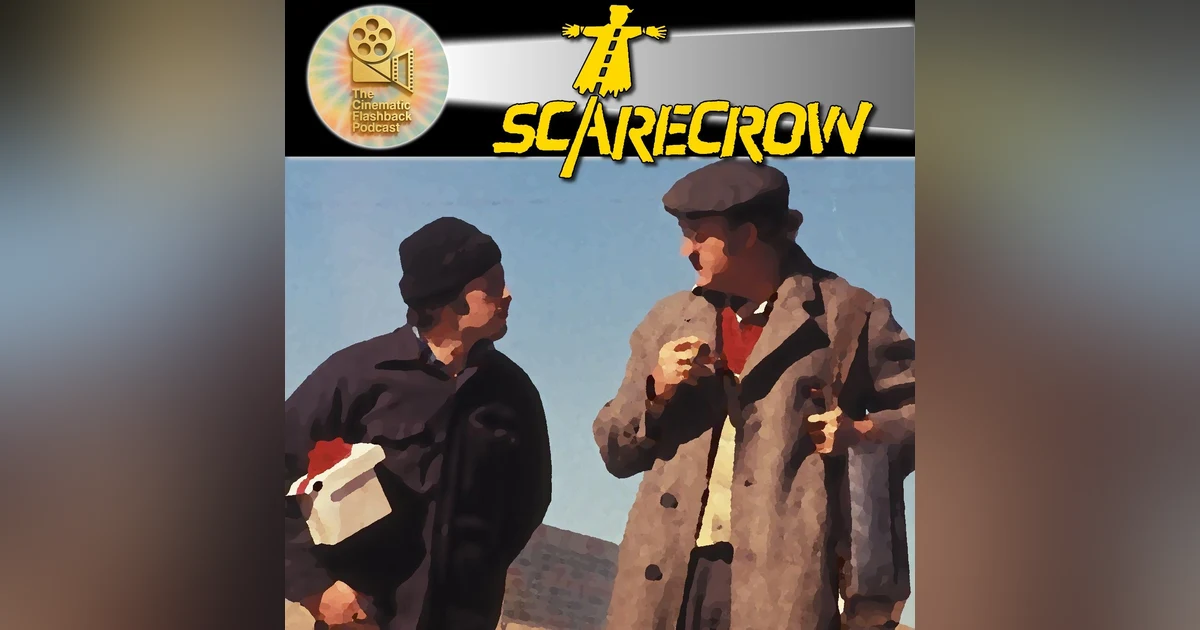

In this episode of the Cinematic Flashback Podcast, we wrap up our 1970s Road Trip series with a deep dive into Scarecrow (1973)—a Cannes Film Festival Grand Prize winner that has become one of the most overlooked and underrated films of the New Hollywood era.
Starring Gene Hackman and Al Pacino at pivotal moments in their careers—between The Poseidon Adventure and The Conversation for Hackman, and The Godfather films for Pacino—Scarecrow is a powerful 1970s road movie that blends realism, character-driven storytelling, and emotional depth.
We explore:
• why Scarecrow (1973) won at Cannes yet faded from mainstream film history
• standout performances from Hackman and Pacino
• the film’s themes of friendship, masculinity, isolation, and survival
• and how it compares to other classic 1970s films
Following two drifters—Max and Lion—on a cross-country journey, Scarecrow is a forgotten gem that rewards deeper reflection and multiple viewings.
Is this underrated 70s classic a hidden masterpiece… or a film that lost its place in cinematic history?
Join us as we revisit Scarecrow (1973) and decide—does it still groove through the decades, or did it lose its beat?
Links & Contact Website:
https://www.cinematicflashback.com
Contact Us:
https://www.cinematicflashback.com/contact/
Listen to Previous Episodes:
https://www.cinematicflashback.com/episodes/
Leave a Review:
https://www.cinematicflashback.com/reviews/new/
Read the Blog:
https://www.cinematicflashback.com/blog/
Subscribe:
https://www.cinematicflashback.com/follow/
Share the Show:
Tell your movie-loving friends!
Other Podcast You Might Enjoy:
- Surely You Can't Be Serious Podcast
- 30 Something Movie Podcast
- A Film By Podcast
- Dockingbay 77
- Def Dave's 1984
- Accidental Legends
- Phasers Set to Stun
- Children of the 80s
0:01 Do you think crows are scared of a scarecrow? Yeah, they're right. Oh, crows are not scared. Believe me. Crows are laughing. The farmer puts out a. Scarecrow right with funny hat on. It got funny face. Crows fly by, they see that strike some plenty, makes him laugh and then they say, well, that old farmer Joe's down there. He's a pretty good guy. He made us laugh, So we will bother anymore. Hello, carry something. That's the most hair brand idea ever heard? That is true.
0:45 Welcome to the Cinematic Flashback Podcast. Getting ready to hop into the wayback machine as we journey through the wild, bold, and unforgettable films of the nineteen seventies. Each episode, we break down a classic movie or forgotten gym, seeing how it performed then and now, and wrapping things up by asking did it group of the decades or did it lose its beat? I am your host, Chuck Bryant, and today we are reviewing Jerry Schatzburg's nineteen seventy three film Scarecrow, starring Gene Hackman and Al Pacino, and writing the rails with me today is Matt Sargent, Good to see you. Well, it's good to be back. Running away to join the navy takes a lot of time.
1:27 Let's get back on the road, oh man. That is right. In our last episode, we took a trip with Jack Nicholson, Otis Young and Randy Quaid and hal ashbats the last detail. Today, we are traveling cross country with a film I first saw last year, right after Gene Hackman passed away, Scarecrow. I'm going to go out on a limb and guess this was a first time watch for you as well. It was. Indeed, I had never seen this film before, and that was a treat to see it now that I'm old enough to appreciate it. Twelve year old me would not have enjoyed this film. That is definitely for sure. By the third act, the story gets really deep and I cannot wait to get into it. Who is talking to us today, Chuck. Our good friend David Burns posted a review on Facebook for us.
2:16 I don't know if you remember this, but David was the game show host on our Jaws episode. That is a very fun episode that people should go back and listen to if you haven't. He writes, and I quote a fantastic podcast with some knowledgeable hosts that make it not only interesting but also a lot of fun along the way. Highly recommend to not only listen to this podcast, but add it to your daily routine. Trust me, you won't be sorry. We have our work cut out to make this into a daily podcast. David. We appreciate you. We love your work over on both a Film by Podcast and Phaser Set the Stunt. Jeff, David and the whole gang make shows that you actually could listen to every single day and make it a part of your daily routine.
3:01 Yeah, I think a daily would be tough for me at this point in the game, but I encourage you, Chuck, to go ahead and dedicate your life to making a quality podcast. Oh well, let me tell you. Yeah, we want to hear from you. Post a review of the Cinematic Flashback podcast and it will be possible for you to appear here in this podcast that you yourself review. Oh that's great, Matt, Thank you, Matt. I have a hypothesis as to why Scarecrow is a forgotten gym. This was a small film. It was intended to be a small film by the studio, and it was a small film in the Valley overshadowed by much larger films of that time. For example, nineteen seventy three, this might be the year we've covered the most on the podcast. Nineteen seventy three was stacked at the box office. The top ten films included The Exorcist, The Sting, American Graffiti, Papion, The Way We Were, Magnum Fours, Live and Let Die, Disney's Robin Hood, Paper Moon, and Serproco.
4:15 Yeah, and just one year earlier, The Godfather dominated nineteen seventy two. The Poseidon Adventure opened in December and rode that disaster movie wave straight into nineteen seventy three. I recently read a quote that Gene Hackman gave that said he did the big budget films so that he would be free to do films like Scarecrow, which you know, I think we all can see that was more of an art film, smaller budget, very intimate, and I think when you watch the film, we're really glad that he got the big payday and was able to do this film. You know, Hackman also never made a small film like this ever. Again, he was blowing up and also too al Pacina. Yeah. In the summer of nineteen seventy three.
5:01 Scarecrow was not a forgotten film at the time it may director Jerry Shatsburg took Scarecrow to cons and it shared the top prize, what would become the Palm d' or. That's one of the most prestigious honors in the world of cinema and back home. It wasn't really a disaster, but it wasn't a blockbuster hit either. It hit number one one time briefly in late June of nineteen seventy three. Reviews were mixed. Critics praised the performances, of course, especially Hackman, but questioned the film's final third act the most. Over time, it just slipped out of the mainstream conversation. It went from winning the world's biggest prize in cinema and somehow just becoming one of the least talked about films for either Hackman or Paccino.
5:51 Funny last night, I asked my group of seventies film buffs about Scarecrow, and even though some of them are a couple of years older than me, none of them remembered it, which is sad because I think it was a good film. Of course, look at what came out next. I mean we just talked about it, so it's easy to see why it had been relegated into the dirty gift box of the past. Yeah, well, I think we're ready to get into the production details, but first we need to take a quick break. Yeah, you're driven a jail a line. You'll buy it right us. Behold the captains of industry, the prospective owners of Maxie's car Wash Pittsburgh, Pennsylvania, maybe Maxi's car Wash carwash.
6:37 Yeah, okay, for every car where it is dirty. Max and Lion. The only difference between them and the Rockefellers is a few hundred million dollars and about fifteen hundred miles. First off, there's Max. I've got to tell you. Something about me, some Meana Sundlin. I mean trust anybody. I don't love anybody. Hey, we're gonna be partners. Okay, okay, all right, come on, Max did six years in prison for beating the hell out of a guy and it didn't teach him a thing. Okay, all right, No, Max, just one way.
7:18 Believe it or not. Max is the brains of the partnership, a. Me plastic fie for Joe Building six. And then there's a Lion. I think your speciality is gonna be waxing, waxing, wax no nowhere. And keeping the customers happening. Lion figures if you can make somebody laugh, you won't ever need to fight. Why did your call? Stupid? Lion is a scarecrow. You don't have to hit people. How did you make them laugh? Crowser not scared. Believe me, crows are scared.
7:59 The croisy laugh, crosy laugh. Right. You know in a joint, I heard some tails. Oh boy, Holly, I heard some tall tales. I mean, you're not playing with the full deck. Man. It's been five years. You know. Your wife might be married, you might have moved. Away, but you give her a call. Look, I want to see my kid, right, What am I going to do? Shove the lamp through the phone? Sure, sure, send the money and see the world. Any please look, let me come over. I don't want to see you. Max and Lion, the prospective owners of Maxi's Car Wash. All they have to do is get to Pittsburgh. Between California and Pennsylvania, there are a lot of.
8:41 Ups kicks on the house everybody, and. A lot of downs. Max and Lion, the future owners of Maxi's Carwash, Pittsburgh, PA. Welcome back. Let's get into these production details. Scarecrow was released April eleventh, nineteen seventy three, distributed by Warner Brothers, with a running time of one hundred and twelve minutes. It was directed by Jerry Schatzburg. I had never heard of him. I had to go and look him up. He was once a high profile fashion photographer for the magazine Vogue. He even shot the cover of Bob Dylan's Blonde on Blonde before moving into filmmaking with a film called The Panic in Needle Park, which helped launch Al Pacino's career. What goes better with Shatsburg's eye than cinematographer vilmosh Zigmann, whom we've talked about countless times on this podcast, most recently on Deer Hunter. You can still see his fingerprints all over this film. The screenplay was written by Gary Michael White, and it was one of his original stories.
10:01 The score was composed by Fred Meiro. Now this was one where that name I recognized, but I had to look him up and I learned that he was a classically trained composer who at one point worked with Leonard Bernsteine at the New York Philharmonic. But nineteen seventy three turned out to be a pretty big year for him too, because he scored Soylink Green as well as Scarecrow back to back. But I'm sure that most genre fans might recognize his name from later in the decade, he wrote the score for the horror film Phantasm. So this is a composer who could move from dystopian sci fi to an intimate road drama to this cult horror. But much of the music in Scarecrow comes from sources that are inside the world itself, like from jukebox are radios and you can hear playing Wilson Pickett's in the Midnight Hour and Retha Franklin's You Make Me Feel like a Natural Woman, And even at one point Pump and Circumstances is played on the jute box.
11:17 Which is a hilarious and really very fun scene. And with that playing in the background, it's really funny. Yeah. Now let's talk about the cast, and we need to start with mister Gene Hackman. This is nine years of planning right there, right there, nine years of planning. Initial bank saving so and so, accumulated bank interests so and so, expected salary while I was in a penitentiary. So and so total twenty six hundred and forty eight dollars and seventy three cents. That's planning ahead. Un there's Dan. By the way, that's something you don't do. Is there anything that seventies Gene Hackman cannot do?
11:57 He is He is the man in seventy and I'll be honest with you. One of the things you just told me is kind of sad. But I think about that he didn't do more small films because he's such a talent, and obviously he brought that talent to some big films, and obviously at a certain point, just getting Gene Hackman into your film means you have a big film. Yeah, he was in that kind of demand and he delivered. I guess we'd get a glimpse into how Gene envisioned his craft in a more pure form in this because he really inhabits this character. I have a sneaking suspicion a lot of Max is really Gene Hackman.
12:38 Before the film started, Pattino and I were up in San Francisco and we thought maybe we'd try to get into the characters, you know, the bombs and we got some clothes and stuff and walked around Market Street. I said to maybe we go to the Salvation Army that see if there's a soup kitchen or some mys A guy where it was. And he looked at us and he said, yeah, it's down a couple and you go over in this and I said, thank you, and he said, you're welcome, mister Hackman, Mistercino. To some expense. You know, I always say that about actresses and actors. I mean, I really get. They're pulling from something, right. They're pulling from something. And I don't mean to say I mean there are certain actresses and actors that I have said they are playing the exact same person in every film they appear in. It is themselves. Oh yeah, which you know can be entertaining. It also can be you know, one note flat, I don't think that's Gene Hackman.
13:30 We've seen him in a variety of different roles, playing vastly different personalities. But I have a sneaking suspicion that there's more than a little bit of Gene Hackman in Max. Yeah, and Max is a volatile x con with the dream of owning a car wash in Pittsburgh, and he is the engine that makes this film move forwards that character. When we first started cinematic flashback, if you were to ask me, what role do you know Gene Hackman from I would say Lex Luthor, Superman. I would not have gone through this entire litany of films that we have watched and talked about. Hackman's performance in this is one you don't want to miss.
14:14 What I was really shocked at is al Patino coming in with a performance that I thought was amazing for someone who I am not a big out I we'll just give you the heads up. I am not a huge al Patino fan until this film. Okay, listen, you got a middle name? Why well, I got a little trouble with Francis. You know, Lionel Final Francis Lionel Dope, okay, Lionel no on?
14:55 You are lyon? Okay, Okay. He's best known for his films The Godfather Part one in Part two, but also he's about to do Surpaco, He's about to do Dog Day Afternoon. Yeah. I had one note for both of these guys. It was the way in which each one would prepare for a scene. Oh yeah, we always talk about method actors and method acting. Pacino inhabits who he is, and if you know the character of Lion, sometimes he might be a little too much. Pacino inhabits that character at all times. Hackman is different. Hackman before a scene will just withdraw completely into himself as he is beginning to visualize how he is about to go from being Gene Hackman to being Max. And sometimes those two preparation styles kind of collided on step and so sometimes it wasn't all the world's collide. It wasn't always a happy set on this one. I just think that's kind of part of how the sausage is made.
16:03 I know, Chuck, you and you know I've done this before. You know, we're getting ready to take maybe a large speaking stage. Do we're going to present something, or we're going to present a project, or we're going to I mean, in our small little world, we have to prepare for that. We have to sort of go over what we're going to say. I can only imagine that's in some small piece what an actor goes through to get prepared. For a scenes. Funny thing talking about al Pacino in line, Like I said, in al Pacina, it's not one of my favorite actors in the world, although he has delivered some amazing performances in his career, and in this particular performance, he plays a character lion His real name is Francis Lionel, but he's a former sailor. Yeah, he clearly seems to have some fragility about how he deals with the world. Clearly, we know this, and we'll talk about this when we talk about how the film goes. The rest of the actors were just kind of the minor characters in the film.
16:57 So we had Dorothy Tristan plays Coley, who was Ax's sister. If you went and watched the movie Clue, you'll recognize Dorothy Tristan. She played Arlene Page. Who was the junkie call girl. I did not notice that she was the same actress, But you are a little more attentive on these things than I am. I just read it in her IMDb page. Well, I really enjoyed her performance. It's very hard to play the sister of this Max character. As a family, they were on some hard times because clearly they were on the rails, they were running the rails, they were on their own. Yeah, so it's an interesting peek into what sort of put Max together. And Wedgeworth played Frenchie. She was later known to TV audiences as Lana from Three's Company. She was also an Evening shade. I thought that in the scene where they're eating chicken and she's just kind of nibbling on Gene Hackman's ear, he's eating the chicken thuwing the bones and the bucket.
17:55 Oh, he wasn't completely ignoring her. He is describing, down to the most minute detail, everything about the cost of this particular car wash. I thought that that scene was well written. I don't think it reached the level of his scene in The French Connection two, but I think it was pretty close. For me, it was a great scene for a lot of reasons. One is you have Frenchie, who is a little bit of comic relief, a little bit of just good time fun. It kind of represents kind of the other side of this You've been at this world that these guys are slogging along trying to get to where they're trying to go, and they end up at you know, Cooley's place, and Frenchie is there as well. And I mean, to me, in the film, she represents kind of the what life could be, you know, for Max, for Max, yeah, if he could accept it. And she does a great job in this. She's really it's funny, it's I believe, in my heart of hearts, it's it's actually difficult to play someone Ditzie. So I think there's a lot in there.
19:04 And I really enjoyed her performance, and I'm glad to see that she was in in other things later because I enjoyed her the whole, the way she played that role and how that. Role was written. Richard Lynch played Riley, and he is the trustee at the prison farm who doles out the work details. Richard Lynch would go on to become one of the great scarred villains of eighty genre cinema. Whenever a TV show needed someone who was like a bad guy and you could tell because oh, he's the bad guy because he's got scars, they would turn to Richard Lynch. But there's actually a dark story about how this guy got those scars. And those scars came from a nineteen sixty seven incident in New York's Central Park in which he was under the influence of drugs and he set himself on fire. He burned more than seventy percent of his body and spent more than a year in recovery, and during that time he gave up drug reduse and began training at the Actor Studio and the HB Studio there in New York and found employment in various films and went on to have an incredibly successful career as an actor.
20:20 It's tough to hear because burn victims. I mean, it just is so so bad. I mean it's so painful, and I can see how somebody might have a catharsis from events such as that. But I'm sure glad he was great in this film. You're definitely your hackles raised as soon as he gets on the scene because you're like, h is this guy good? Is it bad? The way they developed that, I think in modern film they'd immediately moved to his villainy ye. In this film, they were careful to draw it out slowly. Yeah, And I thought it was even again, just perfectly done, because you know, I'm and maybe it's by you know my now modern view is like trustee at a prison, he's going to try to hurt someone, right, because we seed it over and over again, it's almost a trope. But back then I don't think that was the case. It was like, you know, I think back then you had the seventies mindset about people going to prison and it's a work farm, and you know, you pay your time and you get out. And we have echoes of the bad situation from conversations that Max and Lion have about Max's time in prison.
21:32 And finally we have Penelope Allan. She plays Annie, who is Lion's estranged girlfriend. She is perhaps the one character in the film that I absolutely hated, just not in a I hated her acting, but I just so strongly disliked her character. Penelope Allen would go on to appear with Pacino again very soon. She played the head bank teller in Dog Day Afternoon. Huh, Matt, We've got the talent, we got the pedigree. So what exactly were audiences walking into in April of nineteen seventy three. Well, we've given you some hints, but let me give you a little bit more of a synopsis. Synopsis together, your little synopsis here here you. Scarecrow follows two drifters who meet on a California highway and decide to travel east together. Max is a hot tempered ex convict headed to Pittsburgh to open his dream of a car wash with money he's been saving lyon as a former sailor who's just been released, and is on his way to Detroit to reconnect with the woman he left behind and the child he has never met. As they cross the country, their odd couple partnership deepens into an unlikely friendship, but a series of setbacks, including a stint in a prison work farm and a painful reunion in Detroit, tests both their dreams and their bond.
22:53 We need to take another quick break, and when we get back, we are going to dive into our thoughts on Scarecrow, Don't Go Anywhere. I'm Amber, I'm Dayton, i am Disney's Jean, I'm Robert, and I'm Tim, and we are the host of the Docum Bayed seventy seven podcast, and we're here to give you a little tease of what to expect in twenty twenty six. In January, we're bringing it back on our very popular sci fi movie Month. That's one iconic film from the nineteen fifties, fifties, seventies, and eighties. You all know that we love Disney on this broadcast. I mean it's literally in my name. So Amber and I are going to be going to spend some quality time with you looking at their live action films from this fifties, the sixties, and the seventies. Think twenty Thousand Leagues, Apple, Dumpling Gang, and so much more. Now, the year nineteen seventy seven was an important year for pop culture. We're talking game changing, earth shattering, culture defining moments. So we are doing our longest series ever looking at films and albums from that legendary year, Docu Base seventy seven, where Broadway references meet the voice of reason and it's healthy for you. We're just a bunch of nerds discussing what we're listening to, watching.
24:01 And reading, and as always encouraging you to listen to more music, read more books, and watch more movies. I remember, physical media is better than streaming. Docing Baby seventy seven. You're a twenty twenty six adventure starts. Here, Welcome back. From here on out, we might give spoilers, so be prepared if you haven't seen Scarecrow, and I'll be honest with you on this one. I really want you to go hit pause and watch it and then come back to this point because this I don't want to give away the spoilers. It's not like there's cliffhangers or anything, but you will more fully enjoy the film if you don't have some of the spoilers we might unintentionally reveal.
24:44 Let's talk about this odd couple. Max is structured and aggressive, while Lyon floats through life and on paper, this pairing really shouldn't work, but somehow it does because both of them are actually outsiders trying to re enter the world. So let's start by talking about Max and Lyon and seeing how these two got pared together. So I think one of the most interesting things about this film is just how it begins and how the relationship between these two characters begin. They both end up on a road trying to get a lift. Max has walked through a field to get there.
25:26 That was a beautiful shot, by the way, it was when I was describing both Villemonsh and the director. That shot is beautiful. That scene is absolutely beautiful. And what's funny about it too, is you have this ultimate beauty and you have Max walking across the field and he has to pass through a barber ware fence, which when I grew up, we actually had one in the backyard, and exactly what happened to Max? What happened to you? All the time you get halfway through, your stuff would get caught. It was very humor. Yeah. Max makes it to this road. It's kind of dusty. The wind is blowing like crazy, and there's not a lot to traffic. You know. The two characters are trying to both hitchhike, and Max is clearly doesn't want anything to do with the other guy.
26:07 Lion is trying to get Max's attention. Rank, What the hell's up? I'm out here now, it's five hours. I don't know. I don't know what he said? Well, do you talk? Well, wait a minute, I'll get him on a wire. Hold on there, George, what the hell happened? I talked to guy Frank on the wire here? You want to talk to him? All right? Go ahead, back. He's carrying a box a gift, right, So this is kind of this. Okay, here's this guy's he's obviously a traveler. On the other side is this man Max. He wants nothing to do with him, He's not even looking at him.
26:47 But they're competing with each other to hitch a ride. And it's revealed why Max ends up being friendly to this character. On the other side, Max is trying to light his cigar. He smokes cigar virtually through the entire film, even to the stick stand of picking cigars up off the ground, and yeah, this is a good one. This guy didn't have any teeth. I mean, some of those lines are just class. Was so funny. Yeah. It turns out that Lion gives him his last match and that ignites the relationship. I see what you did there. They end up getting a ride and they they're sitting at a diner.
27:30 I'll have some opmea hell me one climate milk. Yeah, he helped me and scrambled eggs, anything else, bacon, toast, get that cream man. You got him money. I have to tell you, if ever I could go and see it at a diner with someone while he's ordering food, it would have to be with Max. I just laughed. It's like, well, only went coffee. Then what he asked for to oatmeal, oatmeal, oatmeal, eggs, bacon, then eggs, and the ladies like you want anything else? He's like bacon and she starts to walk away and toast. And it was funny because it was real it was real, but was also real when you you open your mind up a little bit and you think this guy was in prison for the last six years, right, Yeah, no one asks him what he wants. He just gets what he wants when he goes down the line.
28:35 Oh that's true. He's in this situation where someone's what do he want and they will bring it. I mean, think about it. After six years, it's like that. That's pretty It kind of to me it was it opened up. Oh you serially, this guy is definitely they'd both come from institutional food places and then it shows. So I think Max had just finished serving time due to his temperare from a charge and Lion is he was he was a sailor. I don't know if he was in the Navy, if he was in the merchant Marines, but but he was in the s Yeah. Something Max learned very quickly in prison that you had to be a good fighter. Why was Lyon? Why did he become a sailor?
29:17 Lyon ran away from his girlfriend who had become pregnant and he did not want to stay around, and he just think he says it, he's he was I was a coward or something. As a kid. You know I was a kid. Yeah. Max definitely reiterates to him as like, hey, you're a kid. You didn't know what was happening. Now you're trying to make it right and he runs away, but he sends his pay yeah to the girl, although he's never met it. No pictures, no nothing, no contact from her. He doesn't even know if his child is a boy or a girl. Yeah, which then explains the contents of the present as a lamp. It's always funny to see that it's a box and it's got a bow on it, so it's clearly a present, but it's unlike any other present because you can remove the lid and put it back on in the bowstays on, which is an artifact of it being a movie. Yeah, because they needed to be able to show the contents.
30:11 In any other case, it would just been wrapped with paper and he would have said it's a lamp inside. Well, Max was institutionalized in San Quentin. He too, was making good use of his money because he eventually has a dream for what he wanted to do. Yeah, he saved every bit of money and he's got the grand sum of like twenty three hundred bucks. Yeah, that's enough. He's calculated that is enough to get him started on buying a car wash and getting it going. Does it ever say why he wanted to get this car wash in Pittsburgh. Probably he got a magazine or a paper and it had car wash for sale, got fixated in his head that he's going to Pittsburgh to do this. Because there is a time in the movie when he meets up with his sister and their friends and they're trying to convince him why not open a car wash here? Coley has a house. I mean, it's all set up, and they're really trying to convince him. And part of this is that Lion definitely wants to get to Detroit, and Max, without a doubt, is fixated on getting this car wash in Pittsburgh.
31:18 Max is sending his money to Pittsburgh, so I guess his bank is in Pittsburgh, that's right, So that makes the most sense that it's going to be in Pittsburgh. He doesn't quite realize that, Hey, it doesn't really matter where your bank is. You can open it anywhere. And I realized that from a seventies point of view, you might not have that whole ability to wire money back and forth as convenient as it is today. Literally, maybe he did actually have to go there to get the money. Well. I think though, that his singular focus on this is it informs the character a little bit. It's intended to realize that in some ways Max is not very smart.
31:58 In other ways, he's very street smart. He just feels like if he changes from that path, he doesn't know where it'll end, so he is not willing to change anything. And Lion is also somewhat single minded as well, because he could pick up a phone and call from anywhere, right, he. Doesn't need to go to Detroit. I don't know if it's time for this, but I'm going to say something. If these two hadn't met each other, things would be much better for both of them. Interesting, and here's why Max would have gotten to Pittsburgh without much fuss, because he wouldn't have gotten into a lot of anything else. For sure Lyon would have done what his original plan was, which was to walk up to the door and knock on the door. So we will talk about why. My theory is these two guys may have been better off if they never met each other.
32:48 Well, I think that's a good point to begin teasing that out a little bit more. Because Lion has this speech about scarecrows. Crows aren't scared of them, they're actually laughing because the scarecrow looks so ridiculous and it makes the birds laugh. And because the birds are laughing, hey, we're gonna leave this farmer alone. We're gonna go somewhere else. And this is why he's always trying to make people laugh, whereas Max is much more straightforward. He's coming at it with his fist. These are two diametrically opposite ways of handling life and handling the things of life.
33:31 Well, I think there's more to it than just the theory that he describes about the joke. I think this scarecrow, the name of the film, and the two characters really are the two sides of the Lion has a description of a scarecrow being a joke, and it keeps the crows out of the field because the crows enjoy the joke and don't want to hurt the farmer. Mm hmm. That's his theory of going through life. Keep people laughing, they won't beat you up. Whereas Max, on the other hand, is the proverbial scarecrow, right he is big, and he is blustery, and people look at him and probably don't want to mess with him. And when you look at how he's dressed, that is really funny that you bring that up, because it is a very important point in this movie. Max is wearing layers and layers and layers of clothes, which ends up being one of my favorite scenes in the whole film is the first time Max actually maybe avoids a fight is he does a strict keys of his hundreds of layers of clothes in the bar, and it's really fun. It's really funny. But that's sort of the idea for me with Scarecrow was I was like, what does scarecrow mean in this what are we talking about?
34:45 You know? And a lot of times filmmakers tip their hand about what this film is about by naming it. You know, you have the two sides of this view of a scarecrow, and you know how they navigate life using that. And I think for the most part, Lion has been able to navigate his life well with this, except for the fact that it allows him to be cowardly and not face things, which has been Yeah, I think part of what his problem is is that he's not calling. He didn't call her the whole time he was in the navy. He had plenty of opportunities to call or write notes or say I'm sorry I left, but I'm sending you money and I'm coming back, right. He didn't do any of those things. Max, on the other hand, meets most challenges with his fists, which ends him in prison for years and on the rails, and no doubt they probably he and his sister were on the rails because he couldn't navigate society in any normal fashion when she was without him. She then gets a house to live in and has a job in a life so.
35:49 They wind up in this work form because there's a ruckus at a bar. Yeah, but not after it was a good natured ruckus. Were they playing pomp and circumstance in marching around the bar, which was hilarious, It was so funny, But there were some dudes who were they had beef with Max. Yeah, he definitely isn't going to back down, and they went after him when they were outdoors. So now you had basically a whole bunch of people essentially what looked like, you know, a mini riot going on, and the police show up and everybody gets thrown in the whose gap lying in that scene? He wasn't wearing a bee keeper suit, was he? That was like a fire suit. It was some kind of fire suit because he jumps in the fire. Okay, bucket remember at that point, Well, I was reading someone was saying that that might have been a be suit, and I'm like, I was in an early fire fighting suit.
36:39 A be suit would not go on a fire. Yeah, yeah, that was like it's one of the ones you saw when you saw people fighting fires at like oil well fires. I don't know if back in the day you see the silver suit looked like that with a big flat glass right late in all the yet definitely fire definitely fire fighting suit of some sort of welding or something. The two they wind up at the work farm, and this is where we're introduced to the Riley character. Yeah, who immediately, you know, puts the hair on the back of your neck, starts to stand up, and You're. Like, Max is definitely given Lion the silent treatment. This is what allows Riley to come in and start grooming Lion. Now, you and I we pick up on this right away, because.
37:25 You don't get something for nothing. Riley assigns Max the worst job, which is shoveling up the pig excrement down the pig farm. But for Lion, he gives him jobs like washing cars or becoming the talent scout. Yeah. I think we also see that Riley has some kind of connections and he's hooking the Guard up with some outside good time. Yeah. Inevitably leads to the altercation that physically damages Lion. Will Paul's hair for just a moment, think of it as a real change stick around. There's more cinematic flashback coming up right after this, and we're back. The lights are down, the film's rolling, and the final act begins.
38:12 Let's jump back into the cinematic flashback podcast. You didn't ask about the kid, Francis. I was cool, So what is it? Boy? Girl dead? Never even got born, Francis, Because I was left alone. I slipped on the on the front steps in the snow. I fell down them. There was no one there to help me. You know what I mean. I lost the kid. It would have been a boy. Francis, never even got born, never got baptized. You know what that means? That soul cannot go to heaven? Francis, that's what you did. Your son's soul, Your bust is send it into limbo. That soul cannot go to heaven.
39:07 So man, if the work farm is where a lion is physically damaged, I think Detroit is where he is just emotionally undone. Detroit has always been his emotional destination. It's the reason he's on the road. It's the reason that he keeps laughing and keeps smiling, and then he gets on that phone call and everything changes. Yeah. I wanted to point out something from a production standpoint. They may not have had permits to shoot. Oh, they're talking on the side of the road. They're being filmed, and if you look, you'll see the traffic going by. Everyone in the car is looking straight at. Them, right, because there's a bunch of people standing around with with ham reflectors and care.
39:49 That might even be the reason why there's bumper to bumper traffic on this little small town road, because it's a movie being filmed here and people are slowing down and rubbernecking. So obvious that people are rubbernecking. I found it funny, So I think I may have texted you. I said, take note of this scene. I don't think they had permits for. The no no. I think you're right, and they probably thought, oh we can get this. Take at the payphone. Pay attention to him making the phone call. It had a rotary dial which you put your finger in and you moved a certain number of spaces based on the number you wanted to dial. And it was an ingenious invention that allowed the switching equipment to hook your phone to the phone of the number you were calling.
40:34 I find it funny now that you described it, that they were in the rotary phasis and not in the push button, so it was old. Yeah, it wouldn't even it would have been touch tone. The funniest thing that happened to me, and this was this is this has been quite a few years. One of my nieces we were at the airport, and at the airport they have payphones, right. She was probably ten or twelve, and I took her over and I showed her a payphone. I go, hey, look at this, and she's like, it's a phone hooked to the wall. She'd never seen a phone a payphone in her life. So my brief run in with a little bit of larceny was I was down in Myrtle Beach, staying at a campground, and they had a whole row of these payphones near the mini golf. I realized that if you took a palm fron, folded it up and stuck it down into the catch where you put the coin in, you can actually trigger a coin return or something you didn't put in, and you could actually trigger all of the coins to come in. And that was how I got money to play at the arcade. So Lyon makes this phone call. He calls Annie out of the blue.
41:43 I said earlier I didn't like Annie, but she was played so well. You can see that at the beginning, she's excited almost to hear from like she's gone back in time. He's finally called, and then slowly she kind of starts to works herself up into a righteous rage, and she's going to strike at anyone, and she's gonna hurt whoever she can hurt. And that's lie, Lion. She drops this lie on him because you weren't here, because you ran out and you left me. I slipped on some ice and had a miscarriage.
42:24 Max constantly tells him he should just make a phone call right, which would have ended in this way anyway, Lyon's idea was he was always going to go to the door, and I think in this particular case, Max enabled that because if he had gone to the door, I think this is the point of having her on the phone and showing the child on the floor of the one room right there in the view of the front door, that he would have seen the child. Yeah, and he would have been, yes, ashamed, embarrassed, and all those things that he was, but he wouldn't have been broken. He would have thought, Okay, my money went to something good, making a life for this kid. But she closes the door on that, and it's horrific and tragic, and it is why you hate that character. It's why I hate that character.
43:16 From this point to the end of the film, we really don't see Lion as he was. I mean, he's broken. It ends up with Lion going into basically a catatonic state and being in a hospital. And Max is beside himself, I've got money, I've got money I can pay, thinking it's some kind of he needs to pay. I mean, it's just it's a tragic scene. It's really hard to watch. And then what we see is Max he still wants to get to Pittsburgh, but he says he'll be back. He absolutely is coming back for Lion. So the question becomes, after all of that, does Scarecrow still groove through the decade or does it lose its beat today? Matt, I'll let you go first.
44:04 This is one of those films, in my opinion, that when you first watch it, you're kind of like, hmm, not sure. And one of the cool things about being on this podcast is you get a chance to kind of re review your thoughts and feelings about the film when you watched it and really appreciate it. And this is clearly one of those films that on retrospect, on thinking about it, and on review it is far far better than when you possibly first watch it. To me, now, if I had something like the Cinematic Flashback podcast to listen to before I watched this film, I would have enjoyed it far more. But I also enjoy the ability to reflect on the film and appreciate it for the artistic and the the acting that was in it. I definitely appreciated the acting while I was watching the film, but the entire story and how things were done, I really started to appreciate after I reflected on it more.
45:13 This film clearly groofed in the old days because it got that award, so people knew that this was an amazing film. It got lost, I think, in history because it was bookended by two amazing films coming out and blockbusters and the advent of blockbusters in general. Now, watching this much later in life for the first time, I have to say that it is a great film and it still has a beat. It's a different beat to me, and it's a beat much appreciated by a kind of a deep reflection on the film. And you know what, some people don't want that kind of film. They want to just watch a film that entertains and that's done. This definitely hits on entertainment. It's fun to watch, it's fun to watch. Gene Hackman and al Pacino, fantast just lots of fun. So I would say, yes, it definitely hits a beat here in the mid twenty twenties.
46:08 When I first saw this film last year, it stuck with me. I kept thinking about Lion's scarecrow theory and just how it It's just not how scarecrows actually work, it's how we kind of wish they would work. We would love to believe that if you just laugh and you're a nice person, that you're disarmed people and they're just going to leave you alone. And Max is what a real scarecrow is. He projects strength, he keeps threats at bay. And what I love is that after the workfarm, Max starts to shift. The strip t scene might be my favorite in the entire film, because it's not only ridiculous, it's Max learning Lion's language, and for me, scarecrow grooves.
46:55 Any final thoughts, Matt, I always like to think what would happen in the future after these two people, After Max comes back and picks up Lion, would they both move into a more healthy position? In other words, Max disarms people more by being less confrontational, and Lion protects himself more by by not just being the jolly jokester but also being real about something. So I want to know how they went forward, not in a sequel. Well, Matt, you will be glad to know then that the sequel did not go forward Because a sequel was actually proposed. Lion would have recovered, he would have been into computer programming. Max would be married with Frenchy and they would have adopted an Asian daughter. Don't know what this film would have been about, but there was a sequel.
47:47 I think Hackman did not want to be any part of it, and Shatsburg said, well, we could just recast as if you can recast Hackman. That sounds hor horrifying, and again proves my point about sequels are usually junk. But I will tell you there's some guys out there who like will basically tell you everything they make on their car wash. I gotta tell you. My feeling is Max is a multi millionaire because he got in on the ground floor on self served car washes and just goes to these places and empties the money out of these bins. Like these guys do on YouTube. They become millionaires and they just do really well in Frenchy and Koley come out and live with them in Pittsburgh and they go to Pittsburgh Steelers games. And I mean, that's my future vision of them.
48:35 Hey listen, if it's Friday night and we're in the Alternative Universe and I'm in Blockbuster Video and there's two potential sequels, I want your sequel more. Oh man, that's funny. Well, that wraps up our road trip lineup coming in April, we're shifting gears to crime, two heist films from the seventies, and we're gonna kick it off with The Getaway, starring Steve McQueen and Ali McGraw and directed by Sam Peckhampah. And we're going to follow that up with Walter Matthau in a Don Siegel film called Charlie Arrick. I think you're gonna like it quite a bit. There are two very different kinds of criminal films, two very different styles of filmmaking, but they're both very good films and I'm looking forward to diving into both of those.
49:25 Oh that sounds amazing. And I might have seen The Getaway, but I definitely have never seen Charlie Verrett. I am a big Walter math ALFANSO. That's going to be great. Thanks for tuning in. Let us know what you thought about Scarecrow. You can reach us at www dot cinematicflashback dot com, and don't forget to leave us a rating and a review. It might just get red on the air. If you enjoy the show, help us grow by sharing it with your friends. Join us next time as we hop back into the wayback machine and head once again to the nineteen seventies for another classic. We'll see you that, hm, I'm sure. Flash back to the Tales untold, where the heroes were, the buildings were bled from the highs to the loss.
50:11 E be twist, spin, it's the thematic flashback. Then the should beget hey, tell aloud yo, go like it right as us