
 Spotify

 Amazon Music

 Apple Podcasts

 iHeartRadio

 PlayerFM

 Podchaser

 YouTube
 RSS Feed
The French Connection (1974) - William Friedkin - Best Of Cinematic Flashback Podcast
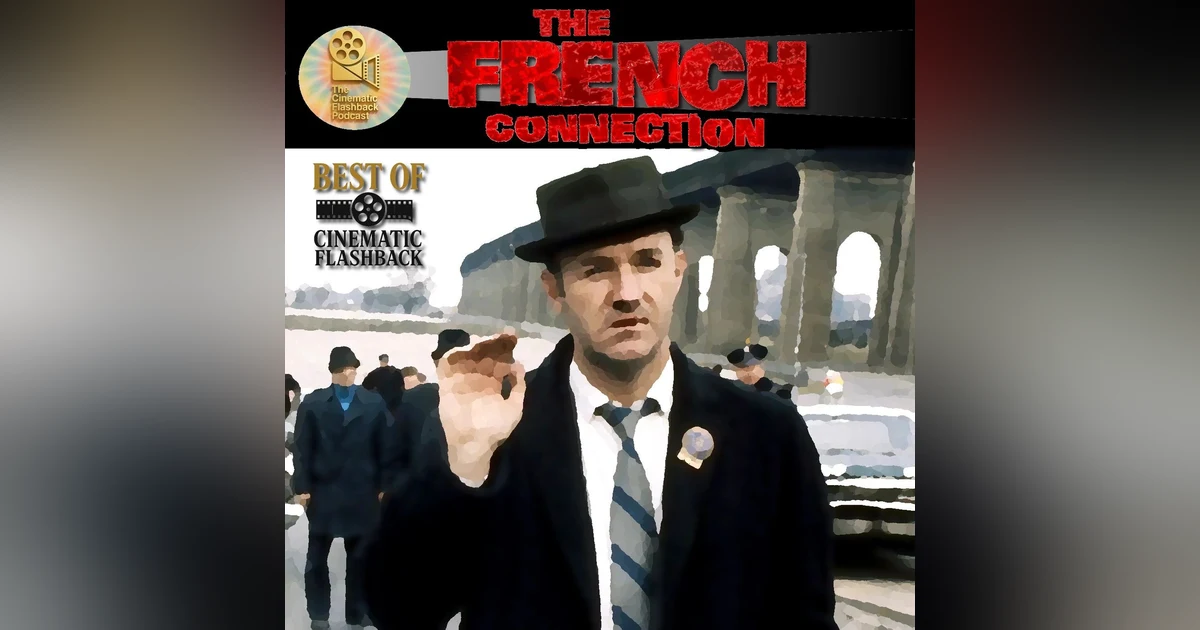

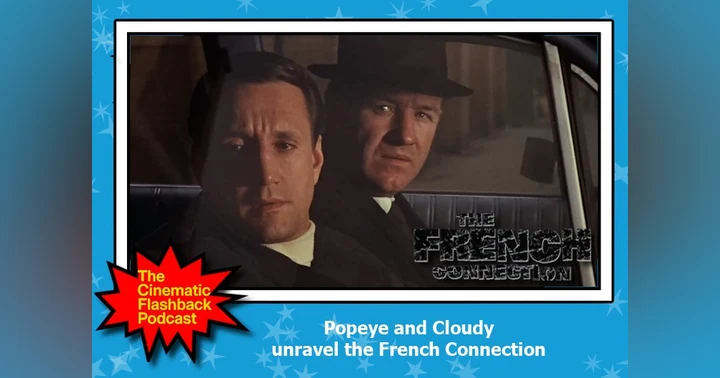
This week, we’re tailing Popeye Doyle through the gritty streets of 1970s New York. It’s a Best Of Episode while Chuck and Matt take a quick summer vacation. This week on The Cinematic Flashback Podcast, we rewind all the way back to our very first episode—The French Connection (1971), directed by William Friedkin and starring Gene Hackman and Roy Scheider. Inspired by an actual case, this Oscar-winning crime thriller redefined the police procedural with its raw, documentary-style realism and legendary car chase. What We Talk About
- Gene Hackman’s iconic performance as Popeye Doyle
- The revolutionary, seat-gripping car chase that still sets the standard
- How Friedkin’s visual style captured the gritty underbelly of New York City
- Why the film’s stark realism and anti-hero cop hit so hard in the early 1970s
- The abrupt ending and what it meant for ‘70s audiences
Links & Contact Website:
https://www.cinematicflashback.com
Contact Us:
https://www.cinematicflashback.com/contact/
Listen to Previous Episodes:
https://www.cinematicflashback.com/episodes/
Leave a Review:
https://www.cinematicflashback.com/reviews/new/
Read the Blog:
https://www.cinematicflashback.com/blog/
Subscribe:
https://www.cinematicflashback.com/follow/
Share the Show:
Tell your movie-loving friends!
Other Podcast You Might Enjoy:
- Surely You Can't Be Serious Podcast
- 30 Something Movie Podcast
- A Film By Podcast
- Dockingbay 77
- Def Dave's 1984
- Accidental Legends
- Phasers Set to Stun
- Children of the 80s
0:00 Hey, movie lovers, you're listening to a best of episode of Cinematic Flashback. Matt and I are both taking a little summer break, so while we're out, we're throwing it all the way back to our very first episode, The French Connection, starring Gene Hackman and Roy Scheider. We'll be back with a brand new episode on August fourteenth, so mark your calendars and join us then. But for now, enjoy this flashback to where it all began. Welcome to the Cinematic Flashback Podcast. Get ready to hop into the wayback machine as we journey through the wild, bold, and unforgettable films of the nineteen seventies. Each episode will break down a class if we're not so classic movie with a fun, fresh approach. We'll explore the who's who of each film, dive into the premise and the plot, see how it performed then and now, and wrap.
0:55 It up with did it group through decades or lose its feet? I am your Chuck Bryan, and with me today is Matt Sargent. Matt, thank you so much for being here. Do you still pick your feet and poughkeepsie? The classic line from a classic movie? For sure? I am happy to join you on this journey, and I thought this would be a great exercise to get together with you and we can talk about some movies that were seventies. Were when I was ten in nineteen seventy one, so from ten to nineteen wow. I graduated from high school in nineteen eighty. The seventies are my years for a lot of impressionable movies, and I saw quite a bit when I was young. I'm excited about this whole journey.
1:39 In seventy nine, I think I was going at this sixth grade. For me, a lot of the movies of the seventies have always been the big tent pole movies, Star Wars, Star Trek, Godfather, Josh. I'm really looking forward to finding films that I'm not as familiar with, but everyone says you should see, Matt. What are we watching tonight? We are going to be talking about the French connection. Hi, popeyees here goet, hands on your heads, Get off the barn, get on the wall. What's my name? Popeye? Doyle? If he doesn't like you, he'll take you a pot and it's all perfectly legal because Doyle fights dirty. If you want to take a ride there, fat man and plays rough. Anybody want to milkshake? Doyle is bad news, but he's a good cop. We're going there on Mine came out in nineteen seventy one.
2:24 It is a crime thriller that was really unlike anything that had come before. It was a very early film by William Friedkin, and it's based on a true story. The stars are actors that went on to have amazing careers Roy Scheider and playing Popeye Doyle was Deane Hackman, so it's not his first film as I understand, but it was a seminal film for him, as I think many people recognize. So my introduction to both of those actors, Roy Scheider was obviously Jaws two because I was way too young to see Jaws when it came out. And for Gene Hackman, he was Lex Luthor in Superman the movie. So imagine my surprise watching this film and trying to put Gene Hackman's Lex Luthor into Jimmy Popeye Doyle.
3:17 Yeah, So that's funny. Our different perspectives on time. Roy Schider was definitely the first I had interaction with him was Jaws, the actual original Jaws, which I actually saw in a movie theater. Wow. Yeah, it was amazing. And Gene Hackman, I have a hard time remembering. I've seen so many movies with him in them, and they were at various different times, and I don't think there were any kind of chronological order, like I may have seen him in a movie from later before I actually really sat down and watched The French Connection. I also think I remember my parents not allowing me to go with the family to go see it. Oh really, why is that? Oh there was rated R or so it was too violent appropriate. Yeah, they took me to see Chinatown. Oh wow, which, yeah, if you've ever seen Chatta Down, there's a lot of violence.
4:08 You're not going to say French Connection, but Chinatown. But let's get back to the Fred's Connection. I wanted to set some context for the movie, because context is king. It's really hard to remember what the world was like. You might not have been there when this film came out. I looked up some trivia. Did you know that the first Starbucks open at Pike Place Market in Seattle, Washington in nineteen seventy one? That's amazing. I thought it was much younger than that. I don't know what they're cuff of coffee, cost at the time. We're both application developers. We work for a consulting company and we live and die by email. Today Ray Tomlinson invented internet based email.
4:48 That's pretty funny. And what do you think the number one show would have been on TV at the time? If I was to think back, it was All in the Family. But that makes a lot of sense. It was a very popular ch show. I remember it, so it was definitely appointment style TV. But we did watch All in the Family, and I watched All in the Family and reruns for a long time. My wife and I we grew up in a house where our parents both watched it, and to this day we can sing the entire opening song. Those were the days. Also in that top ten show was a police program called Adam twelve. It's still on me TV quite a bit. Something I wanted to come back to as we get into the French connection is how the sanitized.
5:33 Version of television police shows. How they differ from what movie audiences were going to see. With the French connection. Yeah, that's absolutely true. I think it's good for our listeners to try to put themselves back in time a little bit and try to understand what was life like when this movie hit the scene, life was portrayed on the screen as Bewitched and May Burry RFD. But it wasn't realistic. This isn't what really happened with police work all. Pretty much a picturesque, sanitized view that didn't match with reality. But sure, at the time, it was entertainment and that's what people were looking for.
6:13 Sure. I remember my mom was a big fan of a show called Dragnet, which was a little more gritty, but it was definitely sanitized. So the idea that you went into the movie theater and saw this movie, which when we look at it now, yeah, that's pretty probably pretty realistic or nearly realistic from what our experience is now. But back then it was shocking. Oh yeah. I think people were really shocked, and there was a lot of controversy over it as well. They thought it was a terrible thing. There are other people saying it's a cinematic masterpiece, that it was the first of a new genre of filmmaking and films that would change things, and I think the latter proved to be true. It was a turning point for how police were depicted, how movies were made, how soundtracks interacted with the movies before. We had wonderful soundtrack and it was a significant part of the movie, but it wasn't intended to emote a sense of foreboding or stress on the audience, where I think when the French connection absolutely is.
7:12 One of the things that really attracted me about movies of the seventies is that there was a much. Different experience going to the movies. Today, you set through multiple advertisements while you're waiting for. The previews to begin. They call it a pregame show, and it used to be you would go and sit down, and probably by the eighties they may have started playing a trivia slide, but for the most part, it was the silent, the lights went down, the curtains came up. It was just a completely different experience. Oh, I have a funny story about that. I'm old enough to remember when you would go to a movie and the preview for an PG rated movie was absolutely R rated. So nowadays previews are all like PG G or the same as the movie you're going to see.
7:58 You had a maybe two or three previews leaders or what do they call them, trailers? Trailers, sorry not leaders, trailers for upcoming movies, but that was basically it. Nowadays there's at least forty minutes of this. It's a good thirty to forty minutes for now. One of the things, of course I do, is I like being able to pick my chair and then I know I can come about thirty minutes after the advertised time. So well, we live really close to the movie theater, literally we can. I can look and say, oh, the movie started twenty minutes ago. Is no problem. By a ticket week, we can still see definitely a different time. Yeah, we already talked about Jane Hackman and Roy Scheider, both detectives. Roy Scheider actually was convinced that he had lost this part because he stormed out of the audition, but that was the reason why he was cast.
8:46 That's perfect. That's so funny because that makes a lot of sense. Fernando Ray played Lame Charnier, Tony lo Bianco played sal Boca. Bill Hickman played the federal agent, and the other movie that he was in that I knew of was Bullet from nineteen sixty eight, and then playing the villainous Montiere Monsieur Pierre was Marcel Bozoufi. William Freakin was the director, and the other movie that I knew him from was from the Exorcist. The screenwriter was Ernest Teideman, the composer was don Ellis Owen. Rosaman was a cinematographer, and Barry Malcolm was the editor.
9:27 This film was nominated. For multiple awards, and it won the Academy for both Best Picture, Best Director, Best Actor, and Best Adapted Screenplay. One of the things you'll remark when you watch movie is it really starts out quite slow. Yeah, very normal. You're in there, basically in some French city I think you later find out it's Marseille or something. I think it's Marseille, and you watch basically you start to see a policeman doing some police work and following someone, and that progresses and you meet some of the main characters. So you see this a Laine Sharnier. I wouldn't call him a heavy because he's very suave, but you find out that he came out of the poor you know, the what do you call it, the loading docks like his.
10:21 You see a scene where his girlfriend is obviously buying him clothes and he thanks her for buying more clothes and making him look sophisticated. Not like right off the docks, I think, is what he says. And that's important because you realize this guy is he looks a dandy, but he definitely is not a dandy. And then you also meet his sort of sidekick, Heavy maybe you'd call him the Muscle, and the interaction with the French detective, which ends, you know, badly for the French detective. And of course it's classic French movie making because a baguette makes an appearance. The Heavy his name was Rousseau, right, but the minutes of the movie, right, he's already killing this detection.
11:01 Yeah, he kills somebody with basically no hesitation at all. And then Elaine and him later talk about it and there to some extent they're like, it had to be done. It's had to be done. He was getting too close. And what you find is that these are the guys that have some drugs that they want to be able to get into the United States, to be able to distribute. And this whole plot, by the way, this is a lot of this plot is what you pick up as you go on at. The very beginning, and never something is happening. They're bringing in this actor here, Devereaux you start to get the feeling that he's going to be the distraction for bringing whatever the drugs are into the United States.
11:42 Yeah, at this point in the movie is you're not really sure what they're going to use this actor for. But it's funny they show this actor and they show that he's agreed to work with them, although the muscle guy really doesn't like it. And one of the things that you see is they're cruising around France in a giant American made car. It's this brown car. It's out of place. Yes, so it immediately draws your eye. If you follow the car, you follow the drugs. And then the titles tell us we're in Brooklyn. There's parts of New York when it's under the neon lights, it looks so romantic. But if it's not at night and it's not lit and you're seeing it for what it is, it's a dump. It's so dirty. Even the grain of the film just brings that out and draws so much attention to New York.
12:28 I have to tell you that a lot of New York was very rough and very bad. You know, my parents wouldn't even take us there. Up there, my wife dad grew up in Jackson Heights and very similar to the neighborhoods that are depicted in this movie, but on the other side of the city, but unkempt and dirty, and you had the unions doing the trash and they may or may not have picked it up and broken down buildings that clearly real estate wasn't where it is nowadays, where you an empty lot with a semi broken down building just exists in New York. Now, it's pretty gross. There's some pretty nasty, interesting places, and I think the filmmaker did a good job of trying to capture that and show and we get there. We're in Brooklyn and we're meeting the protagonists essentially besides the bad guys, we're meeting sensively the good guys, in this case, the good guys.
13:20 And I'm going to put this in air quotes because I don't think the main character is necessarily a good guy. So I'll argue that with you, but go ahead. He's the character that we're with. So outside of this bar, you see a Santa Claus who is Jimmy Popeye Doyle selling hot dogs is Buddy Russo. So the guy dressed up Popeye dressed up as Santa Claus is real close to where this bar is and he can see into the bar and Roy Scheider's character is out serving a hot he's actually selling a hot dog to some guy. And as soon as Popey Doyle character sees this guy that they're trying to get and he rings the bell and immediately they both start to go in and a Roy Scheider character goes right into the bar, takes off his apron and basically try to get this guy. Unfortunately, they're in the crowded bar, and the guy makes it out and there's a foot race, but before the foot race starts, he pulls a knife and he cuts the Roy Schider character on the arm.
14:15 And I think part of this whole very At the end of this, they're very excited. They're very angry because they got knifed, and they know the guy knows them. That's the other thing. He knows them that it's clear during this interrogation that he has had run ins possibly with them before, and then the classic during this interrogation, it's it's pretty rough. They catch him and then they drag him to an empty lot and they are holding up up against the wall and really roughing them up or trying to get this information out of him, and that's when we have this classic interaction between the Roy Scheider character asking normal questions and pop Eye Doyle asking these crazy questions about picking your feet and which is just meant to throw people off. And it's a little bit weird because you're like, what is he doing in us?
15:07 As watching the scenes, We're not the person being roughed up. We didn't just have a foot race. It would be very disconcerting to have this guy asking you about going to Poughkeepsie and maybe you had been there, and maybe you had been there and maybe some bad happened when you were there. You immediately start to think about all the bad things. And then this other person asked you your question and you're like, well, that's nothing happened there. I know what's happening here. I can answer that question. They almost get the information they seek, which is nobody has any drugs. But it is starting to establish this fact that the stuff. That people are holding is really very small potatoes, if you will, right, And that's been going on for some time. So one of the things that this scene establishes is not only does it establish the way in which William Freedkin is going to film this movie. It is very much It has that handheld almost documentary style. There's a lot of long time and then they bring it in close and it has that feel throughout the entire movie.
16:06 It gives the film for similitude. The visual style is one of the most distinguishing features. Free can use the handheld camera to create a raw, almost documentary like feel that really immersed the audiences in the underbelly of nineteen seventies New York. That's absolutely what you get from that. And then a shot, as we were talking about before, in location in the city's rough, some rough areas, right, that's where they shot. It's contrasted sort of the polished crime thrillers of previous decades, you know, fancy hotels and everything like that. And clearly we know from looking back, because we have the leisure of looking back from this time, that it impacted tons of different movies to get the same sort of documentary style kind of authenticities.
16:52 I think of like right off the bat, I think of Taxi Driver. It's again, it's another New York film. It's very gritty, cir and not so much like the gritty parts but Dirty Harry had some real It came out in the same year, but it's certainly had that same kind of hard boiled, rougher side of police. It's the West Coast version. They pack it up there at the and Popeye doile getting ready to leave, and he's at the door. He's about to go out the door and he stops and he's waiting for his partner to come out. His partners are going to go home, So I'm going home. Buy you a drink. Yeah, I'm good to be. They go to a bar. That's where the payoffs starts, because you see the characters that make up the people that are trying to do the drug deal.
17:39 We're introduced to one of the best songs I've heard this month. Popeye goes into this bar. He is always looking, he's always on duty, he's never really at rest. But he's not just having a drink, no. He In fact, he notices two known junk connections at a table and there's this one stranger that he doesn't know who's throwing a lot of cash around. And this turns out to be sal Boca and his wife, and they are the ones who are working with Elaine to get the drugs so that they try and get the drugs to be able to distribute it. They're the middlemen and the deal. Essentially, they're the people in New York that are going to hook up Elaine and his supply with the Underworld distributors. They're the people in New York that are going to hook up Elaine and his supply with the Underworld distributors. And they are new at this, very new. This is their big break.
18:34 Sal Boca, to his credit, he did rob Tiffany's in broad daylight. I thought maybe he was connected or something. But we get into the first of several sequences where Popeye and Russo are tailing the suspects. They don't even know who he is a follow them and ultimately follow them back to their sandwich shop, right, which is hilarious because she goes in with a giant haired you with the thing over the top, and the next time you see her she's holding it in her hand, and she's a dark haired American woman. Lovely really as is, but without the big air. It's so funny. And there's a similar thing I want to point out with that is that they switch their cars about as much as they're switching her hair, So it was one of those funny kind of coincidences, like they're switching to a different car and then now she doesn't have her hair anymore.
19:27 So they clearly are trying to throw anybody off, but they're terrible at it. Oh yeah, they're one hundred percent trying to cover their tracks because they know that they're starting on this the beginning of the story of making this drug deal. So during this time they also learn of one other character, Joel Weinstock. Now Joel is the lawyer slash money guy who is going to finance Sal to be able to get the drugs. And once they find out, once they make the connection with Sal, Jimmy goes to the captain and they get but the court order so that they can wiretap the phones and they can start listening to them on their wire taps, and that's where we're introduced to the two.
20:12 Federal agents Muldrig and Climb. Mauldrig there's some beef between him and Popeye due to an earlier case that they had where another cop had gotten killed. Maldrig keeps digging on Popeye about getting this other person killed. On stakeout. They're listening in on Sale's phone conversations with the wire tap when suddenly there's a French accent on the end of one of the phones. Elaine is asking Bogra to meet him at the hotel. They're all tailing Boca. The way they filmed it clearly had a strong influence real police, because they showed how the real police work and how they hand off and they have a phone and they have a radio phone. They're talking and like okay, yeah he just went by. Okay, I'm going to get I'm on it. We had to turn off they saw us or they made us. So there was a lot of that very realistic following and how incredibly important they were because they were trying to find out where things were and what was going on, and it's literally the only tool they had. Clearly, this is not the age of cell phones and that sort of thing where everybody does everything by sending a message. They had to go to where they were going to go, and so tailing was the way you figured out what crime they were going to do and how they're going to do it.
21:29 And consequently, there's a lot of times when there's little to no conversation or dialogue. Yeah, I was going to say that. It's one of the things that's marked in this movie to me is how little conversation, how little dialogue there is, And there's whole minutes that go by where they're just doing these tailings and trying to figure stuff out. And as a person watching the movie, you're not given a lot of exposition to figure out what's happening. It's really on you to figure out why. Are they falling? Oh, okay, this is why they're following. You're really in the dark for a good part of it. In my opinion, there. Are two scenes in this film that I think are just masterful. Sal Boca looking. At getting a profit of thirty two million dollars once it comes off the street. However, Weinstock is a little bit nervous. He wants to wait till the end of the week to make this deal, so they're going to go meet in Washington, d C. Because of all the heat that's on it. Lane comes out of his hotel.
22:27 The two federal agents never see Frog one leave the hotel. This is where Popeye is coming up. And also Popeye trying to get to the phone to call the federal agents because at one point he gets into a phone box to tell him I'm trailing him, and they're like, no, he's still in a hotel. He said, no, he's right here on the platform. And you've seen this done so many times since then, where one person gets on the train, the other person steps. Off of it, and then he goes back on. Right, it's the other person and they're trying to time the doors closed. I think it was so funny because that scene progresses from pretending to be totally innocuous, like he jumps off the train and throws some trash away, yes, and then Popeye has to jump off the train, and then it starts to get obvious that this is not innocuous.
23:15 He is definitely following me. Unfortunately for Popeye, he loses it. He loses this round, and Elaine is on the train and is pulling away, and as Elaine goes. By Popeye, he just waves at him. Yeah really just his fingers are moving like he's saying bye bye, So off he goes. That was one of my favorite scenes. The funny thing is there's a just fixation between Elaine's swave and deb in air very put together his trim beard, he's very neat, and the last thing he does is he sticks his umbrella through and opens. The door, gets out, and then pop Eye. It was just it was very well done. But anyway, I do want to talk. You said before you were like, he's Popeye's like a bad eye to some extent, I'll argue that a little bit. But he's a riven guy. Yeah.
24:05 What I was meaning more by that is he's much more of an anti hero. Yeah, he's for sure an anti to some extent, he's an anti heriot. He's clearly a guy who's probably had if he was ever married, it ended in disaster, right, because he is a one track, one trick pony, one track mind. He is nothing but working and that's what drives him. Man. Yeah, they maybe trod on this guy, this witnesses rights, but honestly, at the one point, they go into a bar and they rough up a bunch of people and they've all got drugs, and they dump the drugs into a drink and ruin them and that stuff's a whole milk or nothing around nobody's holding.
24:49 I got a name for you, sound Bulk of Brooklyn. Yeah, b u c A. What about his wife? Enji? Rest time, there's been some talmb what shipman and as we you have to everybody push. Breed, what do you want it? That's all. I'm going to check on his address in the Bronx and if they don't know you, they're. Directly I thought. I told you to stand get that hair down before sir, we're going out by no. Everybody will be backing.
25:31 Out, and it's all just so that they can talk to their informer. And then they punch the informer, basically to keep him safe. If they hadn't punched the informer, everybody in that bar would have known they went into the room to talk to him, not to rough him up to some extent. Yeah, I agree with that. He definitely has maybe not classic methods, but of course if he had classic methods, the story never would have happened. After they get back from DC, there's a scene where they're finding out that the captain is taking them off the case. Popeye is heading back to his apartment and all of. A sudden, shots ring out. He's being fired upon by Rousseau, the muscle of French muscle. By the time that Popeye gets up to the roof, he looks down sees so running off and this starts off the signature scene of this whole.
26:17 Film without a doubt that the car chase scene is frenetic and crazy, and the idea that it was filmed sort of semi legally. What what do you mean by semi legally. They didn't get any official permits at all. And what they did was they used a bunch of policemen they hired to drive in a bunch of cars to block traffic to keep non part of the movie people from getting in the way. But there are scenes where they dodged real citizens driving their cars on that road and just filmed it. There's some scenes where it's it's so obvious. There are other scenes where it's like when the lady has the baby and the stamps, Yeah, that.
26:58 Hits the trash and that has set up scene, sure, clearly, But they weave it in so well that you're sort of believable. And the poor guy who gets his car taken, the last thing you hear from him. Is how all I got my car back? Call in pieces, it's the answer. There's no cut in between the time Hackman gets in the car and he does that peel out and. Does it one hundred percent successfully because you know, it would have been pretty funny if the give me your car the immediately wrecks it. Bill Hickman drove the car in the chase, was this actor who was playing Muldrag. The car chase scene was considered one of the greatest in film history. You're not actually chasing another car, he's chasing a subway train, which is the crazy part. It's a it's an elevated subway. He's underneath it trying to make his way down there. And the crazy thing is all of this was achieved without any level of CGI.
27:48 Today, some of those things they may have put some things in there digitally or for sure. I think one to pull away from this is nowadays what you do is you'd get the permits. Obviously, that's just that goes without saying. You get the permits and you do everything, and you'd have hundreds of extras, hundreds of stuntmen driving cars, and it would it would balloon the budget by millions and millions of dollars for just that scene. It's a great scene. It really pulls together the frenetic level. We're out because remember we've been building for the beginning of this movie was calm guy hanging out with his girlfriend in Marseille, all the way to this guy who's on a train. Popeye's chasing them in a car below the train and getting into all kinds of recks and crazy things. And at that point, everything is just going really fast at that point, and there's a high level of tension and people are getting shot, people are trying to stop the train. Shout out to the transit authority in New York and in the film for showing the runaway train breaking that it's one hundred percent mechanical. If you noticed in the in the show, it goes over the trip and the trip. If you hit the train of a certain speed, that trip flips up and starts a mechanical breaking process.
29:09 You cannot stop. And that's how that train stopped. Yeah, it's actually a whole mechanical thing, because if you hit that thing slow, it lets you go over it evidently, but if you hit it hard and fast trips and that's why the train stopped. Now, even though it stopped really fast, everybody got hurt. If you look in the train, you saw people getting thrown. That was kind of goofy, like when the bad guy got thrown and his gun got thrown. It was like, wait a minute, it looks like he's being thrown the wrong way. If you've ever seen the movie poster for the French Connection, we come to the scene where Popeye is chasing Rousseau up the stairs and shoots them in the back. So now we're heading into the final act of the film, and the brown Lincoln makes an appearance again. After Russo is tailing sal Boca. Sal has parked it off in this innocuous place for it to be picked up again.
29:58 Popeye knows that there's something. On that car, and eventually they impound the car. They bring it into the lot cars dirty. They take the car apart. They're looking for the drugs, pulling up the seats, taking out all the oil, ripping everything to pieces. They cannot find the drugs. And nobody been under that car since they came from five grade. That thing is clean. I don't buy that earth the stuff is in that car. Will you find it? I can. That was the way to the car when you got it. But he's sell one hundred and ninety five pounds on this mino says four thousand, six hundred and seventy five, one hundred and twenty pounds up away.
30:43 They realized that there's one last place that they didn't look, the rocker panel, and that's where they find the heroine. It was hidden inside the frame because back in the day, a car, a big car like that, had a big, heavy steel frame with a body on top of it. Nowadays cars are made with what are called unibodies, so the body and the frame or one thing, and there aren't as much heavy pieces. But this is in the days of big v eights and giant cars, and that's where they had hidden the drugs in that rockert channel. They had to use a chisel to get it out, and you see later the drug dealers have to use a chisel to get it out right as well. And you see when they're searching the car, they look inside the tires, they look all over the places. This is well hidden, and they had to work hard to get it and then they return it to them sort of in the same condition that they got it, which I think is a stretch, but the point is they wanted to get the car back to them so that they could catch them in the act of recovering and making the deal.
31:44 The scene was kind of funny, a little bit because the actor who was the third Frenchman, Henri Deveraux, he shows up and he says, I've heard my car was here, you know it was to take it up. And I'm the guest of the United States. This is where I really like Roy Scheider's character because he comes out there and he's like, he's like his best friend, like, yeah, no, we've got a car. It's right here. We're going to bring it around for you. And they bring this car around he'd take you, and it looks like they never touched it. But it's funny because very Charter is exactly doing. That, oh yeah, we found it, and just totally puts him at ease. And of course this is where you find out what the role of that actor really was, what his role was. He was supposedly scouting locations for a movie. That's why he needed to move around the city, and that's why he brought this car because the car is part of the movie, right and it has He needed to have the car to see how it would be in scenes.
32:38 And you find that out when the guy at the door is talking, is like, why did you leave this car down in a terrible part of town? If you're staying up at some other place. It's really nice and with the director, you know, he wanted to see and he was out scouting locations and he left it. So obviously it was funny, a little bit contrived, but that's really where you find out what the role of the actor. You see the actor. I think before that. When he and Elaine are having a conversation in the hotel. Elaine no longer has Russo Russo's dad. He needs Henri with him, and. Then they take the car out to a location under Hellgates Bridge to transfer the heroine to another vehicle. Make the money swap, right, They're going to take the drugs out with the money in the same place.
33:20 Elaine is driving away with the money and he comes up over a bridge and the police have been following them the entire time. Popeye just gives him the exact same wave that Elayne had given him before, because I caught you, We got you. Elaine takes the car back, the police close in. There's a firefight that happens, and I think, yeah, Russo ends up killing Boca with a shotgun. Elaine is getting away and Popeye is pursuing him. Mauldrig also sees Popeye following him, and so he starts to follow. Russo follows him as well into this abandoned warehouse, and he definitely sees Elaine and he's chasing him. He's hyper focused on getting this guy. Russo comes up behind him.
34:03 Popeye spins around and looks like he's about to shoot him, but he doesn't because it's his partner. The next guy who pops up looks like the outline of Elaine and shoots him dead in a classic foreshadowing. It's mouldric. It was very ironic that the entire time talking about him, there's a lot of fort Popeye shoots him and it's, oh my gosh, a lot of foreshadowing. Popeye says, Frog one is in this next room, and you see him reload his pistol and he goes over you. Hear a single shot and we go to black and then we see what happened afterwards. Yeah. In text, a lot of people have a problem with this ending, right because it leaves you up in the air to some extent. It also does not pay off.
34:50 There's no payoff, the bad guys getting their just deserves to some extent, except for Boca, who's like just a hustler trying to hustle and not really. I don't think he he was a bad super bad dude, didn't seem kill anybody. He gets shotgunned in the chest. The bad guy does get killed by Popeye, which is good. But this guy the mastermind Elaine in these and you can wrap it up with what happens to each one of them if you want. Joel Weinstock he was indicted, but he was released because of lack of evidence. Alain Charnier was never found, but he was believed to have. Returned to France. Interesting. The actor Henri Devereux was sentenced to four years in federal prison for conspiracy.
35:31 The guy that goes to jail is the actor. The actor is the only guy who goes to jail. I don't know if freaking was trying to make a statement there, think you will. And unfortunately for Jimmy and Buddy, they are reassigned outside of narcotics. Yeah, that was a big That was probably a huge demotion for him. Yeah, and probably result of the fact that the guy got shot and then we didn't get the main guy. But it's I have to say, it's one of those ones where you're like the end of that movie, you're like, you're gonna end it. Like, oh, the first time I watched it, I was a little bit angry about it. Yeah, you know that. It just it suddenly stopped with that. I agree, and it was it was certainly it certainly again one of those things that were different in this movie that sort of unlike a lot of other movies, there usually wasn't There was sometimes an epilogue, but it was usually acted out. It wasn't just usually text.
36:20 So if you were to remake this movie today, what would you keep the same and what would you change. There were a lot of following doing a lot of following, and I thought, after a while, you're like, I get it, okay, yeah, you're following. We know it's hard. After the first couple of times, you realize how hard it is. And what's interesting. And the car scene, I don't think you could have done anything better than that, And it worked out really well. With the sole exception of the following. Once that guy got on the train, I failed to see how he knew Popeye was following him Because you're on the train. You cannot see underneath that train, right Oh yeah, cha, Yeah, I mean maybe you'd hear it a little bit, but frankly, those trains are really loud.
37:07 So I have a hard time saying. Why wasn't that guy just sitting there waiting for the train to come and getting off at a station? And he made him stop not stop at the station. Now I know he almost didn't get on, but the idea that he would take a car and. Be able to get to that station before he could. Get off the train, right, And I think they should have somehow shown him the car. And the way I would have done it was I would have had the guy look out the train and look at some windows of a building and see the car, that. There's a car that he's being chased. Yeah, Because without that, I'm like, why is he so crazy about getting off? Why is he going to shoot somebody? Right? Right? Yeah, he waved at the policeman, right, and the policeman came up to him. But to be honest with you, even shooting the policeman seems silly because he pulled out of the station. It's like, you say, the policeman, I don't know who that guy was. He's crazy, he ran into me or I don't know. Maybe I just thought that was a little bit of a stretch that he would know that it was being followed.
38:05 So let me ask you, this did a groove through the decades or has it lost. I think definitely. I think a couple of things, like most things that when you watched that were made in decades before. You're maybe for a lot of people who are listening alive, but some of us who are older realize is that you really have to put yourself a little bit in that timeframe and realize what's going on and not and also realize it was the first of these coming not it was not like I think I made mentioned before that or if you see the if you watch The Wire, which is really an amazing, amazing show that really delves into how police work had to be done in the electronic age, with burner phones and with phone tapping, and the analog for the car following in this movie is the phone tapping and trying to trace those phones in the Wire. It really showed you how real police worked and we just take it for granted.
39:03 And I was like, oh, I think it show us really how they do these things. This was the first of those, and not that at very first, but definitely the not dressed up Peter Marlow, Spencer Tracy type of policeman detective thing going on. I one hundred percent agree with you. I know you you were talking about the wire the show that it reminded me that I thought of a lot was there was a show and the I can't reme feels like isn't the late nineties called n why PD Blue? And it reminded me of that where these cops were operating a lot on the edge of things, and they were very driven and sometimes they flirted with going up to the line and sometimes stepping over the line. And I think we've seen other characters who are like Popeye, who are driven to just being almost singularly focused on their task that's at hand.
40:05 Yeah, for sure. Yeah, it's great, a great movie. I think it was really well done. Shock assume. My biggest takeaway is in what people would probably notice the most is how little dialogue there is. There really is not that much dialogue, and so you have to listen to what they're saying because they don't say a lot. Do we have anything else we can close it out? I do not have anything else. I think we probably provide you with far more information than we need so. Matt, I just wanted to thank you so much for your time, your perspective in helping to set the context of the nineteen seventies at that time based on your experience and what you live through. And I also want to thank our listeners for coming.
40:47 Along and joining us on this. If you want to contact us, you can email us at podcasts at Cinematiclashback dot com or leave a comment on our Facebook page the Cinematic Flashback Podcast. We're trying to build this show and we would deeply appreciate a review on the. Platform you're listening on. If you enjoyed the show, please give us a five star review so we can reach more listeners. So join us next time as we take the way Back Machines to the seventies to explore another film from that decade. Now, I'm good to bev Tar