
 Spotify

 Amazon Music

 Apple Podcasts

 iHeartRadio

 PlayerFM

 Podchaser

 YouTube
 RSS Feed
The Long Goodbye (1973): Philip Marlowe Gets Lost in Robert Altman’s ’70s
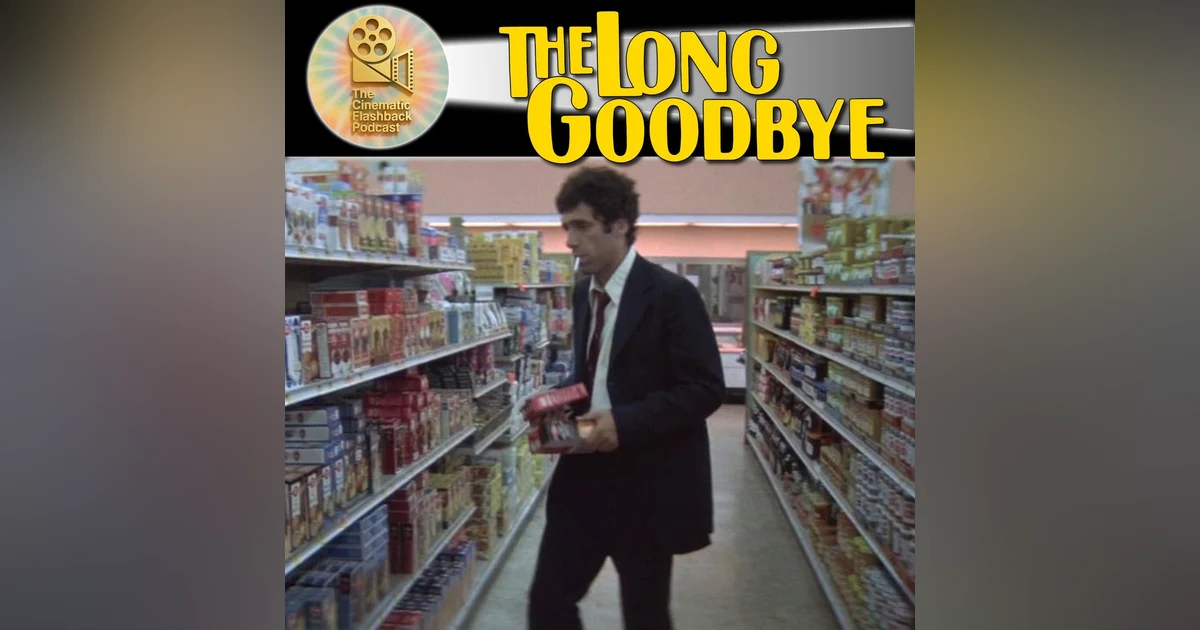
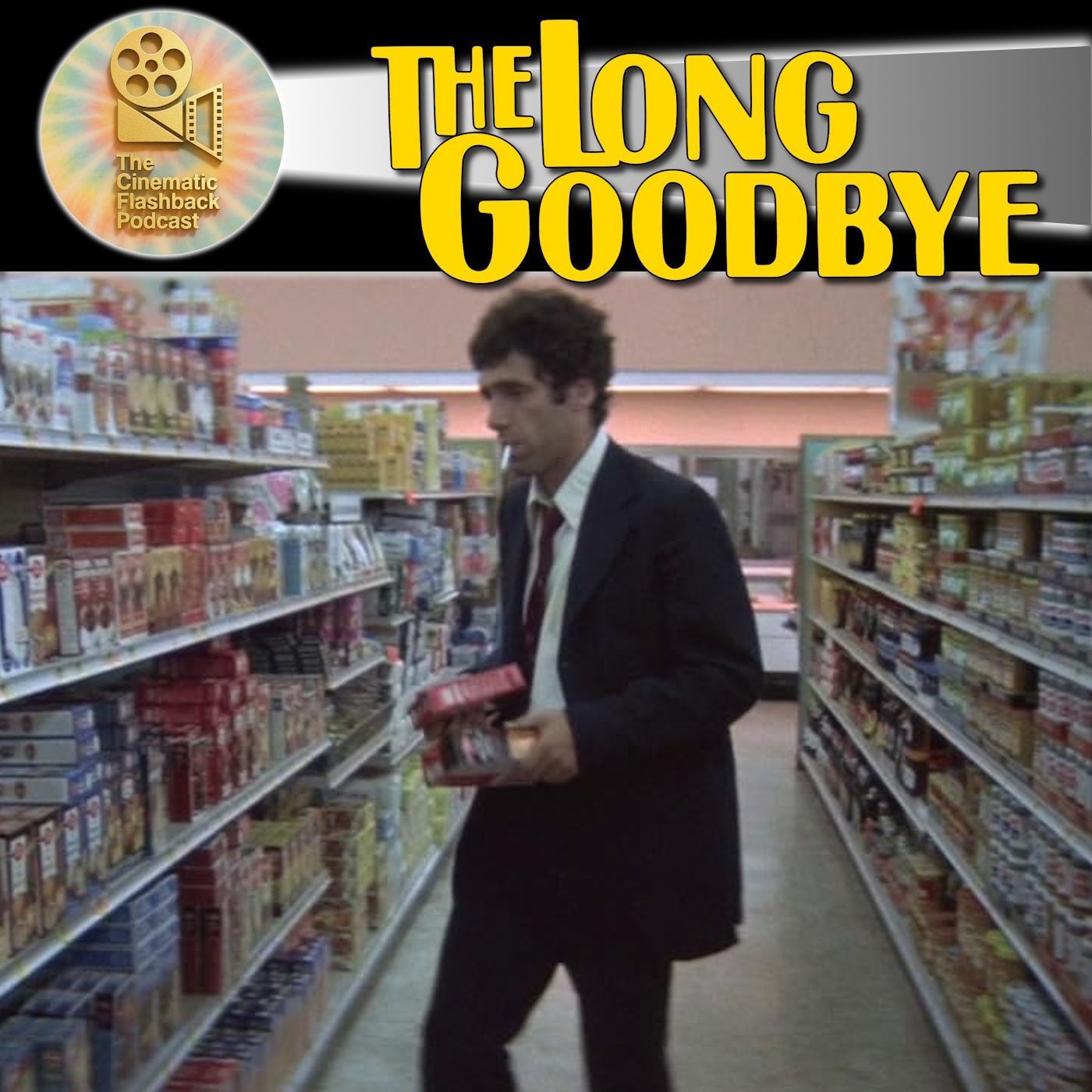
Chuck and Matt wrap up Shades of Noir Month with Robert Altman's The Long Goodbye (1973), starring Elliott Gould as Raymond Chandler's legendary private detective.In this episode:
- Elliott Gould's unconventional take on Philip Marlowe
- How screenwriter Leigh Brackett reworked Chandler's novel for a new era
- Robert Altman's offbeat approach to the detective story
- Marlowe's unwavering loyalty to Terry Lennox
- The film's controversial ending—and whether it works
- Does The Long Goodbye still groove today?
Links & Contact Website:
https://www.cinematicflashback.com
Contact Us:
https://www.cinematicflashback.com/contact/
Listen to Previous Episodes:
https://www.cinematicflashback.com/episodes/
Leave a Review:
https://www.cinematicflashback.com/reviews/new/
Read the Blog:
https://www.cinematicflashback.com/blog/
Subscribe:
https://www.cinematicflashback.com/follow/
Share the Show:
Tell your movie-loving friends!
Other Podcast You Might Enjoy:
- Surely You Can't Be Serious Podcast
- 30 Something Movie Podcast
- A Film By Podcast
- Dockingbay 77
- Def Dave's 1984
- Accidental Legends
- Phasers Set to Stun
- Children of the 80s
0:01 Are you laughing at me? Yes, you are. You're laughing. I see you're laughing. I wouldn't laugh if I were you. I'm not laughing. Is Terry Lennox alive? Are you making. Did you have a deal with Terry Lennox? Do you think it's funny? Funny to steal $ 355, 000. From Marty Augustine? Jack, let me see that knife. Oh, with pleasure, Marty. Give it to me. Harry. Your father was a moral. Cut him. What? Cut it. Where? Cut it off. Cut it off? That's what I said. Cut it off. Welcome to the Cinematic Flashback Podcast. Get ready to hop into the Wayback Machine as we journey through the wild, bold, and unforgettable films of the 1970s.
0:54 Each episode, we break down a classic movie or a forgotten gem, seeing how it performed then and now. and wrapping things up by asking, did it groove through the decades, or did it lose its beat? I am your host, Chuck Bryan, and today we are reviewing Robert Altman's 1973 film, The Long Goodbye, starring Elliot Gould, Nina Van Pallant, Sterling Hayden, and Mark Rydell. This is our second and final film in our Shades of Noir month. This time, we're going back to one of the most famous private detectives in American fiction, Philip K. And joining me, as always, is Matt Sargent. Matt, I feel like I've just seen you two or three times this week. It's good to see you again. How are you doing? And more importantly, have you been kicked out of your book club yet? No.
1:43 We had the inaugural meeting last night. It was a blast. We had a great time. We're reading Lonesome Dove. It's such a long book that we only had to read to chapter 50, and I only got to chapter 39 because I was actually reading it on my tablet. So you and I got together recently to go and see a John Wayne film out at the Narrow. We did. We saw The Searchers. The reason why I wanted to go out and watch The Searchers is because this is a film that has inspired many 70s directors and their films that they have made. One of them being Taxi Driver, which is a great film. Funny that we watched The Searchers because The Searchers purportedly takes place in sort of maybe a little bit before Lonesome Dove, the book takes place. And so it was cool that that tied in with the Lonesome Dove and kind of also our investigation into how cinema changed in the 1970s, because that movie was squarely in the before.
2:47 The Searchers was directed by John Ford. And when you think of Hollywood in its golden age, two directors always kind of step out. One's John Ford, the other is Howard Hawks. But one of the things that really struck me was how locked down the camera was. So they would put the camera, they would lock it down, they would do the scene, and then they would move the camera, film it a different way. And then you compare it to, say, Robert Altman. The camera's always moving. It's either handheld or on something, and there's lots of zooms, and it's always, the camera's in motion. After watching so many 70s movies, going back and watching The Searchers, I was really struck by how locked down everything was.
3:34 I think there was some level of technology involved in that. When they were filming back in the 50s and 40s, those cameras were absolutely huge. They were mechanical monsters. And if they did move the camera, it was some very specific ways on tracks and stuff like that. Nothing, anything like handheld. Okay. So today we're reviewing The Long Goodbye. And this is our third Robert Altman film that you and I have watched. The first one being... McCabe and Mrs. Miller from last year, recommended by a friend of the show, Jeff Panano. Then we watched MASH, which was really different from the TV show as it had a lot more comedic elements that were slightly subversive, that it was comedy, but also there was a statement as well. Oh, 100%.
4:22 I think The Long Goodbye has a little bit of that same vibe to it. Well, I think that's definitely Robert Altman's signature. It's some level poking fun or satirizing institutions. And the film we're reviewing today is not different. It definitely is taking a very different take on a Philip Marlowe film. It seems to be the sort of cornerstone of Robert Altman's films. He's an interesting character. It's like he's deconstructing certain myths and at the same time trying to make some kind of commentary along the way. Well, this is going to be a shocker to you, but I actually did some investigation about this whole thing in his career. One of the funny things was he probably got MASH because no other director wanted it. And they didn't expect much to happen with that film.
5:12 That's right. They thought they were safe putting Robert Altman at the helm of it. And then what came out was essentially a very, very popular film that seriously took on military institutions. And I think they were shocked at that. And that actually... I think in some ways enabled him to do certain things in his career. As we finish up our discussion on film noir, I thought that it would be a good time to go and watch some other films in this genre. I was going to ask you if you have ever seen the movie The Big Lebowski. Oh, for sure. I love that movie. It's so funny. I thought the dude reminded me of Elliot Gould's character, The dude is just trying to get his carpet cleaned, and then he just kind of floats through this entire film where things get worse and worse and worse. But then finally, at the very end, it all kind of just works out, and the dude abides.
6:11 The dude abides. And in this movie, L.A. Gould's Philip Marlowe, sometimes it just feels like he's kind of drifting through. Things are just rolling off of him. His version of the dude abides is, it's okay with me, man. He says that about 100 times. Yeah. Are there other films that you've seen that you like that are noir-esque? I'm not that big of a fan of the film noir, but there is a show on TV called Sugar, and it's sci-fi. But the guy is essentially a 1950s detective working in modern day L.A. It's a very cool series. And if you like this movie, you will love that series.
6:54 Why, Matt? At this point is when we normally do our listener feedback. This week, why don't we just go ahead and turn this around. What do we want to hear from our listeners? I want to just call out to our listeners and say, look, we like to talk about movies, but we much more like to talk about what you guys want to hear about. So, please. Reach out and give us a shout and say, hey, talk more about the directors or, hey, talk more about the actual filming and locations. I really love to hear about the locations. And we have given locations kind of short shrift, I think. But I really, I love to stay to the end of a movie and watch where they filmed it and what town they filmed it in and stuff like that. It's just, it's something I really love to do. Please, whatever it is that you love about film, that you want us to maybe dig in for you or talk about, or maybe call out that you asked for this. And so we're really going to focus on it. Please do it. We're here to put together something you enjoy listening to. So let us know what you want to hear and we will do our best to include it.
8:01 So just as an example, friend of the show, Jeff Johnson asked about the vanishing point, I believe it was. And I have that one scheduled for season three. I'm writing down film pairings right now. So if there are films that you would like to see, let us know. We would love to get that feedback. To echo what you're saying, Chuck, one of the sort of cornerstones of this film is to try to find forgotten gems. We do our best to look for them, but honestly, we can't watch every film of the 1970s and find one. So if you guys know of a great film that was released in the 70s that you think people don't appreciate it enough or it wasn't seen very much at the time, let us know. We'll put it on the list. We'll build it into the show some way or somehow. It might not happen in a month or two, but we'll try to get it on the queue.
8:48 Definitely. So this is the time we turn to saying, how did the long goodbye happen? Matt, this is going to be an interesting story because instead of looking at a producer or a director for the long goodbye, I wanted to look at the writer and to start this story You and I are going to have to go back to the 1940s, to that director I mentioned just a little bit ago. Because Howard Hawks was kind of imagining he's in his office and he's reading this hard-boiled crime novel in preparation for a movie he's getting ready to make. And the name of the novel is called No Good from a Corpse, written by an author named Lee Brackett. And he really likes it.
9:36 I mean, this is the kind of writing that he wants on his film. So he picks up his phone. I imagine it's one of those phones where he hits the buzzer and the buzzer rings onto his secretary's desk. She hears on the other side of the phone, get me that guy Brackett. But you know what? There's a problem with that. That guy Brackett was a young woman named Lee Brackett. That is absolutely right. Hawks hires her and puts her... on her very first screenplay. And there's another writer in the room, and that writer is none other than William Faulkner. And they are adapting Raymond Chandler's The Big Sleep. Do you remember who played Philip Marlowe in The Big Sleep? I do. One of my favorite actors in the whole wide world, Humphrey Bogart. What a way to start off.
10:19 your career in Hollywood, you're working for director Howard Hawks, you're writing with William Faulkner, and you're writing lines that are going to be spoken by Humphrey Bogart. I mean, that's like, that's like the meal ticket right there. You know what I mean? Yeah, it's all in one. You know, here's something I think you're going to like, because just a little bit ago, you mentioned a science fiction show called Sugar. And we've talked about science fiction before. And I know science fiction is one of the genres that you particularly like. Lee Brackett didn't just write hard-boiled crime fiction. She was better known as a science fiction author. She gets this nickname of being the queen of space opera.
11:01 I'm not sure if you've ever read anything by her before. You know, I probably have because the name seems very familiar. But man, that is so cool. That it ties into science fiction like that. She's also running around with other people you might recognize. Have you ever heard of Robert Heinlein? Yeah, just a little bit. How about that guy named Ray Bradbury? Fahrenheit 451? Yeah, you know, he's had a couple of books, I think. A couple of books. You know, they've sold a few copies. Just a few. That's crazy. She marries another science fiction writer named Edmund Hamilton. And you're never going to guess who the best man was. I have no idea. Would it surprise you that They were such good friends with Ray Bradbury that Ray Bradbury was the best man in their wedding.
11:48 That is crazy. That is a cool detail. I learned something today. Almost 30 years after the big sleep, she gets Marlowe back. She's gotten hired to adapt Raymond Chandler's The Long Goodbye. Now, a few things you need to know about The Long Goodbye. It was the next to last book that Chandler wrote about Philip Marlowe. Mm-hmm. And it was also the longest Philip Marlowe adventure written by Chandler. And one last fun fact, I recently listened to it on Audible. And I can attest that it is long. But you know what made that book even longer? What? Is when I finished it and I realized at some point I had put it at. 86 speed. That's funny. Because we've all been talking about the Lonesome Dove and putting it at 1.2 speed. Yeah.
12:36 I'm listening to this book. I'm enthralled by it. I'm right there in the mystery, but I'm just kind of going, oh man, it's just taken so long to finish this book. But I downloaded it and said 16 hours. What's going on? Well, because of that, I also realized that she's adapting the long goodbye, but it's no longer 1946. It's the 1970s. She's thinking that you just can't put Humphrey Bogart's suit onto anyone and just make another big sleep. So she starts to take Raymond Chandler's novel, and she begins to reshape it so that it would be more in tune with the 70s. There's a lot of plot in that book.
13:19 Some of the payoffs in that book takes a long time to get to. So she makes some pretty significant change, including one change at the ending where Oh, wait a minute. I'm going to hold off on the ending until we get after the spoiler warning. You can't talk about that one. Well, the project goes through several possible directors before landing with someone that we've covered already, Robert Altman. As you already know, Altman calls his friend Elliot Gould for MASH. Did you know that he wanted Elliot Gould to play McCabe in McCabe and Mrs. Miller? I think Beatty was a better choice than Elliot Gould, but I think Elliot Gould would have been interesting. I honestly, I can't see Warren Beatty as Marlo in this version of Marlo. Oh, no, for sure. But Elliot Gould, I do see. Before we leave this story, I have one small ending for Leah Brackett. Remember what I called her earlier? Queen of space opera. That's right. A few years after the long goodbye, Brackett gets another call from another filmmaker. And his name is George Lucas. You've got to be kidding. He's had a little bit of success at this point, and he's developing a new movie. And he wants Lee Brackett to write the screenplay based on his story idea. So she takes the job, and she completes the first draft early in 1978. But unfortunately, Brackett has been seriously ill, and she passes away shortly afterwards at the age of 62. This was to be her final screenplay, and that movie was The Empire Strikes Back.
14:49 Man. That's crazy. And it's so sad to hear that she died so young. Clearly, she impacted the film world in a very large way with her literary capabilities. I'm not quite sure how much they used of the original screenplay in the Empire Strikes Back. I would bet that the broad strokes of the whole film were probably in that original screenplay. It is famously said that Lucas was not happy with the draft, but Come on, it's the first draft. What first draft ever goes to screen, right? And she was dying. He completed the script with Lawrence Kasdan, and that was a great relationship. We got a lot of good films between Lucas Kasdan and Spielberg. But there is something that listeners should keep in mind. Again, it was the first draft.
15:37 If you read the script, it's available online. You can still see those broad strokes that you were talking about are laid down, and it supports the final story that would become The Empire Strikes Back. But anyways, that's how The Long Goodbye happened. That's pretty cool. Are we ready to get into production details? I think so, but we first need to step away for a quick break. We'll be right back. It's a cinematic flashback. Let the show begin. It's a cinematic flashback. Let the show begin. It's a. Cinematic flashback. Philip Marlowe, just an average guy who happens to be a private eye. Elliot Gould is Philip Marlowe.
16:29 Your friend stole my money, and the penalty for that is capital punishment. Ow! You'll never learn. You're a born loser. Elliot Gould in Robert Altman's The Long Goodbye. Goodbye, goodbye, goodbye. Rated R. I'm through, I'm through this time, and I mean it. Welcome back. Before we get to the actors, let's take a quick look behind the camera. We've already talked about Robert Altman and Lee Brackett, so let's go ahead and start with the cinematographer. And this is another filmmaker whom we spoke about before. It's Vilmos Zygmunt, who shot McCabe and Mrs. Miller. And we also talked about him earlier this year with, I believe it was The Deer Hunter. This movie would be his final collaboration with Robert Altman. Well, it definitely has a certain look to it in this film. He uses some of the same film flashing techniques that he did in McCabe and Mrs. Miller to give this film that washed out look, similar to what we talked about Bruce Serti's last time.
17:28 Yeah, I think that tracks with the film and the material, because I think in the film, they're trying to portray L.A. as a very shallow and, you know, not morally deep place. No. And the film and the texture, I call it texture. I guess it's that washed out thing. I'm waving my hand. No one can see it. I can see you. It was trying to portray an L.A. that was really maybe a shadow of what it once was, you know, the relationships are not deep. And they're certainly trying to indicate some moral decay. And I think we even see that in what is film. Well, think about when we did Chinatown, right? Chinatown had this bit of a glow, like almost kind of a amber golden glow behind it.
18:17 And it was almost like a memory of a different age. In this one, it's very horizontal. Harsh and very, I think you were using a term earlier that was very flat looking. Yeah, yeah, 100%. The movie was edited by Lou Lombardo, who's another Altman regular. Now, here comes the interesting part about this movie. It cost them about $ 1. 7 million to make. And guess what? I have no idea how much it made back. I would assume it made money. It made about $ 959, 000 in its original rentals. So that's not so great. And there's possibly some reasons behind this. United Artists was not exactly sure how to market this. Now, imagine that it is 1973. You are a Philip Marlowe aficionado, and you have another Philip Marlowe movie that's coming out.
19:13 The last one that was available was a movie with James Garner from 1968 called Marlowe. And so this is another Philip Marlowe story, and it's by Robert Altman, the guy who did MASH. So you might be coming in with some expectations of what Philip Marlowe is. And so United Artists, the marketing for this made it look like a traditional story, which was not what was there. And a lot of people were very disappointed about that. Probably most of the people going to see this film had read the novels. oh yeah and that's a very different expectation if you don't expect that there it's being moved into the future it's not a 1940s hard-boiled crime detective story it clearly is being moved into 1970s america I think that might have been one of the big problems, like you said. But I think it's I think we need to cast ourselves back. Most people had consumed those stories as actual books. Right.
20:18 I'm sure, you know, people like my parents age saw the original and the other versions. So I'm not sure my parents ever went and saw the one with James Garner, although my mom loved James Garner. And by all reports, James Garner was one of the nicest guys in Hollywood ever. There's a lot of anecdotes of how nice he was. which is kind of cool. Well, one of the things that UA did is that they pulled the marketing and they redid another ad campaign for it. They emphasized that it was more of a parody and they hired Mad Magazine artist Jack Davis to do the poster for it. And Jack Davis, we have seen his work before with Kelly's Heroes, The Bad News Bears, Woody Allen's Bananas, and it's a mad, mad, mad, mad world.
21:08 I think I got all the Mads in that one. Yeah. Four of them. But here's something that's really interesting. The reputation of this movie has completely changed. The only thing that Altman needed was time. Because today, it sits at 93% on Rotten Tomatoes. Ebert eventually added this to his great movies. And in 2021, it was selected for preservation in the National Film Registry. So whatever it was that people didn't see in The Long Goodbye back in 73, the film eventually found its audience. Yeah. All right, Matt, let's get to the cast. Who do we have? Well, first off, as the titular Philip Marlowe, we have Elliot Gould. Gould was one of the defining actors of the early 1970s Hollywood. He broke through with Bob and Carol, Ted and Alice, which earned him an Oscar nomination and then became a major star as Trapper John. in Robert Altman's M.A.S.H. Younger audiences probably know him as Ross and Monica's dad on Friends or as Ruben Tishkoff in the Ocean's Eleven movies.
22:16 That's right. He was in those. Yeah. Fun fact, at the height of his fame in 1970, Gould made the cover of Time magazine, which called him a star for an uptight age. That's hilarious. You know, I'll be honest with you, Elliot Gould, I like him as an actor. I've never been a huge fan. He's not one of my favorite, favorite actors. I don't know why, but he just doesn't sort of do it for me. Can I give you an idea that my friend Jay suggested? Sure. Because I'm the same way. Whenever you watch an actor, say, like Harrison Ford, whether he's Han Solo or whether he's Indiana Jones... At some point, you forget that you're watching Harrison Ford and that now you're seeing that character. And you can say that about a lot of actors. At some point, you stop seeing the actor and you just see the character. With Elliot Gould, I never lose the fact that I'm watching Elliot Gould. Yeah.
23:21 And I'm trying to say that. I hope I'm saying that nicely. I think you're spot on because I think that's exactly the problem I have. The next actor is Jim Bolton, who played Terry Lennox, who is the character that is Marlo's friend. He sets everything into motion. But Bolton wasn't really an actor. He was a major league pitcher. He played for the New York Yankees. He won 21 games in 1963, and he appeared in two World Series. But he is best known for writing a book called Ball Four. which was very controversial in 1970s because it was a tell all about life behind the scenes in professional baseball. Go figure who would have known, right? It's probably the same in all sports, but here's a fun fact. Bowdoin later helped to bring big league chew to market. Now, if you don't know what big league chew is, Matt, it is shredded bubble gum that is designed and packaged to look like chewing tobacco so that boys out in the field can have a pack a big league chew in their pocket when they're out on the baseball field and they can put a pitch of that gum in their jaw and look like they're in the big leagues.
24:35 I think it went the same way as canned cigarettes, which were outlawed because they're basically marketing tobacco in later life to children. I remember my friends who played baseball would always have it. It was literally bubble gum in long shreds in a packet that looked like Chewing tobacco. Playing Eileen Wade as Nina Van Pallant. Before becoming an actress, Van Pallant performed with her husband as the Danish singing duo Nina and Frederick. Fun fact here. James Bond fans, you might recognize her voice because she sang the song Do You Know How Christmas Trees Are Grown in the movie On Her Majesty's Secret Service. And Matt, that is a very bizarre song. It sounds bizarre. It is a bizarre song. However, I am going to add this to my Christmas playlist on Spotify this year, but her life even gets stranger. This may not be something that a lot of listeners will relate to, but I have to ask you if you remember anything about billionaire Howard Hughes. Yeah, sure.
25:46 He was a famous recluse, germaphobe, designer of airplanes, and basically an entire iconoclast of how planes were designed. I mean, the guy was absolutely brilliant, but like many brilliant people, I think, ended up with serious mental problems. You named him exactly right. He was such a recluse that people really wanted to know about him. It was a surprise when Clifford Irving, who was an author, got exclusive access to him, and he wrote Howard Hughes's biography. There's a problem about that, because at the time... Clifford Irving was having an affair with Nina. And later, Nina would testify that there's no way that he could have had the dates that they had recorded because Clifford was actually with her. And so there was an entire scandal.
26:38 I think Clifford Irving ended up getting in some legal trouble because he actually made the whole thing up. Howard Hughes was famous for suing people and journalists for to to keep his privacy. So I'm sure he went after him with both barrels. Her testimony helped exposed it. And it was one of the biggest publishing hoaxes of the era. Now we turn to Sterling Hayden, who plays Roger Wade, the husband of Eileen Wade, who we just talked about. He's a brilliant novelist who clearly is sinking into the terrible disease of alcoholism. He has a troubled marriage, and he becomes tangled up in Marlowe's investigation. Sterling Hayden was a towering presence in classic Hollywood, best known for films like The Killing, Dr. Strangelove, and The Asphalt Jungle. And of course, he's Captain McCluskey in The Godfather. Captain McCluskey, if I remember, he was the police officer that was shot by Pacino, and then Pacino shot Al Lethierry.
27:45 Right. So we've had both Al Lethierry this season, and now we have Sterling Hayden, and both of them shot by Al Pacino, who was in Scarecrow. Right, right, right, right. Trifecta. There you go. Six degrees, right? Yep. Everybody will instantly recognize this guy when he comes on screen. He really has a unique face, and he's a big guy. Big, big, big guy. Fun fact, during World War II, Hayden joined the Marines... legally changed his name to John Hamilton and served with the OSS behind enemy lines. He was awarded the Silver Star for his work with the resistance fighters in Yugoslavia. Did he remind you at all of Hemingway? I think that's what he was trying to go for.
28:26 Okay, good. That wasn't just me. The other thing, and I read this, he was either stoned or inebriated in order to get into character. So that wasn't in the hack. Yeah. You know, that's method acting. I guess that could have happened. I think the most interesting thing about Sterling Hayden in this particular film was that Dan Blocker was supposed to play this role. Really? Unfortunately, Dan Blocker had died. In fact, if you watch the film, there is a in memoriam for Dan Blocker. He was cast as this character. So Dan Blocker, we all know from... bonanza little joe yeah and here's another tie-in robert altman directed some of the bonanza episodes no way yeah.
29:12 I'm i'm trying to imagine i i almost. Yeah i'm i will i'll tell you what you're thinking hayden was perfect in this role i think so too you had to have a certain amount of pity and dislike for this character yeah which sterling hayden was able to elicit. Sure Last of the big actors that I wanted to point out was Mark Rydell, who plays Marty Augustine, the gangster who is looking for the $ 350. $ 350, 000 Terry Lennox supposedly stole from him. Rydell is actually better known as a director. His films include The Cowboys with John Wayne, The Rose with Bette Midler, and a film we've talked about a couple of times on Golden Pond with The Fondas.
29:57 on Golden Pond, earned him an Oscar nomination for Best Director. Yeah, I think Rydell was actually really good in this role. He was very unpredictable. When you watch the film, you'll be like, should I be scared of this guy? And then, yeah, definitely. At one point, yes. Yeah. One of the things that's interesting about Rydell, as a director, he did not like the way that Augustine was written. He rewrote the lines. with Altman's approval, of course. I think that those scenes play off really well. You're right, you're not sure. Am I supposed to take him seriously? Is he funny? What's going on here?
30:38 For a semi-small part in the movie, he plays a big role, and he did a great job. Oh, yeah. Well, before we leave casting, I wanted to mention a couple of uncredited cameos. The first was David Carradine. He's sharing a jail cell With Elliot Gould. Gould names him Socrates. Yeah. The next actor is probably not going to be super obvious. At the party is Carl Gottlieb. Carl Gottlieb worked with Altman on M.A.S.H. He played the anesthetologist. But two years later, he co-writes Jaws, and he also plays the newspaper editor Harry Meadows. Yeah. That's funny. And there's one more guy. Did you see him?
31:25 Arnold Schwarzenegger. He plays one of the heavies on Marty Augustine gang. And he's sporting a 70s mustache too, right? A porn stache. That was funny. His 70s physique is unmistakable. Yeah. Iconic. All right, Matt, before we get into the movie itself, let's make our usual stop at Mom and Pop's video store. We've found the long goodbye on the shelf. Let's flip it over and read the back of the box. Matt, what does it say? Elliot Gould gives one of his best performances as a quirky, mischievous Philip Marlowe in the fascinating and original send-up of Raymond Chandler's classic detective story, from maverick filmmaker Robert Altman. The Long Goodbye is a gloriously inspired subversion of the film noir genre with the sun-baked Sodom of the 1970s Hollywood as its backdrop. Private Eye Philip Marlowe faces the most bizarre cases of his life when a friend's apparent suicide turns into a double murder involving a sexy blonde, a disturbed gangster, and a suitcase.
32:43 Full of drug money. But as Marlowe stumbles toward the truth, he soon finds himself lost in a maze of sex and deceit, only to discover that in L.A., if love is dangerous, friendship is murder. Let's rent this movie. Yes. We've got a lot to say about this one, but first we need to step away for a quick break. Stick around. We'll be right back with our thoughts on The Long Goodbye. Ed's been working overtime practicing his serve. He needs a deodorant that works overtime.
33:24 My boss is working overtime on a big presentation. He needs a deodorant that works overtime. Only Old Spice Dick deodorant gives you both 24-hour protection from odor plus that famous Old Spice scent. My son's been. Working overtime practicing his saves. Good thing my Old Spice Stick works overtime, too. Old Spice Stick, the deodorant that works overtime. It's a cinematic flashback. Let the show begin. Eileen, are you lying about Roger?
34:06 Are you lying about Roger? Your crazy Looney Tunes husband could have killed Sylvia Lennox. Could have killed Sylvia Lennox. Look, he's not gonna be walking out of there. I'm sorry. I thought the guy was okay. I never saw one like him before. Now, the police say that Terry Lennox killed his wife. Now you tell me what really happened. What happened? Now look. Terry Lennox is dead. I want to know who killed him because that guy is dead, right? Are you going to tell me what really happened now? He killed Sylvia. I think so. You said you think he killed Sylvia Lennox? All right, everybody. From here on out, we're getting into our thoughts on The Long Goodbye, and there will definitely be spoilers. If you haven't seen it yet, it's available to rent at all the usual locations. So this is your chance to hit pause and go watch it and then come back.
35:02 And if you're a physical media collector, Kino Lorber has a great Blu-ray with plenty of extras and behind-the-scenes material well worth the purchase. Matt, we started talking about Elliot Gould. What do you make of this version of Philip Marlowe? It's hard to describe in some ways because I think what most people are used to for Philip Marlowe is someone who's fairly well put together, kind of knows a lot about what's going on around him. and is constantly trying to think steps ahead. This version of Philip Marlowe is basically just in with the flow. He does have some instincts to go talk to the right people, to try to follow up. He literally finds clues, but once he finds the clues and then other things happen, he's just sort of taken on a ride.
35:53 Just two years later, a movie called Farewell, My Lovely, starring Robert Mitchum, would come out. At this time, he's an older Philip Marlowe, but it's still taking place in the time period. And it has all of the hallmarks of this classic story. It has narration that's always going on. You know, if you ever have seen those movies where you hear the detective is narrating what's going on. And in this case, Gould's version, he's very frumpy. Yeah. Disheveled. Mumbles. Mumbles a lot. And that may be a little on par with Robert Altman, because his dialogue is sometimes not always the clearest. But there are times when Marlowe is very much being Philip Marlowe. And I think that's where you see the strength of Lee Brackett knowing who Philip Marlowe is. And I think the parts that are maybe not as common with the character may be where Altman was stepping in. and putting his fingerprints on it.
37:02 As we've discussed with Robert Altman, he was an iconoclast. He's trying to make something that's maybe turning genres on in their head. And you can see where he comes in and is subverting that for his grander purpose. And that is maybe one of the problems I have. With Robert Altman. Everybody's like, oh, he's the greatest. I'm like, he didn't deliver to the studios what they asked for. And so then he's not able to get the access to the budgets and films that maybe were a little more in tune with his talent. But it's his own problem. He basically takes their money, doesn't make what they want. They get mad. And in the case of this movie, they don't make their money back, which is crazy. You're talking about a bankable star, Elliot Gould, who would bring in tons of money. But probably what happened is people went to the first nights of this film, Then told all their friends, it's not like any Philip Marlowe film you've ever seen.
37:59 I'd skip it. And they did. I think this is like one of the risks that happens in early 70s. Studios were really willing to give up. 1.9 million is still cheap. It wasn't nothing back then. Well, it was still cheaper than the 15 or 16 million that they had spent, say, on Camelot. Yeah. That one flopped. I mean, I would rather 1.9 flop versus 14, 15 million dollar flop. Right. It's one of the strengths of early 70s films, but it's also one of the greatest risks. So we look back on 70s cinema and we always think everything they did was great. Well, this movie is great, but it's not great at the time. It was something people found later looking back on what Altman was doing.
38:47 But at the time, people didn't know that. People just went to the movies for entertainment. And I guarantee you that people went to the movies for entertainment on this movie and went, what was that? And I'll be honest with you, all the marketing in the world cannot get over your best friend telling you, don't go see it. Oh, yeah. It wasn't a terrible movie, but it wasn't what people expected. And people get angry. This is the way that I think of it. Rian Johnson directed The Last Jedi. he deconstructed who Luke Skywalker was. You took a well-known, well-established character, and you completely took some of the main defining characteristics that made him the hero of of the 70s or the hero of the 40s. And you completely threw that out.
39:35 If I would have seen this movie back in 70s and I was a fan of Philip Marlowe, I think I would have reacted very negatively. Yeah. Yeah, I agree with that. What exactly does a movie owe? the book it's adapting. For example, you can argue that the movie Jaws is also equally as impactful as the book was when it came out. What do you think? I 100% agree. And I think what's beholden on someone adapting a book into a film is to get rid of what doesn't matter and keep what matters and possibly adjust some things to get a net same effect without having to spend 75 pages on it. I mean, they have a limited time, right? This is not a 10-part miniseries.
40:25 It's a film. You've got to cut it down. And I think at Jaws it was very effective. They kept all of the stuff. The novel made it interesting and left off affairs and the nonsense of the characters that were happening that did not matter to the story. Yeah. It was a very... adept adjustment. And I think we're also going to talk about Stephen King and Stanley Kubrick on The Shining. What do you think about that? This is an example where I think the gulf between movie and book is greater. And I think it's also an example of where the author wasn't 100% on board with what the movie did. I believe both the movie and the book are so far apart that they actually stand apart. as separate works of art. Yeah. And I feel the same about Jaws, but those I felt like were closer. Peter Benchley even has a small cameo in Jaws.
41:24 I don't think Stephen King was ever quite happy with what Kubrick did, but Kubrick made something that it had a lot of the elements, but it also elevated it in a different way. I agree completely. The difference between Jaws and The Shining to me is they're really, like you said, they almost stand apart. Whereas I think Jaws is the differential equation of the book, right? And, you know, a lot of times when you've read the book and you watch the movie, you're like, wow, they left this out. They left that out. Why did they leave this out? I didn't think that at all when I watched Jaws. I just said they went from part to part. And I was like, great. They didn't cover just stupid love affairs and nonsense that means nothing.
42:06 I think. What a movie owes to the source material is an adaptation that is still faithful in character, but it doesn't have to do it beat by beat. Right. I think there's a difference between an adaptation and a, you'd almost call it inspired by. Yeah. Yeah. Well, there you go. That would have been a great way. That's funny. So when Robert Altman was making this film, the concept that sold him the most was how he wanted to show that Philip Marlowe was like a Rip Van Winkle kind of character who had fallen asleep in one age and woke up in today's world.
42:52 So in the today being the 1970s. So what does an old fashioned hero like Marlowe do now? when he's dropped into the moral landscape of the 70s. What do you see that like? Well, I think this actually was addressed in a lot of people. And even when they were filming the movie, I think they talked about calling him, was it Marlo Van Winkle? Yeah, Rip Van Marlo or something like that. Rip Van Marlo or whatever, with a nod towards exactly what that was. And I think this part of the movie is interesting because it's definitely dropping this... character that has a much more black and white moral framework than the 1970s had at the time. And in the film, we see his neighbor, there's a bunch of girls who are yoga instructors who like to go around topless most of the time, and lots of other sort of innuendos about moral decay and loyalty and things like that. And we see the juxtaposition with that, with Marlowe steadfastly believing his friend and considering... the chance of him doing this horrible act as being zero.
44:00 I felt like he had this quality of loyalty to his friend Terry Lennox. Right. What did you think of the song in this movie? Did you notice it? Oh, yeah. I mean, you hear it in every way, shape, or form. Even the Mexican band down in Mexico is playing it, which is hilarious. So it comes through all the time. When Altman hired John Williams. Right. Yeah. He hires him and he says, I want you to write one song, but I want you to arrange it about a billion different ways. Right. At the very beginning, you see Terry Lennox driving in his car. You hear it playing on the radio. You hear it. playing in the grocery store, and then you hear it playing on sitar, and then you hear it playing in the mariachi band, like you said, or he rings a doorbell, and the doorbell song is the first few notes from the song.
45:00 I think it's speaking more towards Robert Altman, not to reuse the word deconstructing too many times, but it's him kind of deconstructing those lush scores John Williams would be reintroducing with Jaws and Star Wars in just a couple of years. When I was watching the film with my wife, She picked up immediately a voice singing the song at the beginning over the credits. That voice was Jack Sheldon. He sang a lot of the songs in Schoolhouse Rock, like Conjunction Junction, What's Your Function, as well as I'm Just a Bill. I'm just a bill, simply a bill, waiting here on Capitol Hill, or whatever.
45:41 She pulled it up. I had to look it up, and yeah, sure enough, it was him. That was funny. That's so funny that she recognized that voice. Now, in the book, what's drastically different is the third act. It was the ending that was written in the script that convinced Robert Altman that, yes, I want to do this, but we cannot change the ending. Interesting. Did the ending work for you? I think it did, actually. It was a real left turn thing. in terms of what had happened in the entire movie about Marlo's loyalty to Terry Lennox. But in some ways, it's kind of like the only thing that was going to right the balance on the scales. Although.
46:24 is very unlike the character to commit a crime. Oh, yeah. The whole movie, he basically is cruising along, basically above board. Here's my PI license. This is what I'm doing. Yeah. At any point during the thing, he wasn't telling people lies and stories to get what he wanted. He's like, I'm looking for this person and this and that. And, you know, so to me, that was a real Weird turn, but when you think about how this guy from the 1940s is stuck in this hedonistic 1970s society and then being so drastically played by this friend who he had even gone to jail protecting, to me it wasn't surprising how it ended, but it was, to me, it was very unusual, I guess, so. I liked it. I mean, I wasn't against it, but it seemed when you think about the rest of the whole character, it's definitely out of character.
47:21 It's definitely out of character for Raymond Chandler's Marlowe. Yes, 100%. Chandler would never have written this. No. It is in character of Robert Altman. Yeah. Only thing he still has is his loyalty. He goes to jail for Terry. And then he finds out at the end that Terry has used him and Marlo ends the relationship. It's the long goodbye. I think that's all I'm going to say about that. Yeah. Yeah. I think that's good. All right. Well, I think we've gotten about as close as we're going to get to figuring out the long goodbye. We need to take one final break. And then when we come back, we'll give our final thoughts and find out whether this movie grooves to the decades or if it lost its beat. We'll be right back. All right, Matt, now comes the question that really matters. Did the long goodbye groove through the decades or did it lose its beat?
48:21 Where did this one land for you? I don't have a ton to say about this. Like I said, Elliot Gould is not my favorite actor in the world. I do enjoy some of the roles he's played. In this particular role, he was pushed along like a leaf on a stream. He didn't seem like he had a lot of self-actualization really things happen to him versus he doing things and and to me that's just not that interesting in some points he you know he acts like a real detective he certainly gets to the bottom of a lot of stuff pretty quick and he does have some insights here and there but he also has huge blind spots that cause the movie so to me it was an interesting movie to watch and i enjoyed it on a historical perspective. But we know that it didn't really groove back in the decades when it was released because of the numbers it had. I don't think it was that great. I think it's seen some research in film. People who enjoy film and the historical part of how films were made and the whole Robert Altman arc is very interesting. And for those parts, it's a good film to see for that. But no, I think your time is spent on some better films. So I'm going to say it doesn't groove for me now. But it wasn't a total disappointment. Like, I never thought about turning it off. Let's put it that way, okay? I'm not panning it, but I'm also saying there are other films we've recommended that you would be better off seeing.
49:51 That's my personal take. It may not jibe with you. But what did you think, Chuck? You know, I'm just going to start off by saying I do like this film. After watching The Long Goodbye, I went off and I watched Marlowe with James Garner and Farewell, My Lovely with Robert Mitchum. And I thought both of those films were great. Good, but neither of them did anything new with Philip Marlowe. And that's what I appreciated about The Long Goodbye. Brackett didn't write a straightforward adaptation of Chandler's novel. She freed Marlowe from those constraints, and that gave Altman the opportunity to just retell this detective story and make it relevant to the 1970s. But I'll admit, there are times when I couldn't tell how seriously the movie wanted me to take it. Sometimes it felt like a comedy, but I think that's part of what makes it interesting. And I have to say that I really enjoyed some of the performances in this film, especially Sterling Hayden as Roger Wade and Mark Rydell as Marty Augustine. So for me, it grooves.
50:58 And I actually think it's grooving better today than probably it did in 73 based on those numbers. So I would recommend it. So that's my thoughts. Anything else on the long goodbye before we say goodbye to it? No, but I would just echo that I agree with you. I think the performance of Sterling Hayden, which I spoke of before, I thought was really, really good. And I love Mark Rydell as Marty Augustine. He really was good. I mean, it was terrible to hate. And I do agree with what you say. I think it grooves more than it did in 1973. I just think there's far better films out there. But I agree. I absolutely think people should listen to you, Chuck, over me. I'm just the loyal sidekick. Well, listen, if you're going to the video store and you only have money for one movie, you have Night Moves or you have The Long Goodbye. Which one are you renting? I think Night Moves. I think Night Moves, yeah. I think Night Moves was a more interesting film to me and a little more truer to kind of the genre. Yeah, exactly.
52:02 But I would definitely say Night Moves. It does a good job of deconstructing what the film noir hero is, but still keep a good story that goes along and doesn't fall into necessarily all of the tropes of earlier genres, like with the narration and whatnot. Yeah. Yeah. I would probably pull Night Moves off the shelf as well. All right. I think that puts a bow on Shades of Noir. And now we are moving into that spooky season of the year. The 1970s gave us some great horror films, and in October, we're looking at two very different examples of what that decade had to offer. First up, we're going to watch Dario Argento's Suspiria from 1977, and then we'll wrap up the month with George Romero's Dawn of the Dead from 1978. So join us again in two weeks as we.
52:58 Hop into the Wayback Machine for the Goblin Connection. We want to thank you for taking the time to tune in. If you've seen The Long Goodbye, we'd love to hear what you think. Reach out to us on Facebook or leave us a message over at cinematicflashback.com. Don't forget to subscribe so you never miss an episode. And if you're enjoying the podcast, we really appreciate a rating and a review. In fact, your review might just get read on the air. And tell your friends and family about what we still proudly believe is the best podcast dedicated exclusively to 1970s cinema. Join us next time as we climb back into the Wayback Machine and head once again to the 1970s for another cinematic adventure. Until then, thanks for listening.
53:48 Barbara Stanwyck. I've been working on Barbara Stanwyck. I'll show you. All right. I don't understand. I don't understand it at all. I've never understood it, Walter. I just don't understand why I don't understand it.