
 Spotify

 Amazon Music

 Apple Podcasts

 iHeartRadio

 PlayerFM

 Podchaser

 YouTube
 RSS Feed
The Parallax View (1974): Warren Beatty and the Fear of Being Right
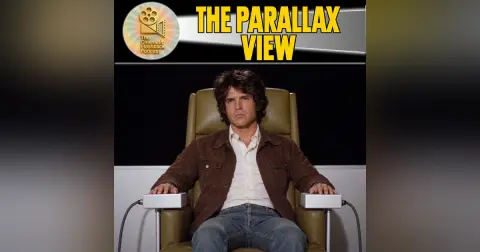
What if the conspiracy theories are right? Chuck and Matt revisit The Parallax View (1974), Alan J. Pakula’s political conspiracy thriller starring Warren Beatty, to see whether its atmosphere of suspicion still holds up today.
On this episode of the Cinematic Flashback Podcast, we discuss reporter Joe Frady’s investigation into the mysterious Parallax Corporation and the film’s connections to the anxieties of the Kennedy assassination era and Watergate. We explore Gordon Willis’ cinematography, Michael Small’s unsettling score, and the extended personality-test montage that leaves us with different interpretations—and questions about its pacing.
We also discuss supporting players Paula Prentiss, Hume Cronyn, and William Daniels, while Matt asks whether Warren Beatty is simply too pretty for the part. A detour into 1970s airline travel brings cigarette smoke and the surprising possibility of buying your ticket in flight.
Does the film’s slow build earn its payoff? Does The Parallax View groove through the decades, or skip a beat? Join us for our first-time reactions and final verdicts. We discuss some early plot developments while keeping the ending under wraps.
Have you seen The Parallax View? Share your take at cinematicflashback.com, and subscribe for more conversations about 1970s cinema.
Links & Contact Website:
https://www.cinematicflashback.com
Contact Us:
https://www.cinematicflashback.com/contact/
Listen to Previous Episodes:
https://www.cinematicflashback.com/episodes/
Leave a Review:
https://www.cinematicflashback.com/reviews/new/
Read the Blog:
https://www.cinematicflashback.com/blog/
Subscribe:
https://www.cinematicflashback.com/follow/
Share the Show:
Tell your movie-loving friends!
Other Podcast You Might Enjoy:
- Surely You Can't Be Serious Podcast
- 30 Something Movie Podcast
- A Film By Podcast
- Dockingbay 77
- Def Dave's 1984
- Accidental Legends
- Phasers Set to Stun
- Children of the 80s
0:02 It is the conclusion of this committee that Senator Carroll was assassinated by Thomas Richard Linder. It is our further conclusion that he acted entirely alone, motivated by a misguided sense of patriotism and a psychotic desire for public recognition. What happens when you begin to think the conspiracy theories just might be right? And maybe, just maybe, they really are. That's what today's movie, The Parallax View, asks. So hop on into the Wayback Machine as Matt and I travel back to 1974 to take in the second film of Alan J. Pakula's Paranoia trilogy. This is the Cinematic Flashback Podcast.
1:09 I am a healthy person agreed i like fashion magazines disagree i get angry sometimes agree my life is full of interesting things agree my stomach hurts disagree. Hey welcome back to the cinematic flashback podcast how you doing matt i am fine Listen, you're going to get those questions if you watch this film, because I was just trying to give Matt the Parallax Corporation Division of Human Engineering personality inventory. Matt, I think you're normal. That's got to be wrong.
1:50 Maybe I'm not a fit for the Parallax Corporation, which is probably a good thing. Well, boy, I tell you, it's been almost, it seems like two months since you and I actually recorded together. Just kind of getting through the October recordings with Amanda and Jeff. So glad to have them on board. Had a lot of fun with them. I hope you did, too. Oh, 100%. They're super fun to talk to. And honestly, we could have kept going for longer, I think, because we just had a lot of fun chatting back and forth. And those guys are awesome. And I loved being able to interact with them. You know, Matt, something I was thinking about recently, I went back and I listened to a couple of our earlier shows. Something that I thought was actually rather unique about our season one podcast is that we kind of wore our spoiler-free badge on our shoulders.
2:45 Yeah, I agree. I think it'd be a great idea for us to try to maybe walk that back a bit and let people discover some of these films on their own and not us give them away. Yeah, so that's... I think we can do a little bit of renovating here as we're bringing season two to a close. I'm just going to say I kind of like the spoiler-free badge. I mean, we're going to have to talk about some details, right? But we're not going to give away the ending or like the really big stuff. For example, we're not going to tell you that Darth Vader is Luke Skywalker's... See? We didn't tell you. That way, what we really want to do and the goal of the cinematic flashback is we want to go back to the 70s. We want to find movies to talk about.
3:33 You may have seen them. You may not have seen them. We're going to give you our opinion on whether they're actually worth seeking out today to watch. I don't know. What do you think about that, Matt? I think that's a great idea. And I think We'll be able to let you know. And I think as part of our concluding part of our show, we always kind of give you our impression on whether it's one that you really ought to go out and look. So as we build some trust with our listeners, they'll take that to the bank and go ahead and seek out the ones we think are well worth it without having to tell them the entire story and ruin an ending or a plot twist or something like that that makes it fun to see if you haven't seen it before.
4:13 And if you've been with us for any period of time, you will know that Matt and I don't always agree on whether or not we think the movie grooves or not. Sometimes it skips. Sometimes it doesn't. So if you find yourself liking the movies that I like, well, go watch it. If you find yourself watching the movies that Matt likes that I didn't like, then, you know, watch his. If we happen to both not like it, you know, you're at your own risk. Well, you can also go and watch it and then give us a bunch of reasons why we were wrong, which we will. Oh, that would be great. That would be great. Yeah, yeah. Speaking of audience talking back to us, last time you and I recorded, you put out a call for people to send in movies we should consider for season three.
5:00 And boy... I was not expecting the feedback that we got. Yeah. I think maybe there are about seven films that I have put on our season three list that were requested. It just so happened that one of them we were planning to review in December called Foul Play. The other one we were planning to review, I moved it so that we could add the Towering Inferno into that mix because Towering Inferno was requested as well. So I said, You know what? This listener is going to get both of their requests in December, and you and I can review films that are a little bit lighter than today's topic.
5:41 Yeah, that's easy to do. I think the other thing is, you know, and for the listeners, you know, Chuck and I spend some time trying to curate what we're going to do in the next season. And this year is a little bit different, I think, than it was before, because what we decided to do is each of us would independently put together a list of things we would like to review. And Chuck went and got our recommendations. And we put all of those together and tried to sift out where we think we wanted to go for next season. And I'm I personally am super excited about our slate of movies to review. Some of them are ones I've seen. Some are ones that I remember fondly and some I've never seen. So it's a great mix.
6:21 I'm pretty excited about next season. Can I tell you, Matt, what really surprised me is that you and I both had one movie. I don't know if it's very well known or not, but it surprised me that both of us had it in our list. That was Martin Scorsese's Alice Doesn't Live Here Anymore. starring Ellen Burstyn. I found that funny. Yeah. Well, you know, in researching the films, I've never seen that before, to be honest with you. I've never seen the movie. But in doing the research, I'm like, this really intrigues me, especially because Ellen Burstyn, I think she's a great actress. So I'm excited to see her in a role. And honestly, the 1970s were dominated by a lot of male actors. And it's nice to have some female presence in the movies that were reviewing and from some I think some pretty pretty accomplished actresses so yeah it's pretty cool well I am looking forward to that starting it starts in January and we're going to come out of the out of the gate swinging with a selection that Matt picked I am looking forward to to watching that one because it is a film that I have not seen before. I'm excited about it. Under our new organizational arrangement, I have to do the prep work for that film, so I'm not 100% sure how that's going to go. But hopefully it comes out as good as usual. We're going to buckle in and we're just going to ride that pony. I think it's going to be a lot of fun.
7:42 I think it's going to be fun for you, the listeners, to get a different flavor of cinematic flashback as you kind of get the matte seasoning all over it. So I think it's going to be fun. Might be too salty. Without a doubt. Let's start looking at this film today, The Parallax View, directed by Alan J. Pakula. Is this a film you've seen before? You know, I actually had not seen it before. I had heard of it, so I kind of knew what it was about, but I had not seen it end to end. And interestingly, I watched it with my wife, so I have a little bit of her reaction built into my reaction. Because, of course, when you watch a movie with someone... You sort of feed off of their vibe that's happening during the film as well. Oh, I think having Kathy on as a guest host would be amazing. If she ever wants to do it, let me know. This would be a great episode. She is an avid listener, which I find hilarious because the last thing I would have thought my wife would want to hear is my voice droning on again and again. And she does give me pointers about, you know, hey, tighten it up. Well, this was also a first time watch for me. I wasn't really sure what to expect personally.
8:57 From this. You know, I just knew that it starred Warren Beatty. I knew that it was part of the Pakula Paranoia trilogy. But the plot points of this, I didn't know. I think that some of the marketing for this film kind of leads you along the path that this may be about the subject matter that it turns out to be. But I don't think I really had any expectations of about this film going in because i just didn't know. It yeah yeah yeah i think it definitely it led with what the movie's about it's pretty complex you understand what's happening at the pace that's appropriate for the movie i think this obviously in all movies they're not going to tell you the entire story in the first five minutes it unfolds but it's you can follow it you know so.
9:45 Well, before we get into the movie itself, do you want to set the table for where we are in June of 1974 when this film opened? What was happening at that time? June of 74, I was.... 12 years old? 74? No, 13 years old. Yeah, I was 13. No, I was 12. Going to be 13. But I still remember what was going on because the Vietnam War was still in swing, although it was clear that We were going to be getting out of it. And that was a mess. We had echoes in the political environment about the Kennedy assassinations, both of them, and the Warren Commission coming out and all this stuff. And then a whole bunch of stuff went on with Watergate and President Nixon. There was just a lot of political turmoil going on at the time.
10:38 You know, again, remember, we're seeing through this through the view of a 12 or 13 year old. All I had was an overwhelming feeling of kind of shaky ground, maybe more doing it. It was a pretty interesting time. I'm very interested that this movie came out right during that time. I'm sure it's incredibly appropriate. At the time, it was not a movie I saw in the movie theater, obviously. I think it was rated R or whatever equivalent. So you weren't going to. I wouldn't go into that. When this movie landed in June of 74, there were a couple of events that were happening in the political arena. The first one in July, the very next month, the House Judiciary Committee had adopted three articles of impeachment against the then President Richard Nixon. And just a month later, in August, Richard M.
11:31 Nixon died. Resigned as president of the United States. So the moviegoing audience walking into this movie right now has what we described in Night Moves. They're the Kennedy generation. They're coming in with that. And then the very next month, they're dealing with Watergate. That might be the reason why we picked the next movie coming up. But we'll talk about that at the end. The Parallax View. At a high level, this is a movie that opens up very, very quickly, and then it settles down into a little bit of a stroll before it picks back up again. It starts off with a presidential candidate named Senator Charles Carroll, who is assassinated during a campaign stop in a chilling echo of the Kennedy assassination. It's pretty much on the nose.
12:29 And then years later, a newspaper reporter begins investigating the people who were connected to the killing. He finds himself drawn into a conspiracy that is just larger than what he imagined and is one that may have other political figures in its sights. Before we get into the film itself, Let's talk about the characters and the actors who played them. If you happen to know a piece of trivia, Matt, just throw it out there. But I'll start with Joe Frady, who was played by Warren Beatty, and he was a newspaper reporter investigating the assassination.
13:09 Then we have Paul Apprentice, who plays Lee Carter, who was also in attendance at the assassination. She's a television reporter, and Joe Frady meets up with her some years later. Just a piece of trivia, Paul Apprentice is still currently the wife of actor and director Richard Benjamin, who is a favorite of our friend Jeff Johnson. So next we have Hume Cronin. He plays the role of Joe Frady's editor. You're going to recognize Hume Cronin much later. He was married to Jessica Tandy, and we saw him in Cocoon and Batteries Not Included. That moves us to William Daniels, who played Austin Tucker.
13:52 He plays an aide to Senator Carroll, the one that was assassinated, and witness to the assassination. Incidentally, he also voiced Kit in Knight Rider. Yeah, he was also Mr. George Feeney, teacher and neighbor in Boy Meets World and Girl Meets World, which was a pretty popular television sitcom that a lot of our younger listeners might recognize him from. I actually mixed him up with the guy who plays Higgins on Magnum P.I. Oh. The reason I mixed him up is they both played very stiff roles. slightly pompous characters. And the guy who played Higgins in Magnum P.I. was John Hillerman. So when you look at John Hillerman and you look at this guy, you're like, ah, okay, Matt, you can be excused for mixing that guy up.
14:44 Next, we have Kenneth Mars, who plays Will Turner. Now, Will Turner has a very small role in this film. He is a former FBI... Well, wait a minute. He's been off the FBI so long that he is now no longer an ex-FBI agent. He helps Frady to get fake IDs for his investigation into the assassination. And you know, Matt, I thought that His explanation for why he was giving him multiple IDs, I didn't even think about that until I watched it a second time, knowing how the film ends. That actually plays out later. So I thought that was a very clever setup. And it was very smart that he did. It that way.
15:25 Mm-hmm. That leads us to Kelly Thordson, who plays Sheriff Wicker. And the sheriff being investigated by Joseph Frady unknowingly provides significant clues. I had to put the next actor in because every time he comes into the cinematic flashback, I have to point him out. Earl Hyman. He plays Deputy Red, who happens to be Sheriff Wicker's sister's son. But Earl Hyman went on to play Mr. Wilson in Home Improvement. Oh my gosh, that's amazing. So you get to see the bottom of his face. You do. The last time we saw him. That's why I didn't recognize him. You're forgiven for that. The last time we saw him was in the taking of Pelham 123.
16:10 That's amazing. That's so funny. I know the name and I was like, how do I know this name? That is really hilarious. So that brings us to Walter McGinn, who plays Jack Younger. And he is the representative of the Parallax Corporation. And I'm telling you, that guy plays a creep better than anybody. He's one of my favorite actors in this film because the way that his character was written was that he was supposed to be a six foot two ex-FBI type of guy. But if you watch the film, you'll notice that Walter McGinn, the height differential between Walter McGinn and Warren Beatty is significant. He plays a much smaller person But like you said, he has like the, oh, yeah, he's good. Yeah.
16:57 He's good. He does a good job. Next, we have Bill McKinney. And now Bill McKinney, his character does not have a name, but he is a mysterious figure who appears to be working for the Parallax Corporation and kind of shows up all throughout the film. Yeah. Every time he shows up, there's something bad that's going to happen. He is the harbinger of doom. Yeah. So then Jim Davis plays Senator George Hammond. Another potential target. It was driving me nuts because I knew I had seen him. It finally hit me as we were watching it. Jim Davis played on a show that came on, I think, Friday nights, maybe about 10 o'clock. I would come in at the end of that getting ready to watch Friday night videos at 11. And that show was Dallas. And he played... Right. He played the father of J.R. and Bobby, and he was the head of the Ewing family.
17:54 Oh, that's hilarious. That is 100% on the nose. That's so funny that you pointed that out. It was niggling at me as well. I knew I knew him, but I didn't know what from. Like we mentioned at the very top, this is an Alan J. Pakula film. It was shot by Gordon Willis, and the composer was Michael Small. Now, if those three sound familiar... It's because we last talked about them in February when we reviewed Clute. So Pakula just got the band back together and said, let's make another film. And we're going to see them in two weeks again when we talk about our next film. The movie is based on the book The Parallax View by Lauren Singer. And the book is significantly different. It is a fictionalized version of the Kennedy assassinations. This movie bases a lot off of it, but fictionalizes it even more without going back into the 60s.
18:52 Well, I think it was pretty effective. I think this is maybe one of those cases where some license that the screenwriters took is probably good. Well, this is an example where you can go and read the book, enjoy the book on its own. You can watch the movie, enjoy or not enjoy the movie on its own. They're going to be separate. Not always a bad thing. Matt, this film literally starts off with a bang. Yeah. We're introduced to three characters. We're introduced to Joe Frady, Lee Prentiss, and we're introduced to Austin Tucker. Of those three characters, Joe Frady does not have a pass to go up into the Space Needle. He is not there to see what follows. There is an assassination. They come out with a commission that has the official reporting. The man who we think he pulled the trigger is identified as the lone gunman although you and I actually saw two gunmen. Right.
19:54 So right off the bat, we've got this parallax view of of what's happening we know there's a little bit more to the assassination but we really don't know the details and then the commission comes out and assures us that it was a lone gunman acting on their own which we know doesn't really jive but we really don't have a lot of the details this is the great part of the movie is it is opening that door to the doubt of what's happening in our doing our research and watching the movie, there's a lot of techniques that are used in the film to put this just, I can't say the word. Juxtaposition. Just, this just, I still can't say it. This juxtaposition.
20:38 Can't do it. You can do it. I believe in you, baby. I can't. I can't. Anyway, there's a lot of things in this movie that really are intentionally filmed to give you this parallax view, the old and the new, the one view and another view. And it's pretty cool how that theme returns throughout the movie. So if you watch this movie, really keep an eye out for those things. And it actually goes into the music as well, which I'm sure you'll talk about, Chuck, because you always love the music so much. I thought the music for this was the entire time. You know, we always talk about that music will swell and then it'll release. It'll swell up, it'll release. The music in this film has a lot of dissonance. You know, it feels like everyone is always on edge. There's a motif that sounds almost like a news motif, like there's a little bit of hope. But then the dissonance comes in and it kind of squashes that.
21:32 Yeah. And as everybody knows who listens to this podcast, I pay attention not as much to the music. And I will say in this movie, the music and the theme really plays an important role in making you uncomfortable. I don't know if you knew this or not, Matt, but there was also... a conspiracy around the Kennedys, people who were nearby who were being killed, or at least they were dying of mysterious causes that the only thing that the deaths all had in relation was that their proximity to the assassinations. And this film takes that and brings it into it. The news reporter who we see at the very beginning, Lee Carter, She is a longtime friend of Joe Frady, and she shows up at his hotel room to say that she's afraid that she is about to be killed. And this is three years after the assassination. I thought Paula Prentiss did a really good job seeming like a person who has been living in fear a very long time.
22:36 Yeah, she delivered a great performance. I agree 100%. She definitely was able to show that feeling, that overwhelming feeling of dread and almost like trapped. She's putting the connections for Joe together about all the people who were in proximity of Senator Carroll's assassination, that they are dying. And of course, Frady, he's very skeptical of all this. I don't know how much you remember of Clute. At the beginning of the movie, it opens with almost like a Thanksgiving dinner table, and it focuses at the head of the table where the husband is sitting. It cuts really quickly, and that chair is empty. You, as a viewer, know instantly that Pakula is telling you, Something has happened to this man. And he uses that same language in setting up this scene where Lee is the focus of the scene. And I think Frady is playing off of her. But then there's like a quick cut.
23:41 And then you see that Lee Carter has indeed died of, well, her blood says there's a lot of barbiturates and she died that way. Yeah, no, it's very shocking because at one scene you hear her talking and the very next scene she's laid out on the slab. You're not given any kind of like thrill of, and I don't mean thrill that way, but kind of the dread or the anticipation of her being chased and or you just, the realization is she's here, she's gone, right? It's very shocking. So this leads us down the rabbit hole. Joe finds out about the Parallax Corporation. And he finds it in some papers that have the test with the questions that I was asking Matt at the very beginning of the episode. And they do something that I thought was hilarious. He's working with one of his friends and he's just asking him, well, could you and I take this test? His friend is a psychiatrist.
24:36 He goes, oh, no, I have someone better. Yeah, the psychiatrist is doing research on criminals. Right. And he happens to have one there. Yeah. A total sociopath. Who takes it. This opens the door. This is what gets Joe Frady noticed by the Parallax Corporation, and they bring him into the office. Now, he's using an alias, right? I believe he's using an alias. I think the important thing to point out is that Joe Frady is trying to do an investigation, and he feels his investigation will work if he's able to infiltrate this organization. Yes, that was it. And so he does. He gets the invitation to come and they administer him. You know, I guess if you get past the questionnaire, you get to... What I'm going to say is maybe the weirdest five minutes of film that I have seen. Because it's like the movie almost pauses and you're seeing a movie inside a movie because this is the test that they're... It's not the test. It's just they're... It's like a training. Oh, no, it's...
25:40 Do you remember the beginning of Blade Runner? They're issuing this Voight-Kampff test to try to determine if the person is an android or not. I think this is a similar Voight-Kampff test where they're trying to figure out if Frady is actually a psychopath or not. Right, right, right. The movie repeats love, mother, father, me, home, country, God, enemy, happiness. The first time it goes through, all the pictures are just non-controversial, right? Right. They're warm. Apple pie and, you know. Oh, gosh. And then you get to the enemies and it's like Hitler, it's Mao Chung, it's, you know, everything that no one has any problems with. But then the second round, it starts to change a little bit. And then it starts to speed up. And then some of the words don't quite go with some of the pictures.
26:31 At what point, Matt, did you say... It's time for this movie to end. It's interesting what they're doing. Here's the question I had is, if these guys were so good and they appear to be so good, remember, Frady has taken this test, not the psychopath that filled out the questionnaire. So to me, I was worried at the time, at what point do they realize he is not a psychopath, right? So to me, some of that question happens right during that scene. And then as we see, I'm not going to give away any secrets, but as the movie goes on, We continue to wonder, do they already know that he's fake? We don't know. They never answer it directly. You can walk away with your own interpretation of it. And it's not, you know, necessarily a spoiler. But I think that's a great question to ask as you're watching the film. Is Joe Frady pulling one over or is he actually fake? getting pulled.
27:29 Exactly. That's the question. Maybe he did pass, which is even a little more terrifying, right? Yes. That he actually either was either this thing was a brainwash and he was successfully brainwashed or he wasn't. And they knew and they were setting him up. But I mean, again, here's the cool part about this movie is it It never really declares one way or another as it resolves in the end. And we're not going to give you any spoilers, but it's very exciting. Yeah. Yeah. The other scene that I really like to maybe land the plane on, if you will. Okay. What is the most 70s thing that happened in this film? And what came to my mind, and people who are listening to this will know my issues that I have had recently with traveling by plane. But in this movie, this is early 70s. In the early 70s, you could go through a metal detector, get on a plane with absolutely no ticket, And as the plane is in flight, you could purchase your ticket. I doubted that that happened. And I researched it and it was a thing. That blew my mind.
28:40 That was probably the most shocking thing of this whole movie that had nothing to do with the movie. Well, the ticketing for airplanes was just like the ticketing on buses and trains. Trains that came through and said, where are you stopping? And they put your ticket in and they had a punch. for what you've paid through. And if you were still there and your punch said the last station, then you need another 75 cents. The thing that really got me, which was hilarious, is as they're panning through the plane, like half the people are smoking. There's clouds of smoke coming up, right? It was insanity. Oh, I can't. And I remember flying in the 70s because when I was a little kid, my parents would put me on a plane in at National Airport and I would fly up to Providence, Rhode Island to visit my, you know, we called them cousins, but they really just really good friends of the family. And they would pick me up at the airport. So it was just one flight. So they all they just put me on the flight. I'd sit in the chair and fly up to Providence. there and it was like a one hour flight or whatever and but hilarious because i remember everybody around me smoking cigarettes and my mom smoked all the time was insane it's crazy to see that if you watch this movie for nothing else this is a good sort of peep into what air travel in the 1970s were. And I believe his fare was $ 68.
30:01 68 bucks to go from Los Angeles to wherever they were going. Yeah, right. Matt, I think we're starting to move into that area that if we continue talking about this film and at this point, the tension in this film and the pace of the film is picking back up and it's leading towards that ending. I think we're going to give a little bit too much away. So why don't we land that plane, get off before anything happens, and let's go to a quick commercial break. We'll be right back. We are now finishing up our review of the Parallax View, and this is where we're going to ask that question.
30:43 Did it groove through the decades? Did it skip or beat? Or maybe, maybe it fell somewhere in between. Matt, what do you think? Well, as I said before, I did not see this in the 70s, but I have to believe that it grooved back then, especially in the political climate that it was released into. It wasn't a happy frolic by any stretch. You know what I mean? It's serious subject matter done well. I also, as I've said many times on the podcast, that pacing of movies is just different nowadays than it was back in the 70s. I think a modern viewing will be a little frustrated with the pacing that some things take too long to evolve. But I don't think anybody will be upset with the pacing at the end and how it's done. So if you ignore pacing, if you can understand the 70s, I would say it absolutely probably grooved in the 70s. It definitely improved. hit the mark.
31:46 And it wasn't, like I said, a feel-good, go-to-the-movies type of movie, but it was definitely one that you continued to think about, I can imagine. Now, move forward to nowadays. I watched it for the first time. Like I said, I watched it with my wife. We both watched it from beginning to end, which is actually saying something because I typically will break these up into several evenings of watching. So that's a big vote right there that we actually went from beginning to end. But I think she and I both definitely had some issues with the pacing and the brainwashing scene in the middle of the movie for me was just a little too long because it definitely gets the point across that they're trying to brainwash the Frady character. But at some point, it drops off showing what they were doing to Frady and appears to be trying to do it to you, which I don't like.
32:37 So I think that went too far. It went too long. Then after those scenes and when things start to really go, it moves very quickly. But this movie really sticks with you as you think about it more and more because you start to put together things that you saw in the movie and how the movie ended. And it brings up even more questions. So this is definitely a movie I'm probably going to watch again. So I would say 100% this grooves through the decades. My one caveat, Warren Beatty was the wrong person to play Frady. He's too pretty. He's too superficial. He is not a hard-cutting guy who this organization would be concerned about him getting to the answer.
33:21 That's my personal opinion. He's Warren Beatty from Shampoo trying to do a dramatic role. I didn't buy it. But the character is awesome. The writing's awesome. The other actors do a great job. And then the whole story really is very powerful. And again, that ending... really builds and that dissonance that you pointed out in the music also plays a big role. So yeah, I would say it definitely grooves. And if you love Warren Beatty, man, this is your film. If you're like me, I'm kind of so-so on Warren Beatty, I'd still like the film. So what did you think, Chuck? What was your take? I really like Alan Jay Pakula in his movies. I really like Gordon Willis and how he shoots films. If you look at the film, not necessarily from a story point, but from a technical standpoint, it's amazing. They shoot a lot of film at the beginning in the Space Needle, which is full of windows, images that would be totally washed out just due to light differential on the film.
34:24 You get to see everything exactly as they want you to see it. So technically, this film is just amazing. And once again... Gordon Willis, he's called the Prince of Darkness. This film is shot anamorphically, so he composes pictures with placing characters on the right-hand side of the screen and giving you a lot of visual on the left. The film looks so good. The story. Okay, I think the story was a bit on the nose because... They're not trying to talk about, you know, John F. Kennedy. They're trying not to talk about Robert Kennedy. But we all know what they're talking about. So many times I hear conspiracy theories. I think that they're just they're out there, that they're cuckoo.
35:15 But. I think sometimes the older I get, I see that some of those things that I thought was cuckoo are starting to come true. This movie is asking you the exact same question. What if the conspiracy theories are based in some kind of fact? Because there is this corporation called Parallax that is behind it all, that makes it even scarier. So I did not interpret the film scene as trying to brainwash, but to elicit reactions that they could determine whether or not Joe Frady would or would not be a potential candidate for Parallax. And you made an observation that had me thinking, well, what if they were not trying to see if he was a candidate because of him being psychotic, but rather because he wasn't, and maybe they could set him up. And I think that that was a great observation that I hadn't thought about.
36:14 And it actually kind of turns that scene around for me a little bit now. So, yeah, I think that this film has a lot to like about it. If you are looking for a film that is going to keep ratcheting up the tension until the very final frame and you go, oh. That is a great reaction to watch. I watched the film twice and I watched both times front to back and I watched it the second time with my wife who also had a very similar reaction to you and Kathy with the pacing but we both enjoyed how the film ended and it started a lot of discussion afterwards, you know, just about how we perceive things in our world. So I think it does groove. Sorry, I went off forever on that one.
36:57 No, it was great. Trying to find my way. No, 100%. And I totally agree with you on the cinematography. I did not mention that in my summary, and I 100% agree. It's really powerful, well done. And it goes with the music, the dissonance of the music. There's some dissonance. And the filming, the sound dissonance at one particular scene, there's like a dam opening that just comes over the top of you, right? And I don't want to give away too much about it because it's an important scene. But it's the way the sound kind of just knocks you over the head and throws you for a loop while the other things are going on in the scene. It's really, it's amazing. It's very, very powerful. But again...
37:39 I do reserve my thing with the pacing. You just have to understand that this is a 70s movie, not a 2020s movie. It's a slow roll that gets moving pretty quickly at the end. And oh my gosh, I can't believe we didn't talk about the damn scene. I'm sorry I had to say it. Yeah, the damn scene. We want to thank you for taking your time to tune in. And as I have teased, we're going to come back in two weeks and we're going to review... the final film in Pakula's paranoia trilogy called All the President's Men, starring Robert Redford and Dustin Hoffman. If you've seen The Parallax View, we would love to hear what you thought about it. What did we get right? What did we leave out? What should we have not said?
38:29 But please reach out. Let us know. You can do that on Facebook, or you can leave us a message over at cinematicflashback.com. Don't forget to subscribe so you never miss an episode. And if you're enjoying this podcast, we would really appreciate a rating, a review. And in fact, I can almost guarantee that your review will be read on the air and tell your friends and family about what we still proudly believe is the best podcast dedicated exclusively to 1970s cinema. And it's spoiler free. Join us next time as we climb into the way back machine and head once again to into the 70s for another cinematic adventure until then thanks for listening