
 Spotify

 Amazon Music

 Apple Podcasts

 iHeartRadio

 PlayerFM

 Podchaser

 YouTube
 RSS Feed
Walter Matthau’s Dark Turn — Charley Varrick (1973) | The Last of the Independents
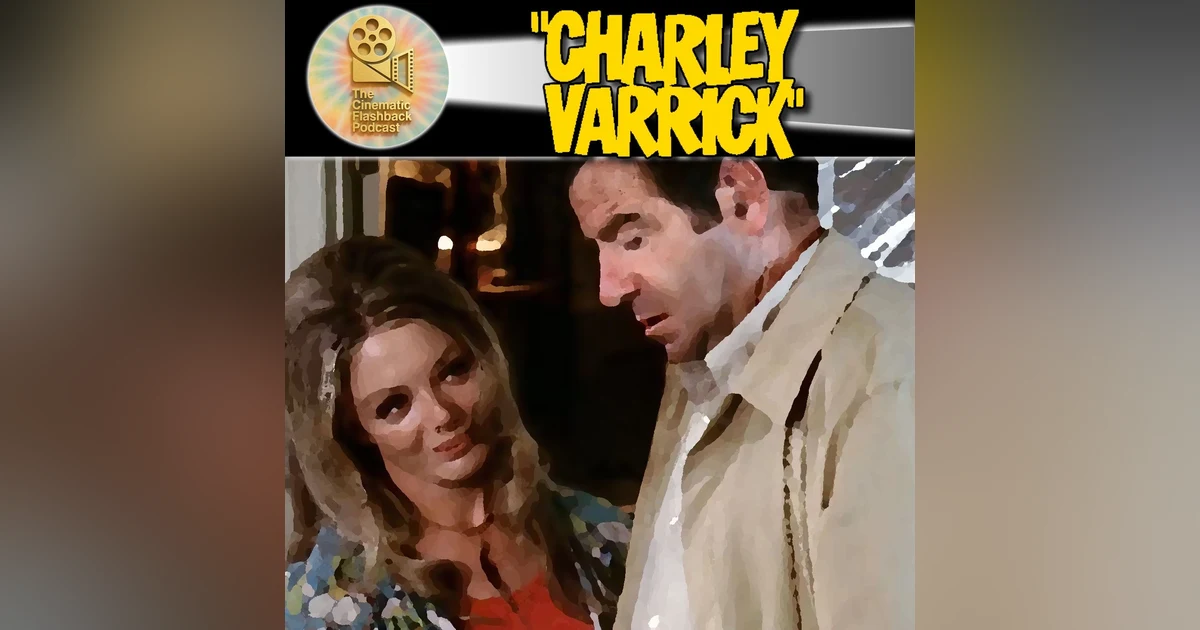

In this episode of the Cinematic Flashback Podcast, Chuck and Matt wrap up their Crime Wave month with a deep dive into Charley Varrick (1973), directed by Don Siegel and starring Walter Matthau.
What starts as a routine small-town bank robbery quickly spirals out of control when Varrick and his crew stumble onto something far bigger than expected—mob money. From there, the film transforms into a tense cat-and-mouse game between a meticulous independent criminal and a relentless mob enforcer. The hosts break down:
- Matthau’s against-type performance and why it works
- Siegel’s efficient, no-nonsense directing style
- The film’s place in 1970s neo-noir alongside Chinatown and other New Hollywood crime films
- The concept of “the last of the independents” and what it says about crime in the 70s
- Joe Don Baker’s chilling, calculated performance as Molly
- How the film subtly builds a layered criminal underworld without over-explaining
- Why the script plays like a “Swiss watch” that only fully clicks in the final moments
As always, it all comes down to the final question:
Does Charley Varrick groove through the decades… or lose its beat?
Links & Contact Website:
https://www.cinematicflashback.com
Contact Us:
https://www.cinematicflashback.com/contact/
Listen to Previous Episodes:
https://www.cinematicflashback.com/episodes/
Leave a Review:
https://www.cinematicflashback.com/reviews/new/
Read the Blog:
https://www.cinematicflashback.com/blog/
Subscribe:
https://www.cinematicflashback.com/follow/
Share the Show:
Tell your movie-loving friends!
Other Podcast You Might Enjoy:
- Surely You Can't Be Serious Podcast
- 30 Something Movie Podcast
- A Film By Podcast
- Dockingbay 77
- Def Dave's 1984
- Accidental Legends
- Phasers Set to Stun
- Children of the 80s
0:01 When are they kidding us? Don't they think we can count? Doesn't make any sense unless unless what unless it's a drop? What's a drop? You know what dirty money is. That's the kind of money you can't declare on your income tax. But when certain people get that kind of money, what they do is send it out of the country to invest, and when it comes back it's clean. So maybe that little bank was a drop, a collection point. Maybe all this was on its way out of the country. Fan fantastic, we lucked. Out or like crapped out. It's ten to one. This stuff belongs to the mafia. This is gambling money, skimmed off the top, horror money, dope money. What's the difference. The difference is that.
0:42 The mafia kills you, no trial, no judge, and never stop looking for you, not till you're dead. Welcome to the Cinematic Flashback Podcast. Get ready to hop into the wayback machine as we journey through the wild, bold, and unforgettable films of the nineteen seventies. Each episode, we break down a classic movie or a forgotten jim seeing how performed then and now, and wrapping things up by asking did it groof the decades or did it lose its feat? I'm your host, Chuck Bryan, and today we are reviewing Don Siegel's nineteen seventy three film Charlie Verrick, starring Walter Matthow, Jodahn Baker, John Vernon, and Andy Robinson.
1:25 This is our second film and our crime Wave month, and this time we're heading to the sleepy town of Trace Crusades to make a little bank. Woudraw driving carefully behind the wheel is my accomplist, Matt Sergeant. Now, Matt, as we drive away from the bank, just drive naturally. Okay, that's funny because that clearly isn't what happened in the film. But I'll be honest with you, I'm surprised as anyone that Walter Matho could play a criminal. It just seemed to be against type. But I think it works. You know, we are in the Walter set of films where he was playing more action roles. So he started with Charlie Verrick, then he went into Pellam one, two three, and then he finished it up with the Laughing Policemen.
2:10 These are just films that he put out where it was not the standard Walter Mathow film. I think next year we've got to get his last action film on our list, because so far I'm all about Walter Mathow. Okay. In our first season of The Cinematic Flashback, we reviewed a lot of films by many great directors, and in our last episode, I made a mount rushmore of new Hollywood film directors. I included William Friedkin, hal ashby Robert Aupman, and I put Sam Peckham pop there. But now I have to ask, does Don Siegel deserve to be up there? Well? I got to say that was a fun thought experiment on the last episode, and I think it's a good way to sort of bring in the three top that we like. But I got to say, after watching this film, I really I really like the action, I like the direction.
3:03 I think we might just need to chisel out a little space on that rock. You're absolutely right, Or perhaps Siegel is just going to need his own monument Matt, who do we have talking to us today? Today we have a review from listener Jason called twenty four. Jason gave us five stars, thank you very much, and wrote, quote, there are tons of podcasts covering movies of the eighties and nineties, which is why I so love Chuck and Matt going deep on films of the seventies. The hosts are enjoyable to listen to, with great insight background in trivia. This is definitely a must listen. Five stars. Wow, that was nice to hear, but you know what, we be better to hear your own review. If you like what you hear, or you have thoughts on how we present or what we present, or some even some comments or some insight that we don't know, please leave a comment and we might just read it on the air.
3:55 Jason, thank you for the review. Now. Jason has been a supporter of the Cinematic Flashback and has his own little podcast called the Surely you Can't Be Serious Podcasts and both Jason indeed joined us last summer on our Jaws episode, and tonight I am sporting a Surely you Cannot Be Serious podcast t shirt, So I'm going to give you guys a little shout out. Go to their merch shop. They got some good stuff over there. Yeah, and you guys in the podcast possibly can't see the T shirt, but I can see it, and it is really nice. It's got great bright colors. And I had no idea that Cinematic flashkit back was having a merch purchase, I would have put my order in as well. Hey, Chuck, when when we look at our page stats, it's cool to see where in the world people are listening to our podcast. Oh yeah, yeah, it's cool. Today we want to give a shout out to our listeners in New Zealand, particularly in the Wellington region, Hawkes Bay and Auckland. We would love to hear from you guys, whoever you are out there, maybe a review or a comment. Tell us about your home and how you found out about our little cast.
5:05 Wow, that is just it's hard to believe that people all over the world are actually listening to the two of us wax poetic about seventies cinema. Yeah, it makes me want to raise my game a little bit. We might need to. Hey, today we are reviewing Charlie Verrick and I'm hoping we're introducing a new film to a lot of listeners today because the first time I ever heard about Charlie Verrick was from the Facebook group Cinema of the Seventies. Matt. If you have ever asked yourself where does Chuck actually come up with these movies to watch? It comes from this group, or it comes from another group called can You Still dig It? Seventies Movies? And I get so many ideas from them, and I highly recommend both groups. And best of all, they have excellent moderation. Groups without good moderation become obnoxious. These are really well done. I think this was your first time watching Arlie Verrick? Am I right?
6:01 It was? For sure? Not sure I had how I missed this back in the day, but I'm glad I got to watch it recently. Charlie Verrick is one of those films that a lot of seventies film buffs. Remember, if you had to put it into a category, you could call it something like, you know, American neo noir, kind of like Chinatown, which sits in that same lane. And since this is a genre I happen to enjoy, We've got two more coming up later in the season. Arthur Penn's Night Moves from nineteen seventy five starring Gene Hackman, and we're going to pair that with Robert Altmans The Long Goodbye from nineteen seventy three with Elliott Gould. I'm hoping both of these will be at least somewhat new to you. They're one hundred percent new to me. I haven't seen either one of those films, but I really look forward to seeing them.
6:48 Let's take a dive into Charlie Verrick's origin story. Okay, check it out. Like a lot of films, it started out as a book, passed through the hands of two different producers, and eventually made its way to this and the history between those two producers, that's the kind of Hollywood drama you really couldn't invent. Those producers were Walter Wanger and Jennings Lane. Now. Wanger previously worked with Don Siegel on a film called Riot in Cell Block eleven and again two years later on a film called Invasion of the Body Snatchers. So Siegel was Walter's choice when he purchased the rights to John Reese's book The Looters, which would eventually become Charlie Verrick, but Siegel wasn't available. From nineteen sixty seven to nineteen seventy four, Siegel released nine films Strangers on the Run, Coogan's Bluff, Madigan, Death of a Fighter, Two Mules for Sister Sarah, The Beguiled, Dirty Harry, Charlie Verrick, and The Black Windmill. The only year a Don Siegel film was not released during that run was nineteen seventy two.
7:54 That's an amazing run. Is that that's like seven years nine film Holmes. That's crazy. And if listeners have seen Death of a Gunfighter they might remember that it was credited to Alan Smithy. Did you know that Alan Smithy is a pseudonym that was used by directors who wished to disown a project. It was first created by the Director's Guild of America in nineteen sixty eight for Don Siegel and Death of a Gunfighter. Now, I did not know that. There's actually a page on Wikipedia with all of the films that have been accredited to Alan Smithy, and there was one entry that surprised me, and that was Meet Joe Black, Because Meet Joe Black was a big film. It was really good and it was directed by Martin Brest who made Beverly Hills Cop, Midnight Run and Sent of a Woman. Had the airline version of the film credited to Alan Smithy because it cut out an entire subplot of the film and he said, Nope, that is not my film.
8:57 Meet Joe Black puld a special place for me as well because it stars Marsha gay Harden and Marcia gay Harden is the sister of my sister in law. What, yeah, no, way, I have held her oscar? What she let me hold her oscar? Well, that's amazing. I'm learning all sorts of new things about Matt Sargent. Yes, and my very large extended family. Well listen, if in your extended family she ever wants to make a little promo about us, will we will send her some of our merchandise T shirt sponsored by the Shirley You Can't Be Serious podcast. Well, she's very busy, surprisingly, I would imagine. So yeah.
9:37 But getting back to Charlie. Verrick Wanger passed away in November of nineteen sixty eight, and the film rights to The Looters ended up Universal with producer Jennings Lane. Now Lane produced many of the non Irwin Allen disaster films, including Earthquake. That was filmed in sends around. I was thinking that that was originally naughty films. Oh my yes, but that application would have been interesting in case our listeners have never heard of since around it was an augmentation to the conventional soundtrack, and in the case of Earthquake, it was activated during the earthquake scenes.
10:17 It was so effective that the resulting rumble could be felt as well as heard by the audience. Unfortunately, it could also be heard in other auditoriums, and Man's Chinese Theater even installed netting to catch any plaster that might come loose and fall on their patrons. Jennings Lane started off as an actor's agent, and this is back in the fifties, and one of his clients was Joan Bennett, who at the time happened to be married to Wanger. Wanger was so sure that Lane and his wife were having an affair, and in a fit of jealousy, Wanger shot Lane in the groin. Yes, Wanger shot Lane in the wang, but in all seriousness he missed any reproductive parts, as Lane's sun is able to testify too.
11:06 Like you said, a tale that could only be told in Hollywood. Without a doubt. Are we ready to dive into Charlie Verrick? I think we should. Okay, let's do it, but we need to step away for a quick break. We'll be right back. It's antimatic flash back you've seen Charlie Verreck. I'm interesting know, mister Derek, last of the Independence. If you want to die for somebody else's money.
11:48 Half a million could be Harold young Trace. Cruis's bank manager is estimated that the band has escaped with less than two thousand dollars. Let's tend to one. This step belongs to the mafia. This is gambling money skimmed off the top. The mafia kills you, no trial, no judge, and never stop looking for you, not till you're dead. I'd rather have ten fbis after me, one man against the mafia. Dang this a little bank a million miles from nowhere gets hit by four professionals that they're gonna take that strange. Why couldn't it be just a coincident? Because they don't believe in coincidence.
12:29 Prop dusters don't wave. Got to put that thing away fast. But we're going to get out. I only ever get out of New Mexico. I feel that in my gut. I want to. Fence off some money, hot burning up. What do you want? I'm sorry to mean to scary you. This doesn't mean I won't throw you right out that window if I have to sooner. Lady, you're gonna tell me everything you know, so why not stay? Several great deal of pains? Charles Verrik. When Charlie Verreck runs out of dumb luck, he always has genius to fall back on.
13:22 Welcome Back. We are in our non spoiler section, so let's dive into the production details. Charlie Verick was released on October nineteenth, nineteen seventy three, with a runtime of one hundred and eleven minutes. It was produced and distributed by Universal Pictures. Charlie Verick is not currently streaming on TV, but it can be easily rented. It has an eighty two percent on Rotten Tomatoes and I found this interesting an eighty three percent audience rating, and that audience rating is comprised of over twenty five hundred reviews. Don Siegel directed. The script was written by Siegeal veterans Dean Reisner and Howard Rodman, who also worked on Dirty Harry. Michael C. Butler was Seagal's godson and also the cinematographer on this film.
14:06 Butler is best known for his work on The Cannonball Run, Jaws two, and Telefon. Music was composed by Leilo Schiffrin, another Seagull regular. And the curious thing about this score is that it was never released. I reached out to friend of the show and soundtrack genius Wayne White had If anyone knows anything about this, he will and Wayne came through. Besides just having some cues on a compilation, Wayne believes that the tapes were actually lost for that score, which is a real pity because it's a good soundtrack. The film also goes by the title Killed Charlie Verrick in foreign distributions. I have to say that I think I like the title kill Charlie Verreck better than just Charlie Verick.
14:51 Yeah, it played in other markets that way as well. I think that would have been a better name, and I'll bet it would have gotten a more people would have seen it. I think that's my personal opinion. This movie was highly influential on Quentin Tarantino. I have no doubt there's some lines in this movie that are emulated in other Tarantino films. Oh, for sure, we have the movie Kill Bill Killed Charlie Verick. Hey maybe maybe not. Yeah. We have a really good cast and one of them is one of my all time favorites. Let's talk about him. Walter Mathow is in the role as Charlie Verick. Verick is a crop duster and a former stunt pilot. He along with his wife Nadine, becomes skilled small time bank robbers.
15:32 They pull off heists at small banks, the heist of the Western Fidelity. It goes terribly wrong. We last talked about Walter Mathow in Pelham one, two three, Last Summer. That film, along with Charlie Verick and The Laughing Policeman, are his three action films of the seventies. Incidentally, his son Charlie Mathow can be seen in Face Cruis's twice, once in the opening credits, trying to saddle a donkey, and then the kid with the black hair who tells the shit the lightcense plate number of the Yellow Continental but gets it wrong. Yeah, yeah, yeah. Incidentally, Don Siegel's two daughters appeared in the opening credits as well, establishing the normalness of Trace Crusis. His youngest daughter is the little girl who's playing with the sprinkler.
16:14 Her older sister is shown cutting the grass. Two of his sons also make an appearance in the credits, but they are mixed in with other actors. Yeah. I thought that the opening of the film. I think what was happening is that they had got the cameras out there and they loaded it up with film and they were just taking test shots, making sure the cameras everything worked. And so they said, hey, we can go ahead and film the opening sequence for the titles. They were already a day ahead of schedule. Yeah. No, and I like it when they do that kind of thing, and it did establish that this was a tiny, sleepy town. Do you want to talk about Joe Don Baker. Yeah, Jodn Baker plays Mollie, and Molly is the muscle and he works for what we're going to get into that. Yeah, let's just say that he is an independent contract who was hunting down the people who just roped the Trace Cruses bank. Yeah. Just the previous year he co starred in Sam Peckhampau's Junior Bonner, starring Steve McQueen. But in nineteen seventy three he had a film that was only meant to be played at drive ins. But as we say today, that movie went viral and it got a wide release. The film is, of course Walking Tall. It was very good timing to have Jodn Baker in your film.
17:29 And I will say that I think he did a great job. He didn't play it over the top. He just played a highly competent contractor doing his work. He's very cordial, he was very friendly until he's not. Yeah yeah, but he's also exceptionally efficient, and he wasn't just I kind of think of in the No Country for Old Men, heavy paid, oh yeah, paid by havy ar Bardem, where he basically just kills everybody. I mean, he's super efficient, he's a terrible he's like a force of nature. But he he flips a coin and everybody dies. Joe Don Baker's Molly, it's like surgical. He goes in, he gets the info, he does what he needs to do.
18:09 I think that was more chilling than having this sort of unhinged lunatic Oh yeah, no, it was over the top. I love No Country froll men, don't get me wrong, but that was just a little. Much for me. Also done by the Cohen Brothers. I believe, yes, yes, exactly. I want to do John Vernon because he hear me laugh, because he hadn't changed very much. John Vernon plays Maynard Boyle. He's the president of the Western Fidelity Bank, and obviously we learn in the movie he's kind of involved with a bank that gets robbed. In Trace Crusis. But the funny thing about John Vernon is he plays the mayor in Dirty Harry. But of course he's probably much more known as Dean Warmer from Animal House. And whenever I see his face, I just laugh about Double Secret probation. And I mean that role for him was iconic.
19:02 And if you didn't know anything about John Vernon, go and take a look at his IMDb page, because a lot and star in Canada, right, he made his profession in Canada before working in American television and movies. He was good, He was good. We have another alumni of Dirty Harry, another friendly face Andy Robinson, is Harmon Sullivan. Sullivan was the only other survivor of the Trace Cruses bank robbery, and he's an accomplice of Charlie Verrick. The last time we saw him was he played Scorpio and Don Siegel's Dirty Harry film. I feel like when these guys get on set, they're like. Hey, how you doing it in six months? Let me ask you this question. Originally they approached Clint Eastwood to play the role of Charlie Verrick and he turned it down.
19:50 Was that a fortunate turn down? That's a funny thought. It would have been a completely different movie. I think Walter math asked, goofy, you're right. Look kind of sets that I mean really works in this movie. Because of what this movie is, we don't want to give it one any spoilers, but I think Clint Ease would have would have would have tipped you off too early, too soon, right, he's too hard. The reason that Clint Eastwood did not want to take it was because he did not like the overall character of Charlie Arrick. You will talk about that. We can see that. I mean, but well, he's a rising star. But yeah, he's a rising star. But he also played Derry Harry basically used everybody, so I don't know about that.
20:32 Alicia Farr played Sybil Fort. Now simple Fort was the executive assistant to Maynard Boyle, and the only reason why I really am highlighting her was because she just happened to be married to Walter Matthow's good buddy, Jack Lemon. And so it's kind of funny to me that there's a scene where Walter Mathow's character is in a very round bed with Felicia Farr's character. I believe the quote is boxing the compass. I think that's what it was. It's funny that you bring up Jack Lemon and Walter Mathow because one of my dad's favorite movies of all time was Grumpy Old Men. Oh yeah, great, just so much fun. But she was great in that she was funny, but she was also she's his executive assistant.
21:15 But there's a picture, a signed picture, a signed picture John Vernon of Maynard Boyle on her bedside. So I mean, honestly, if you're having an affair with some of you give them a signed picture of you. It was like an autograph picture. Major. Well, that was really weird. That was weird. It was funny. I want to talk about Scharie North, and she plays Juel Evert, who was Albuquerque's go to forger. There's a really interesting story about Sherry. In nineteen fifty four, she was signed to a four year contract for twentieth Century Fox. So Fox was finding that their main female star at the time was becoming increasingly more uncontrollable. Fox was hoping to groom North to be that star's replacement. And when I say star, I mean a megastar, and that star was Marilyn Monroe. However, I don't think that North ever quite reached that level, but I will always love her as Cosmo Kramer's mom, Babs in Seinfeld.
22:21 I couldn't be better. My mom, Babbs. Yes, it's a fine day. What do you say everything? Oh, that's hilarious. She played a great I mean as Jewel Everett. She plays a great role in this movie. And when you see the movie, anybody else would have been like, oh, the bad guys here, you know, is Jewel gonna be roughed up? Yeah? She just keeps doing her work. She is so cool in this movie. It was great. That was a bad lock. The next one is hilarious. Do you want to take it? Is? Absolutely We had Norman Fell playing mister Garfinkel. Mister Garfinkel represents the District Attorney's office and he's investigating any possible leads or any kind of shenaniganst maybe an inside job or something. But before he became associated with his most iconic role, Bell appeared in many movies and television programs, but of course he is best known as mister Roper on ABC's Monster Hit Threes Company in nineteen seventy nine.
23:26 In fact, he was awarded the Golden Globe for best TV actor in a supporting role for his role as mister Roper Scout. Are you kidding? That's a great likeness. It's just a blob oto fool me. I'd recognize your mother any player. Yeah, I thought that was funny when you see him and then you look up their IMDb page and you see they were in tons of stuff. Yes, before the thing that is the thing that hit You know, a television sitcom is like gold. Oh yeah right, they get residuals, goes on for many seasons. Hopefully they can really make a good amount of money. Well, the last actor that I wanted to spotlight was Marjorie Bennett, who plays missus Taft. She is Barrick's nosiest neighbor in the trailer park and is convinced that every man she meets wants to seduce her.
24:20 I never can tell this mashes all around this place after me, oh the time. I just don't get any ideas. Oh ma'am, the milkman's the worst. I'm making Levy Shogata on the stoop and I don't break it in and the l after he's gone. Every man's a masher. And this is something my mom used to say. So what's amazing, though, is that Bennett's career spanned from nineteen seventeen to nineteen eighty and she can be seen in just many films and television programs. She first worked with Don Siegel in Coogan's Bluff as Well. You guessed it a little old lady.
25:02 That's crazy that she was acting all the way up to nineteen eighty. Yeah all the way. Why don't you grab that blu Ray turn it over and let us know what the audience was about to see. Sure. From Don Siegel comes this Tough as Nail's action classic about a small time crook who out foxes the mob and the law. Screen great Walter Mathouse stars as the titular career criminal, with the powerful jo Don Baker as the tough mafia hit man on his tail. Charlie robs small banks with small payrolls that keeps about of trouble until he stumbles onto the mob's secret cag The chase is on as the big boys go after the last of the independence. It's a heart pounding ride that builds to a fiery airborne climax as Charlie makes his last desperate run for the Mexican border. And safety. How'd you like my announcer voice?
26:02 I like that very much. Oh, before we get into our thoughts about Charlie Verreck, we need to take a quick break. We will be right back. Up here. The air smells like old cardboard vinyl records and that slight combination of aquinette and fresh mimeograph paper. Boxes are staffed to the rafters with the stuff that raised us VHS tapes that were never rewound, game cartridges you had to blow into, mixtapes recorded straight off the radio, and the action figures that never survived mint condition. Each time I visit this attic, I'll pull out one specific artifact from days gone but not forgotten, blow off the dust, flip it over and remember what it felt like to hold it, watch it, play it, or just obsess over it.
26:58 So grab your walk Man, game boy, or whatever ancient tech you're still clinging to settle in and let's see what forgotten Jim we unearthed each time we visit gen x Or's attic, because some things are worth saving from the garage sale. With history coming soon. New podcast gen x ER's Addict, listen to and download wherever you get your podcasts. It's a cinematic fash back. I understand perfectly. I am not a physically courageous man. Man'ute. It's our mafia friends who won't understand. They're gonna wonder why you led them directly to the vault with the money in it instead of the empty vault in the rear, and frankly, how why did you do that?
27:49 Do you know what would have happened if I had taken those people to an empty vault. Number one, the money would have been saved. Number two, There'd be no question of an inside job inside John. So whether disease minds work, a bank gets it bang, they look for a double cross, why couldn't it be Jessic CoInc because they don't believe in coincidence. Welcome back, all right. From here on out, we're going to talk about our thoughts on Charlie Verrick, and we might inadvertently give some spoilers, but Chuck and I have agreed that we're not going to actually detail how the ending happens. It's too much fun to be let in on. The film's opening credits, as we said earlier, does a great job selling you this idea that Trace Crusades is, you know, just this little, sleepy, small ordinary town. But not everything is as it seems. The first time we see Walter Mathow as Charlie Verrick, he's not the same Walter Mathow that we're used to seeing. He's obviously disguised as an elderly man with a broken leg, which explains why his wife has parked their yellow Continental in front of the small branch of the Western Fidelity Bank. So Matt, unlike the Getaway where we had this really intricate bank robbery plan set up, this one, the robbery is really already in motion. We don't really have any complicated steps, but as we're going to see, there definitely was a plan laid out.
29:18 They probably were light on the plan because it seems like they've done this a few times. The problem with this robbery is stuff goes wrong and guns start firing. What I thought they did good was that, just like in the getaway, there's two guys already in the bank. Yeah. I did not even notice them. So that was a big surprise. If you go back and you watch it again, now that you know that you're looking when it shows them over there, the light is real low. You weren't really supposed to see them. Yeah. I think everything was going well until a policeman happened to think that this plate looked funky and calls it in. Yeah, to go talk to Charlie Verick's wife, who's sitting out there in front of the bank. She ends up shooting one of them, and then he gets a shot off.
30:00 And we later learned that it does hit Nadine Varrick. One thing that I really liked about this movie is that they didn't make their criminals look smart by making the police look stupid. No. I thought that was a really good point, and I'll talk about it a little bit later, but I totally agree with that point. The bank heist, naturally, it goes wrong. This is our movie. Yeah, did you want to talk about the guns? It's interesting. You can go to the Internet movie firearms database. So the guard shoots Dutcher with Dutch's Smith and Wesson model twenty eight. Charlie was carrying a Colt python snubnose. Harmon was carrying a Smith and Wesson Model twenty nine. You know who else Carrie is a Smith and meth in twenty nine.
30:40 Yes, I do, because you told us on our Dirty Harry episode. Are you telling me that Andy Robinson's character is carrying the gun that his previous character was shot with. Well, I will tell you this. The Smith and Wesson Model twenty nine came in several days caliber, so it may not have been a forty four. It might have just been a thirty eight, but it was basically the same gun. In our Getaway review, we kind of made fun of this need to speed out of town, but what about here? I kind of called that out because when the driver, who's Nadine, she speeds out of there and rams into a police car that's sitting still, and the whole front of her car goes up. She can't see anything. There's more police coming. It's very exciting, but to be honest with you, she could have slowed down a little bit, maybe driven around that police cards. She'd been better off.
31:38 The way the stunt was actually supposed to happen was the sheriff's hood was supposed to go up, but for some reason, the hood on the Continental went off. And Don Siegel, he's a very efficient director. When he gets the shot, it might not be the perfect shot, but he's going to move on to the next one. And the reason why he does that is because if he doesn't have a lot of takes to use, that means nobody can really fiddle around with this film by picking other shots that put into it. That's actually something that Clint Eastwood does too. He does not take a lot of shots. He's like, Yo, we got it, let's go. He must have gotten that from working with Don Siegel. Yeah, it seems smart. I will say that if we talk about that little getaway scene she rams into the sitting still car. That's when her hood goes up and hides her view and then she's still driving the car.
32:27 It is clear that she is a very very good driver. But then we find out later but she was shot, right, she was shot, yeah, right in the middle. So but even so, she was driving that car like a champ. Yeah. Later on in the film we see a picture of Charlie and Nadine. He's a stunt pilot and she's a female race car driver. This film is smart. It does not spoon feed you. It will show you things right. Yeah, there she is. She's you can tell she was a stunt car driver working with Charlie as he was not pilot. You know, it's already setting up. These are people that have a certain set of skills, and hers was driving. Yeah. At one point, Charlie shares some of their history of all the different things they did.
33:12 Well, she passes, she doesn't survive her wounds, but they still continue with the plan to blow up the Yellow Continental. They set up this improvised explosive device, which kind of shows that Charlie has a few more skills. Yeah. Yeah, it was an interesting thing when he was setting up the timer device, basically using a kitchen timer and a couple of six Folt batteries and a gap to make a spark. They had the black powder around the car. In the car and then they had some cheese cloth coming out of the gas tank. Yeah, it's a standard Molotov cocktail type thing where you put a rag in and then pull it out and it's full of gasoline. But again, this film does a great job of not considering the audience dumb. Yeah, it's not explaining everything, but it's revealing things as we go on.
34:00 Interesting go to sleepers, past to the Independence. The phrase Last of the Independence comes up a lot in this film, so much so that that was the title that Siegel originally wanted. So Charlie Verrick is really about the end of a certain kind of criminal, the small independent operator. Once the mafia and big organized crime starts to move in, guys like Verick don't survive very long. Mister money is good. People kill E. Shut up with that kind of money. Can I use one of your suckers? Next to five hundred, close the outside, doing your way out?
34:44 Okay, you got it. They get back to their trailer, begin to realize that there's something wrong with the money. There's far too much of it. Yeah, it's like three quarters of a million dollars. They state that they were thinking they were getting something like twenty thousand. The radio reports say that they got away with two thousand dollars. Yeah, and they're like what they think we can't count. Varig begins to realize, oh no. Yeah, this is untraced money, and why is it there. This is money that's maybe exiting the country to get laundered. Yeah, and then brought back in. I don't know if you noticed. It was about three quarters of a million dollars, which also was the overall amount of money that was taken out of the bank and the getaway.
35:30 Back then seven hundred and fifty thousand dollars was a ton of money. It could be a ton of money today. Well, I don't know. That's about a house. I think back then that was about ten houses. I was always worried about his partner, Harmon Sullivan. Oh yeah, I thought he was a liability the entire time. He clearly wasn't going to be able to keep his mouth shut, wasn't going to be able to not spend the money. This is the typical problem you get. We see it over and over again all kinds of crime films. You have to be cool. You can't spend the money in any many films. There's a whole thing about we're gonna put this money away. We're not going to touch it for two years. We're gonna live our life like we live our life so that we're totally untraceable. And that's what has to be done. But harm and Sullivan, that ain't gonna happen. I've been waiting all my life to make a score like this, and now that it's here, I ain't waiting no more.
36:20 I mean, I'm gonna whale. And I'm talking about chicks. The world of Charlie Verrick is like that world of John Wick there's this whole criminal underworld that no one else is aware of, and it's right there in plain sight. Maynor Boyle has been working with the Mob from skimming off money at the Reno casinos, storing it in small branches. He I thought this was kind of funny. He didn't use a phone, he used a shortwave radio and somehow he contacts Molly played by Jodn Baker, the mob's enforcer. It's funny that you say that. I mean, there's a whole underbelly going on. For sure. Molly is clearly an inde contractor, which is another funny thing because he's also one of the last of the independents. Right there, you go, nice, good, good Pool. He comes in with the job to do and there's absolutely no evidence for him to follow it.
37:14 He goes to honest John, who tells them we don't have any information at all. This is sort of one of the key inflection points in the whole movie for me. At this point, Charlie Verrick has explained to Harmon Sullivan, we can't touch his money for years. We can't do anything, we can't buy anything, we can't live at all. Different if they actually did what they said they did, which is they don't say anything, they don't talk about it, nothing happens. The only people that Verk's gonna have to contend with are the police, who are now no dummies. We find out, you know, they're they're investigating this crime because one of their friffs was killed. I mean, it's a big deal. I think Charlie Verrick correctly realizes something's got to be done because some way or another, the mob is gonna find out that it's us, and it doesn't matter if we're in jail, it doesn't matter where we are.
38:02 They're like the terminator, So bargain with they can't be reason with. They just are going to come after you. And I think the interesting thing about this film is I'm not one hundred percent sure at this point in the film he has decided to do something about that. Right. You can watch this film and say, oh, he's sort of being pushed around by the wind and he's doing this, and then this happens and things then he puts plan together and things work out. Maybe, But if you really think about it, you wonder if Charlie Verek is actually this calculating. We are purposely talking around the easiest way to say it is that you'll watch the film and Charlie does a whole series of things that seem not connected to anything and not particularly smart, and not particularly smart because you go, so, why would you do this? Why would you tell this guy you've got money to move? Why would you? It boggles your mind And if you're not prepared for that, you might check out. But what I would encourage listeners to do is to check in because this script is really tight. It's like a Swiss watch.
39:18 It does not all click in the place until the very last minute or so of the film. Would you agree, yes? And I will say, it's not like it's a dog in the middle where you're you know, where you're like, oh god, I'm gonna turn it off. It's so boring. It's not. It's it's really It keeps a pace, it keeps moving. You might have questions in your head, but things are happening so fast that you want to continue to watch and see how things unfold. And at the end, let's just say, things come together in a very satisfying way. So it's it's it's interesting, Matt. You are so right about how this movie moves along. For example, between the time they do the robbery and the time that they realize that they have three quarters of a mi million dollars, a half hour has gone by. But you're so engaged with a film you don't even notice how much time has actually passed. It's very entertaining. The one thing that I did want to pull out there is this entire informal underground network gun shops, forgers, gambling fronts, and back channels information. But I did want to point out at the Imperial Restaurant that is a front for Honest John's gambling hall. In the back is a guy playing ping pong with Honest John.
40:30 And he loses. That guy was Don Siegel. Oh that was his candy. Oh that's so funny. I love that. I love that. Now I'm going to do a rewatch of this movie because I liked it so much, and I'll look for That'll that'll be funny. Will Paul's here for just a moment. Think of it as a real change stick around. There's more cinematic flashback coming up right after this, and we're back. The lights are down, the film's rolling, and the final act begins. Let's jump back into the cinematic flashback podcast. Matt, we get to the final act, and you know, I don't know about you, but I don't feel right telling our listeners exactly how Charlie resolves this situation.
41:14 Yeah, I agree, we talked about it before. I think it's this is definitely a film where discovering it is it is nice, So we'll let them discover it. Everything about the conclusion is telegraphed ahead of time, and the first time you see it is you might not catch it, but by the end you're just going to see. Like I said, how everything just kind of cleverly was set up. I should point out that while the film was critically well received, it actually underperformed box office expectations, though it still ended up turning a modest profit. Oh, they should have changed the name. They should have used the name kill Charlie Verrick. It would have been better. It was well known at that time that Walter Matthow was not fond of the film, and he had publicly stated that he neither liked the film nor really understood it, and Don Siegel would later say that Matthow's comments hurt the film at the box office.
42:10 I would agree with Don Siegel on that I think that if your star comes out and kind of pans it, it's going to disincentivize people from going to see it. I find it odd because, as I said before, I think Walter Mathow worked really well in this role. And I think if you had like a Clint Eastwood, it would not have been the same film. It wouldn't have been nearly as good or anybody. But somebody like Walter Mathow, they need to hide a certain amount of his abilities and his delivery of this character I think does it really really well. So I'm sad that he didn't like the movie and he didn't understand it, because it seems very clear to me.
42:52 M h. Finally, there is an interesting parallel with The French Connection. Both films are about professionals chasing each other through these larger criminal systems. Friedkin tells the story from the cop side, while Don Siegel flips the perspective and shows us the same kind of story, but from the criminal's point of view. So in the French Connection, we follow Doyle and Russo, two professional detectives, chasing Alan Charnier and Charlie Veric. The roles are flipped. Veric is the meticulous professional criminal, and Mollie is essentially the mob's version of the investigator sent out to track him down. Yeah, and let's not forget about the police, you know, in the local police, and maybe that was the state police in there as well. They weren't very far behind Molly.
43:37 And even without Molly and his information, I think they were still gonna get to Charlie Vereck and his trailer. Yeah. Well they showed up there. Yeah, and Molly didn't tell him, No, they figured it out on their own with his good solid police work. Yeah. Like I said, they don't make Charlie Verick look smart by making the police look dumb, and I always appreciate that. Yeah, we read it asked a question, does Charlie Verreck groof through the decades or did it skip a beat? Where did this land for you? I don't think it's any surprise for our listeners that I'm going to give a simple Yes. It grows through the decade. It is entertaining, if a little bit bloody, and it is very smart. I only had a couple of reservations about the story, but they are nitpicky, so I'm not even going to elaborate on them. It was a good watch, and I easily sat down and watched the whole thing in one go. I was very entertained.
44:29 Wow, that is some high cotton from Matt Sargent. It is it is. Indeed, what you might forget while you're watching this film is that, with the exception of missus Taff, mister Garfinkel and the trace CRUs Sheriff's Department, everyone else in this film is a criminal. So how can you make your main character sympathetic and by the end you're actually rooting for them. Let's not forget that Arrick does some very questionable things that may be your nick picks in their Matt. But the point is, while we like Veriah, he's definitely an anti hero. So what you do is you make him sympathetic by casting Walter Matthow, and then you have him directed by one of the seventies best directors, Don Siegel, and then you cast Jodahn Baker and John Vernon to track him down and make both of them as classy and as nasty as possible. The final ingredient is to show Matthol doing a bunch of seemingly unrelated things that all come together in the final moments of the film.
45:29 Charlie Verrick is incredibly smart, well written, and as a film that grows through the decades. Matt, do you have any final thoughts? I agree one hundred percent of what you said. I think maybe that's why I like it so much. It has it's very simple, it's very straightforward. It's got a lot of action, a little bit bloody air and there, but it just as tight like you described. It's tight, it's awesome. Can I put you on the hot seat real quick? Sure? This is the end of our crime wave month. I think we had two very good films from two very good directors, with very good stars and actors in them. Which film did you like better? You know, I liked both of these films a great deal, and like I said, remember I don't think I had really seen either one of them.
46:11 M h. I thought the Getaway was just nice because they got to ride away in the sunset, right away in the sunset, and you know, both of them made it. And I think we know, without ruining our spoil thing, that Walter Mathow's wife does not make it right. So that was nice. But in terms of watchability, I think maybe this was a little more watchable and maybe it's because I think Steve McQueen comes off a little arrogant, a little too cool, a little too cool. Yeah, clearly most people are not that cool. Charlie Verreck is not cool. Yeah, Charlie Verreck is smart, but he's not cool. I might give the nod to Charlie Verrick, although I enjoyed both of them a great deal. Now you realize that Charlie Verreck was right at PG and the Getaway was right at R. Yeah, but that's because wasn't there innuendo?
47:01 And well, originally they wanted to get Charlie Verrick out in theaters for Easter, and so they were making sure that this was more of a PG level versus the hard R that they were originally gonna go with. But I think that actually plays to the charm of the film. I agree. I do not want to see Walter Mathows on my naked That would be horrible, or him beating somebody to a bloody Paul. Yeah, exactly what makes Charlie Verick so entertaining is Walter mathout. And there's just something about the way, you know, he looks. It's just something that's just very honest and believable about him. The Getaway is a well made film. It is very good, it's very exciting, and I enjoyed both films. But I've watched both films a couple of times, and I think I enjoy Charlie Verrick just a smidge more. Yeah, I have to say that Joe Don Baker in this film was just fun to watch. He is not over the top violent like we talked about before. He's not Avi r Berdem and No Country for Old Men. He just has that calm menace that is very, very hard to not pay attention to.
48:16 So both of these films had two really good heavies. We had Al Latiri as Rudy in The Getaway and we had Jodan Baker. Both of these bad guys came at it slightly differently. Both of them were menacing in their own ways. Latiri comes off a little more sexually deviant, but I thought Jodan Baker he's a nice guy. You know. It's almost like a Quentin Tarantino character, right, There's always these great conversations and they're great people until something switches. And all of a sudden things go south very fast. And I guess my point is it doesn't switch like sugar in no Country for old men. It's like it's a tool he brings out to do what he has to do and get the information he needs to get.
49:00 If he gets the information without it, it just moves along. It really is like this little network. No one's safe. Yeah, well that does it for our crime Wave month. Join us in two weeks as we keep things in the criminal world, but this time we're shifting from bank robberies and hit men to con artists. First up, we're heading back to nineteen seventy three The Sting, directed by George roy Hill and starring Paul Newman and Robert Redford. This depression eric caper follows two grifters trying to pull off one of the greatest cons ever put on film. We're going to pair that with another classic from the same era, Paper Moon, starring Ryan and Tatum O'Neil and directed by Peter Bogdanovitch. It's a road movie, a father daughter story, and a charming look at the small time hustling in the depression. So Matt next month, we're trading in mobsters and murderers for grifters, hustlers and confidence men, and on a in the nineteen seventies that might just be the most dangerous crowd of all.
50:04 Yeah, I was just thinking in the sting, isn't the mark Robert Shawn Robert Robert Shaw. Is making another appearance on the Flashback We Can't Get Far Away, Robert Shaw and Gene Hackman. Man, it's a shame that two of them didn't do a movie together. That would be an amazing We want to thank you for taking the time to tune in. If you have seen Charlie Verrick, please reach out and let us know your thoughts about it if you can do so on our Facebook page or leave us a message at www dot Cinematic Flashback dot com. And please don't forget to leave us a rating and a review. We really do appreciate it, and it just might get red on the air, and not to mention it really helps us reach more people.
50:45 If you have enjoyed the podcast, let your friends and family know about the best seventies movie podcast they will ever hear, and they will definitely thank you for it. Join us next time as we hop back into the wayback machine and head once again to the nineteen seventies for another classic. We'll see you then with the penigmatic flashback the taste to the test